

Work Power Calculator
In physics, work refers to the energy transferred when a force moves an object over a distance. It depends on the magnitude of the force, the displacement, and the angle between them. The formula W = F × d × cos(θ) captures this relationship, showing…
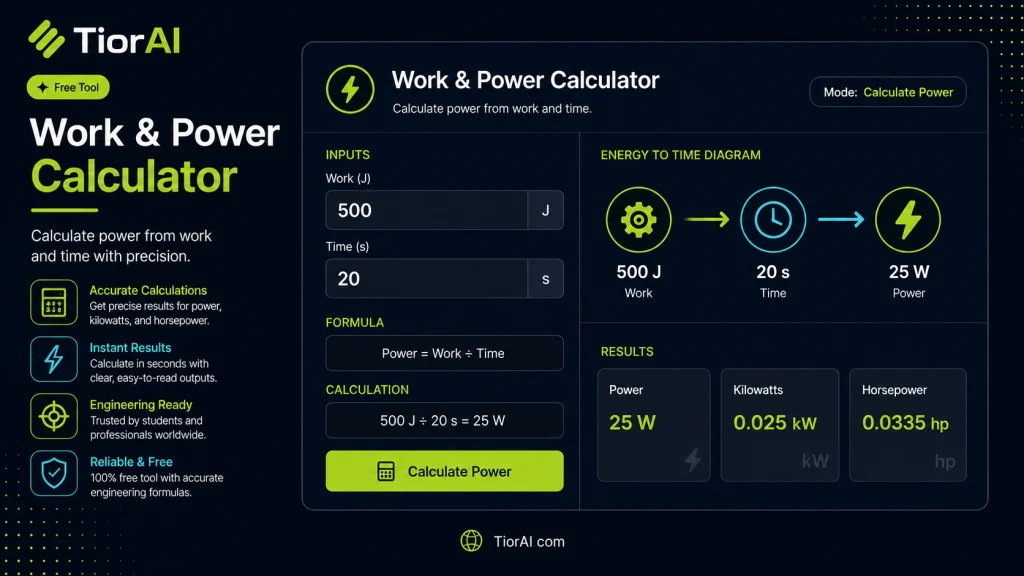
| Result | Value | Unit |
|---|---|---|
| Work | - | Joule (J) |
| Power | - | Watt (W) |
How to use it
- Enter Your Values Input your numbers or parameters into the Work Power Calculator. Fill in all required fields for an accurate calculation.
- Calculate Results Click the calculate button to process your inputs. The Work Power Calculator delivers instant, accurate results.
- Review and Use Review your calculated results, explore the breakdown, and copy or share the output for your needs.
Tip Bookmark the Work Power Calculator page for quick access whenever you need to run calculations on the go.
Understanding Work and Power in Physics
Work in physics is defined as the transfer of energy that occurs when a force is applied to an object causing it to move. Mathematically, work is calculated as the product of the force applied and the displacement of the object in the direction of the force, expressed as W = F × d × cos(θ), where θ is the angle between the force and displacement vectors.
Power measures how quickly work is done or energy is transferred over time. It is the rate at which work is performed and is calculated by dividing work by the time taken, P = W / t. Power is expressed in watts (W), where one watt equals one joule per second.
These concepts are fundamental in physics and engineering to analyze mechanical systems, energy efficiency, and performance. For example, engineers use work and power calculations to design engines, machines, and electrical devices to ensure they operate within desired parameters. Understanding the relationship between force, displacement, and time helps in optimizing processes and predicting system behavior.
Common situations where work and power calculations are essential include determining the energy required to lift objects, evaluating the performance of motors, and analyzing mechanical advantage in tools and machines.
What Are Work and Power?
In physics, work refers to the energy transferred when a force moves an object over a distance. It depends on the magnitude of the force, the displacement, and the angle between them. The formula W = F × d × cos(θ) captures this relationship, showing that only the component of force in the direction of movement contributes to work.
Power measures how fast this work is done, calculated by dividing work by the time taken: P = W / t. Power tells us the rate of energy transfer, which is crucial in understanding machine performance and energy consumption.
When to Use a Work Power Calculator
- When you need to find the energy required to move an object with a known force and displacement.
- To determine the power output of engines or motors based on work done and elapsed time.
- For analyzing mechanical systems to improve efficiency or design specifications.
- In physics problems involving forces, motion, and energy transfer.
Common Mistakes to Avoid
- Incorrectly accounting for the angle between force and displacement, which can lead to wrong work calculations.
- Mixing units such as meters with feet or seconds with minutes, causing inaccurate power results.
- Confusing work and power by ignoring the time factor in power calculations.
Understanding these concepts and using the calculator correctly helps in practical applications like engineering design, physics education, and performance analysis of mechanical systems.
Frequently asked questions
W = F × d × cos(θ) and P = W / t automatically.W = F × d × cos(θ), where F is the force applied, d is the displacement, and θ is the angle between the force and displacement directions.P = W / t, where P is power, W is work, and t is time.Reviews and questions
Whether this tool gave people the answer they needed, and what they asked about it.
Sign in to review this tool.
Sign In to ReviewNo reviews yet
Be the first to say whether this tool gave you what you needed.
Ask how to read the result, or what the tool does with an edge case — or answer someone else.
Sign In to AskNo questions yet
Not sure how to read a result? Be the first to ask.
AI tools related to this topic
Tools from the TiorAI directory that work on the same kind of job.

Contract Power AI
Contract Power AI is an AI-powered platform that automates contract review and management by extracting key clauses, identifying risks, and streamlining contract lifecycle processes for legal teams.

Power BI AI Lens
Power BI AI Lens is an AI-powered tool that integrates with Microsoft Power BI to provide automated data insights, natural language querying, and enhanced reporting capabilities.

SomniAI : Dream analysis with AI Power
SomniAI is an AI-powered web tool that analyzes and interprets your dreams to provide personalized insights into your subconscious mind and sleep patterns.