

Density Calculator
Solve any part of density = mass ÷ volume. Choose what you want to work out, enter the other two values in whatever units you have, and the calculator handles the conversions.
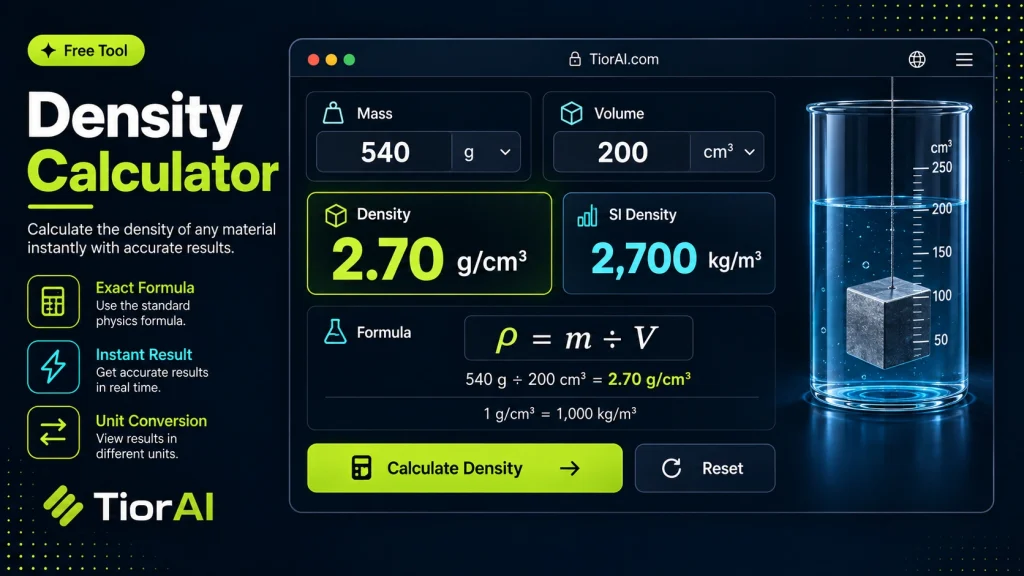
This is what the calculator works out — pick the unit you want the answer in.
This is what the calculator works out — pick the unit you want the answer in.
This is what the calculator works out — pick the unit you want the answer in.
Formulas and Common Material Densities
- Density
ρ = m ÷ V- Mass
m = ρ × V- Volume
V = m ÷ ρ
| Material | g/cm³ | kg/m³ |
|---|---|---|
| Air (sea level) | 0.001225 | 1.225 |
| Petrol | 0.745 | 745 |
| Ice (0 °C) | 0.917 | 917 |
| Water (4 °C) | 1.000 | 1000 |
| Concrete | 2.400 | 2400 |
| Aluminium | 2.700 | 2700 |
| Steel | 7.850 | 7850 |
| Copper | 8.960 | 8960 |
| Lead | 11.340 | 11340 |
| Gold | 19.320 | 19320 |
g/cm³, g/mL and kg/L are numerically identical. Anything less dense than water (1 g/cm³) floats in it; anything denser sinks.
How to use it
- Enter Your Values Input your numbers or parameters into the Density Calculator. Fill in all required fields for an accurate calculation.
- Calculate Results Click the calculate button to process your inputs. The Density Calculator delivers instant, accurate results.
- Review and Use Review your calculated results, explore the breakdown, and copy or share the output for your needs.
Tip Try different input values with the Density Calculator to compare scenarios side by side before making decisions.
Understanding Density in Physics and Engineering
Density is a fundamental physical property that describes how much mass is contained within a given volume of a substance. It is mathematically defined as density = mass / volume. This ratio helps characterize materials and is crucial in fields like material science, fluid mechanics, and engineering design.
Density is important because it influences how substances behave under different conditions. For example, in fluid dynamics, density differences drive buoyancy and flow patterns. In engineering, knowing the density of materials helps in calculating weight, stability, and structural integrity.
Common units for density include kilograms per cubic meter (kg/m³) in the SI system and grams per cubic centimeter (g/cm³) in the metric system. The choice of units depends on the context and the scale of measurement.
Calculating density manually requires accurate measurements of mass and volume, which can be time-consuming or prone to error. This is where a density calculator becomes useful, allowing quick and precise computation by simply inputting the known values.
People use density calculations in various situations such as determining the purity of a material, designing objects that must float or sink, or converting between mass and volume in chemical formulations.
What is Density?
Density is a physical property that measures how much mass is contained in a specific volume of a substance. It is calculated by dividing mass by volume, typically expressed as kilograms per cubic meter (kg/m³) or grams per cubic centimeter (g/cm³). Understanding density is essential in physics and engineering because it affects how materials behave and interact.
When to Use a Density Calculator
- When you have measured the mass and volume of an object and need to find its density quickly.
- To check if a material meets specified density requirements in manufacturing or quality control.
- When converting between mass and volume in chemical mixtures or solutions.
- To compare different materials for applications involving buoyancy or stability.
Common Mistakes to Avoid
- Mixing units for mass and volume without converting them properly, which leads to incorrect density results.
- Assuming density is the same as weight or mass, rather than a ratio of mass to volume.
- Using inaccurate measurements for mass or volume, which compromises the accuracy of the density calculation.
Using a density calculator simplifies the process by automating the calculation once you input the correct mass and volume values. This tool is especially useful in educational settings, laboratories, and engineering projects where precise density values are needed quickly and reliably.
Frequently asked questions
Reviews and questions
Whether this tool gave people the answer they needed, and what they asked about it.
Sign in to review this tool.
Sign In to ReviewNo reviews yet
Be the first to say whether this tool gave you what you needed.
Ask how to read the result, or what the tool does with an edge case — or answer someone else.
Sign In to AskNo questions yet
Not sure how to read a result? Be the first to ask.
AI tools related to this topic
Tools from the TiorAI directory that work on the same kind of job.

Density
Density is a sensor-based platform that provides accurate real-time people counting and occupancy analytics to help businesses optimize space utilization and ensure safety compliance.