

Free Fall Calculator
Calculate the velocity and distance of a free-falling object. This calculator ignores air resistance and assumes initial velocity is zero.
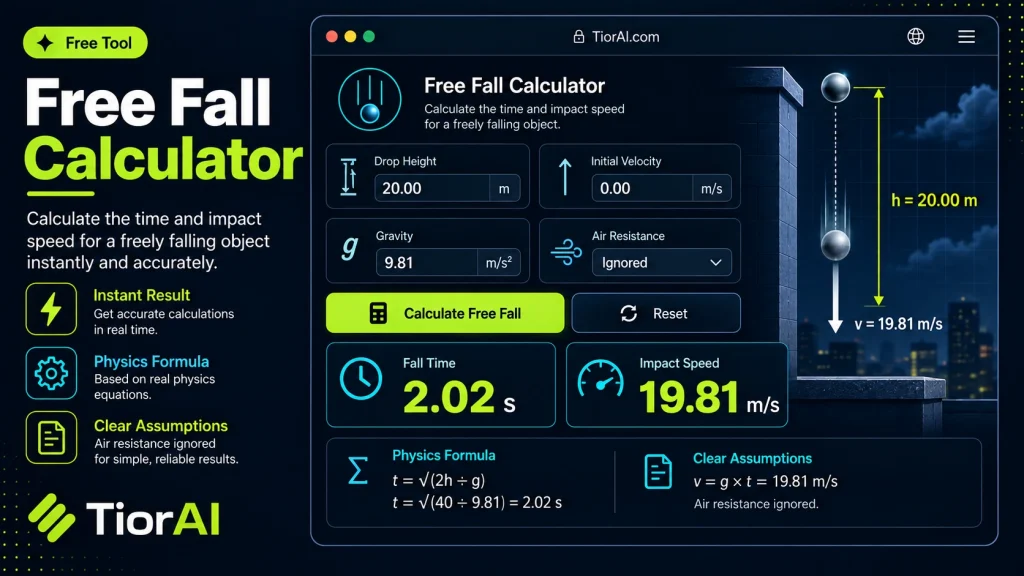
Free Fall Calculator
Results
Physics Formulas
- Velocity
v = g × t- Distance
d = ½ × g × t²- Time from height
t = √(2d / g)
How to use it
- Enter Your Values Input your numbers or parameters into the Free Fall Calculator. Fill in all required fields for an accurate calculation.
- Calculate Results Click the calculate button to process your inputs. The Free Fall Calculator delivers instant, accurate results.
- Review and Use Review your calculated results, explore the breakdown, and copy or share the output for your needs.
Tip Use the Free Fall Calculator on mobile devices too — it's fully responsive and works perfectly on any screen size.
About Free Fall Calculator
Free fall is a fundamental concept in physics describing the motion of an object under the influence of gravity alone, without any other forces like air resistance acting on it. When an object is in free fall, it accelerates downward at a constant rate, typically approximated as 9.8 m/s2 on Earth.
A free fall calculator uses the basic equations of motion to determine parameters such as the time it takes for an object to fall from a certain height, its velocity at any given moment, or the distance it has fallen after a specific time. These calculations rely on kinematic formulas derived from Newton’s laws of motion, assuming uniform acceleration.
Understanding free fall is essential in physics and engineering for analyzing projectile motion, designing safety equipment, or studying gravitational effects. Free fall calculators simplify these computations, allowing students, educators, engineers, and hobbyists to quickly obtain accurate results without manual calculation errors.
Common situations where free fall calculations are needed include estimating the impact speed of a dropped object, determining fall times in experiments, or modeling scenarios in physics education and engineering design.
Understanding Free Fall
Free fall describes the motion of an object influenced only by gravity, accelerating downward at approximately 9.8 m/s² on Earth. This concept is foundational in physics and engineering, helping analyze how objects move when dropped or thrown vertically.
Free fall calculators apply kinematic equations to compute variables like fall time, velocity, and distance fallen. These tools simplify calculations that would otherwise require manual formula manipulation, reducing errors and saving time.
When to Use a Free Fall Calculator
- To find how long an object takes to hit the ground from a known height in ideal conditions.
- To calculate the velocity of an object just before impact when dropped from rest.
- For physics experiments or educational demonstrations involving gravitational motion.
- In engineering contexts where air resistance is negligible and gravitational acceleration is constant.
Common Mistakes to Avoid
- Neglecting air resistance in scenarios where it significantly affects the fall, leading to inaccurate results.
- Entering inconsistent or incorrect units, such as mixing feet with meters, which causes calculation errors.
- Assuming free fall conditions when other forces, like propulsion or drag, are acting on the object.
By understanding these principles and limitations, users can effectively apply free fall calculators to a variety of practical and educational problems involving gravitational motion.
Frequently asked questions
Reviews and questions
Whether this tool gave people the answer they needed, and what they asked about it.
Sign in to review this tool.
Sign In to ReviewNo reviews yet
Be the first to say whether this tool gave you what you needed.
Ask how to read the result, or what the tool does with an edge case — or answer someone else.
Sign In to AskNo questions yet
Not sure how to read a result? Be the first to ask.