

Watts Calculator
Electrical power, measured in watts, represents how much energy an electrical device uses or produces per unit time. Calculating watts is fundamental in physics and engineering to understand energy flow in circuits and ensure devices operate safely and efficiently. At its core, power calculation combines…
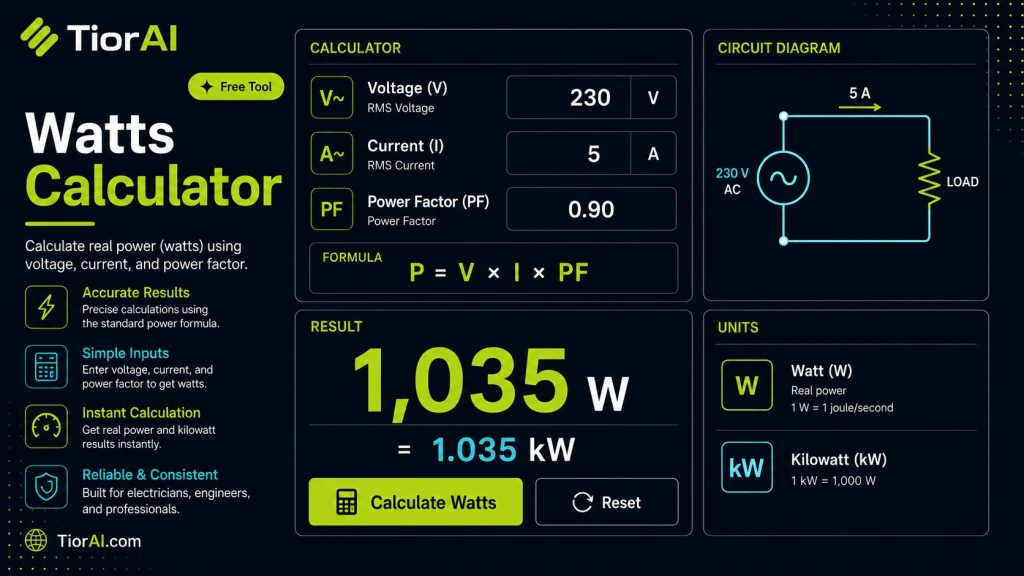
Electrical calculator
Watts Calculator
Calculate power, voltage, or current using the formula that matches your circuit values.
How to use it
- Paste or Enter Your Input Paste your code, text, or data into the input field. The tool supports large inputs without performance issues.
- Process and Analyze Click the action button or let the tool auto-process your input. Results appear in real time with highlighted details.
- Copy or Download the Output Review the results and copy the output to clipboard or download as a file for use in your project.
Tip For large inputs, process in sections to validate intermediate results and catch errors early.
Understanding Electrical Power and Watts
Electrical power quantifies the rate at which energy is consumed or produced in an electrical circuit. It is measured in watts (W), a unit that combines voltage (V) and current (amps, A) to express how much work electricity can perform over time. Calculating watts is essential in physics and engineering to design, analyze, and troubleshoot electrical systems.
Why calculate watts? Knowing the power consumption or output helps in selecting appropriate components, estimating energy costs, and ensuring safety. For example, when sizing a power supply or determining the load on a circuit, accurate watt calculations prevent overloads and inefficiencies.
Common scenarios for watt calculations include:
- Determining the power usage of household appliances to estimate electricity bills.
- Designing circuits where power ratings must match component specifications.
- Analyzing both direct current (DC) and alternating current (AC) systems, where formulas may slightly differ.
The fundamental formula for electrical power in DC circuits is P = V × I, where P is power in watts, V is voltage in volts, and I is current in amps. For AC circuits, especially with reactive components, power factor and phase angles can affect the calculation, requiring more advanced formulas.
What is Electrical Power and Why Calculate Watts?
Electrical power, measured in watts, represents how much energy an electrical device uses or produces per unit time. Calculating watts is fundamental in physics and engineering to understand energy flow in circuits and ensure devices operate safely and efficiently.
At its core, power calculation combines voltage and current values. The simplest formula, P = V × I, applies to direct current (DC) circuits, where voltage and current are constant. This calculation helps engineers select components that can handle the expected power load and assists consumers in estimating electricity usage.
When to Use a Watts Calculator
- When you know the voltage and current of a device and want to find its power consumption.
- To verify that electrical components are rated for the power they will handle.
- When designing or troubleshooting circuits in both DC and AC systems.
- To compare energy efficiency between different electrical devices.
Common Mistakes to Avoid
- Mixing units or confusing voltage and current values, which leads to incorrect power calculations.
- Using the DC power formula directly on AC circuits without considering power factor, resulting in inaccurate wattage.
Understanding these concepts ensures accurate power calculations, which are critical for safe and efficient electrical system design and operation.
Frequently asked questions
Reviews and questions
Whether this tool gave people the answer they needed, and what they asked about it.
Sign in to review this tool.
Sign In to ReviewNo reviews yet
Be the first to say whether this tool gave you what you needed.
Ask how to read the result, or what the tool does with an edge case — or answer someone else.
Sign In to AskNo questions yet
Not sure how to read a result? Be the first to ask.
AI tools related to this topic
Tools from the TiorAI directory that work on the same kind of job.

ChatGPT
ChatGPT is an AI chatbot by OpenAI powered by GPT-4o. It handles writing, coding, research, data analysis, and natural conversation. Free tier available, Plus at $20/month.