

Voltage Divider Calculator
A voltage divider is a fundamental circuit in electronics that reduces a higher voltage to a lower one using two resistors connected in series. The output voltage is taken from the junction between these resistors and depends on their relative resistance values. When to Use…
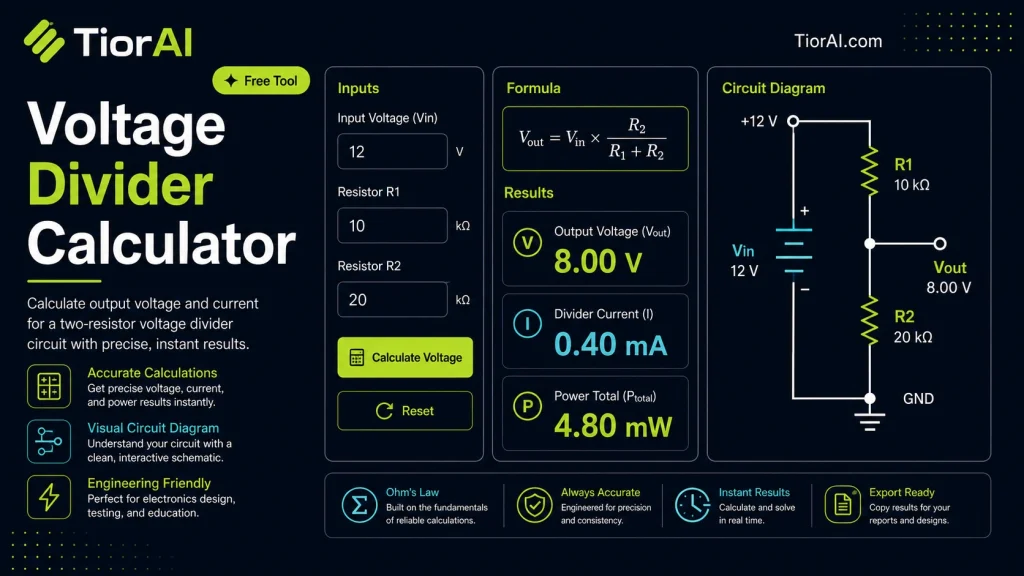
| Formula | Vout = Vin × R2 / (R1 + R2) |
|---|---|
| Output Voltage (Vout) | - |
| Divider Ratio | - |
How to use it
- Paste or Enter Your Input Paste your code, text, or data into the input field. The tool supports large inputs without performance issues.
- Process and Analyze Click the action button or let the tool auto-process your input. Results appear in real time with highlighted details.
- Copy or Download the Output Review the results and copy the output to clipboard or download as a file for use in your project.
Tip Keyboard shortcut: Ctrl+V to paste input, then Ctrl+C to copy output - saves time in repetitive workflows.
Understanding Voltage Dividers
A voltage divider is a simple electrical circuit that converts a higher voltage into a lower voltage using two resistors connected in series. The output voltage is taken from the junction between the two resistors. This technique is fundamental in electronics for scaling voltages to levels suitable for other components or measurement devices.
How it works: When a voltage is applied across the series resistors, the voltage drops proportionally across each resistor based on its resistance value. The output voltage is determined by the ratio of the two resistors, following the formula V_out = V_in * (R2 / (R1 + R2)), where V_in is the input voltage, and R1 and R2 are the resistor values.
Why it’s needed: Voltage dividers are used to create reference voltages, reduce signal levels, or interface components that operate at different voltage levels. They are common in sensor circuits, analog-to-digital converters, and biasing transistors.
Common situations:
- Adjusting sensor output voltages to match microcontroller input ranges.
- Creating reference voltages for comparators or operational amplifiers.
- Testing and prototyping circuits where a specific voltage level is required.
What is a Voltage Divider?
A voltage divider is a fundamental circuit in electronics that reduces a higher voltage to a lower one using two resistors connected in series. The output voltage is taken from the junction between these resistors and depends on their relative resistance values.
When to Use a Voltage Divider
- To scale down sensor signals to levels compatible with microcontrollers or ADCs.
- To create reference voltages for analog circuits.
- When prototyping circuits requiring specific voltage levels without complex components.
- To interface components operating at different voltage standards.
Common Mistakes to Avoid
- Not accounting for the load connected to the output, which can change the expected voltage.
- Choosing resistor values that cause excessive power dissipation, risking resistor damage.
Technical Context
The voltage divider formula V_out = V_in * (R2 / (R1 + R2)) assumes no load on the output. In real applications, the load resistance forms a parallel combination with R2, affecting the output voltage. To maintain accuracy, use resistor values much smaller than the load resistance or buffer the output with an operational amplifier.
Power dissipation in resistors must be considered to prevent overheating. Calculate power using P = V^2 / R and select resistors with appropriate power ratings.
Frequently asked questions
Reviews and questions
Whether this tool gave people the answer they needed, and what they asked about it.
Sign in to review this tool.
Sign In to ReviewNo reviews yet
Be the first to say whether this tool gave you what you needed.
Ask how to read the result, or what the tool does with an edge case — or answer someone else.
Sign In to AskNo questions yet
Not sure how to read a result? Be the first to ask.
AI tools related to this topic
Tools from the TiorAI directory that work on the same kind of job.

ChatGPT
ChatGPT is an AI chatbot by OpenAI powered by GPT-4o. It handles writing, coding, research, data analysis, and natural conversation. Free tier available, Plus at $20/month.