

Scientific Calculator
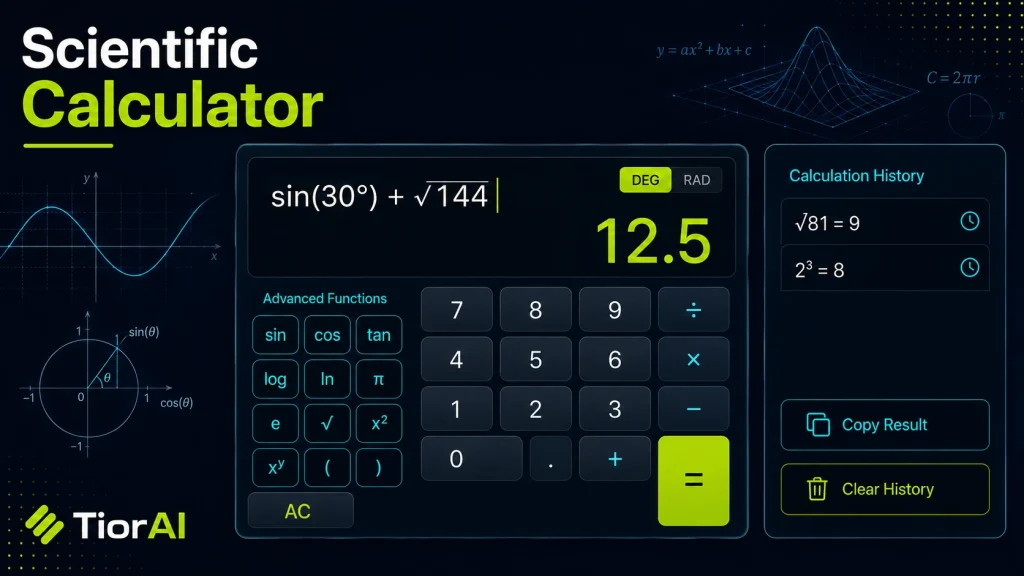
Perform advanced math with our free online scientific calculator. Supports trig, logarithms, exponents, factorials, roots, and more - a full-featured calculator in your browser.
History
| Expression | Result |
|---|
How to use it
- Enter Your Values Input your numbers or parameters into the Scientific Calculator. Fill in all required fields for an accurate calculation.
- Calculate Results Click the calculate button to process your inputs. The Scientific Calculator delivers instant, accurate results.
- Review and Use Review your calculated results, explore the breakdown, and copy or share the output for your needs.
Tip Double-check critical calculations by adjusting one variable at a time in the Scientific Calculator to spot trends.
Understanding Scientific Calculators
A scientific calculator is a specialized calculator designed to handle a wide range of mathematical functions beyond basic arithmetic. Unlike standard calculators, scientific calculators support operations such as trigonometry, logarithms, exponentiation, factorials, and statistical calculations. These functions are essential for students, engineers, scientists, and anyone working with complex mathematical problems.
Scientific calculators are necessary because many mathematical problems require more than simple addition or multiplication. For example, calculating the sine of an angle, solving exponential growth problems, or working with logarithmic scales all require functions that basic calculators cannot perform.
Common situations where scientific calculators are used include:
- Solving trigonometric problems in geometry or physics
- Performing statistical analysis such as mean, standard deviation, and permutations
- Calculating powers, roots, and logarithms in algebra and calculus
- Working with factorials and combinations in probability
Online scientific calculators replicate these capabilities digitally, allowing users to perform complex calculations without physical devices. This is especially useful for quick access, portability, and integration with other digital tools.
What is a Scientific Calculator?
A scientific calculator is a tool designed to perform advanced mathematical functions beyond simple arithmetic. It supports operations like trigonometry, logarithms, exponents, and statistics, which are essential in fields such as science, engineering, and mathematics.
When to Use a Scientific Calculator
- Solving trigonometric problems involving sine, cosine, or tangent.
- Performing statistical calculations like mean and standard deviation.
- Calculating powers, roots, and logarithms in algebra and calculus.
- Handling factorials and permutations in probability problems.
- Quickly solving complex equations without a physical calculator.
Common Mistakes to Avoid
- Not using parentheses properly, which can cause errors in order of operations.
- Mixing up degree and radian modes when working with trigonometric functions.
- Entering formulas incorrectly due to unfamiliarity with the calculator’s input syntax.
Technical Context
Scientific calculators operate by interpreting mathematical expressions according to standard mathematical rules, including operator precedence and function evaluation. Online versions replicate this functionality using programming languages like JavaScript, allowing users to perform calculations directly in their web browsers. This makes them accessible and convenient for students and professionals alike.
Frequently asked questions
Reviews and questions
Whether this tool gave people the answer they needed, and what they asked about it.
Sign in to review this tool.
Sign In to ReviewNo reviews yet
Be the first to say whether this tool gave you what you needed.
Ask how to read the result, or what the tool does with an edge case — or answer someone else.
Sign In to AskNo questions yet
Not sure how to read a result? Be the first to ask.
AI tools related to this topic
Tools from the TiorAI directory that work on the same kind of job.
Advanced SystemCare
Advanced SystemCare is a Windows-based PC optimization software by IObit that cleans junk files, optimizes system performance, protects privacy, and removes malware to keep your computer running smoothly.

Gemini & Gemini Advanced
Gemini and Gemini Advanced are Google’s advanced AI language models designed for conversational AI, content generation, and coding assistance, supporting multiple languages and accessible via web and API.

Math.now: Free Math AI Solver powered by math GPT
Math.now is a free web-based AI math solver that uses GPT technology to provide instant, detailed solutions and explanations for a wide range of math problems.

ScoreApp: Advanced Quiz Funnel Marketing | Quiz Software
ScoreApp is a web-based quiz funnel software that enables marketers to create interactive, score-based quizzes for lead generation, customer segmentation, and marketing automation.

SpeechFlow – Advanced Speech-to-Text API
SpeechFlow is a powerful speech-to-text API that provides real-time, accurate transcription with multi-language support and speaker diarization, ideal for developers and businesses needing voice-to-text solutions.