

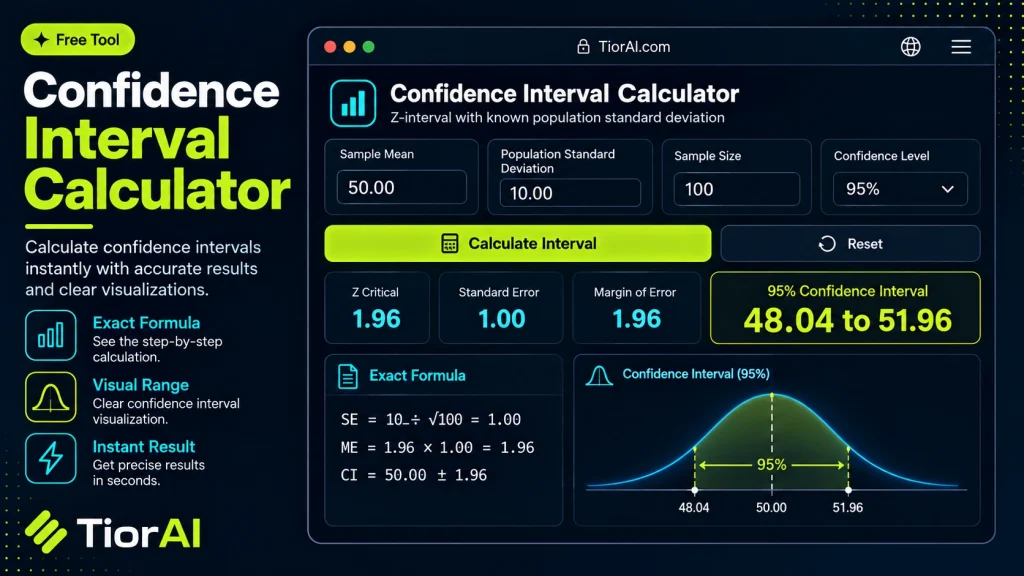
Confidence Interval Calculator
Find the margin of error and the confidence interval for a sample mean.
| Measure | Value |
|---|
Formulas Used
- Standard error
SE = s / √n- Margin of error
ME = z × SE- Confidence interval
CI = x̄ ± ME
The z values used are 1.645 for 90%, 1.96 for 95% and 2.576 for 99%. They come from the normal distribution, so the interval is most reliable for samples of about 30 observations or more.
How to use it
- Enter Your Values Input your numbers or parameters into the Confidence Interval Calculator. Fill in all required fields for an accurate calculation.
- Calculate Results Click the calculate button to process your inputs. The Confidence Interval Calculator delivers instant, accurate results.
- Review and Use Review your calculated results, explore the breakdown, and copy or share the output for your needs.
Tip Use the Confidence Interval Calculator on mobile devices too — it's fully responsive and works perfectly on any screen size.
Understanding Confidence Intervals
A confidence interval is a range of values, derived from sample data, that is likely to contain the true population parameter (such as a mean or proportion) with a specified level of confidence. Instead of providing a single estimate, confidence intervals offer a range that reflects the uncertainty inherent in sampling.
Confidence intervals are essential in statistics because they quantify the precision of an estimate. For example, if you survey a sample of voters to estimate the proportion who support a candidate, the confidence interval gives a range where the true support level likely falls, accounting for sampling variability.
Typically, confidence intervals are expressed with a confidence level, such as 90%, 95%, or 99%. A 95% confidence interval means that if the same population is sampled repeatedly and intervals calculated each time, approximately 95% of those intervals would contain the true parameter.
Common situations where confidence intervals are used include:
- Estimating population means or proportions from sample data
- Comparing groups in clinical trials or experiments
- Quality control in manufacturing processes
- Survey analysis and polling results
Calculating confidence intervals manually involves formulas that depend on the sample size, variability, and distribution assumptions. This is why tools like confidence interval calculators are valuable—they automate the computation, reduce errors, and allow quick analysis.
What is a Confidence Interval?
A confidence interval is a statistical tool that provides a range of values within which the true population parameter is expected to lie, based on sample data. Unlike a single estimate, it accounts for sampling variability and uncertainty.
When to Use a Confidence Interval Calculator
- Estimating population means or proportions from sample data.
- Reporting survey or experimental results with uncertainty.
- Comparing groups to assess differences statistically.
- Monitoring quality control processes.
Common Mistakes to Avoid
- Applying the calculator without checking if the data meet necessary assumptions, such as normal distribution or sample size adequacy.
- Misinterpreting the confidence level as the probability that the true parameter is within the interval for a single sample.
Technical Context
Confidence intervals rely on probability distributions like the normal or t-distribution to determine critical values. The width of the interval depends on sample size, variability, and chosen confidence level. Larger samples and lower confidence levels produce narrower intervals, while smaller samples and higher confidence levels yield wider intervals. Using a calculator automates these computations, ensuring accuracy and saving time.
Frequently asked questions
Reviews and questions
Whether this tool gave people the answer they needed, and what they asked about it.
Sign in to review this tool.
Sign In to ReviewNo reviews yet
Be the first to say whether this tool gave you what you needed.
Ask how to read the result, or what the tool does with an edge case — or answer someone else.
Sign In to AskNo questions yet
Not sure how to read a result? Be the first to ask.