

Cubic Yards Calculator
A cubic yard measures volume and represents a cube that is one yard long, one yard wide, and one yard high. It is widely used in construction and landscaping to quantify materials like soil, gravel, concrete, and mulch. When to Use a Cubic Yards Calculator…
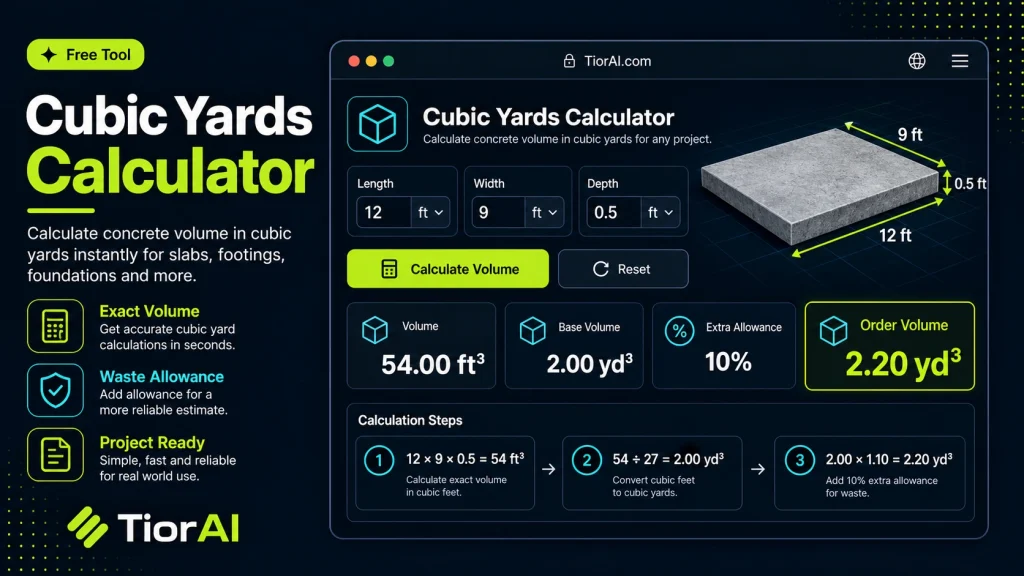
Cubic Yards Calculator
Calculate volume in cubic yards and cubic metres. Enter dimensions to determine the volume for concrete, mulch, gravel, or other materials.
Results
| Unit | Value | Symbol |
|---|---|---|
| Cubic Yards | -- | yd³ |
| Cubic Metres | -- | m³ |
| Cubic Feet | -- | ft³ |
| Litres | -- | L |
Common Uses
- Concrete slabs and foundations
- Mulch for garden beds
- Gravel for driveways and paths
- Soil and fill dirt
- Sand for construction projects
How to use it
- Enter Your Values Input your numbers or parameters into the Cubic Yards Calculator. Fill in all required fields for an accurate calculation.
- Calculate Results Click the calculate button to process your inputs. The Cubic Yards Calculator delivers instant, accurate results.
- Review and Use Review your calculated results, explore the breakdown, and copy or share the output for your needs.
Tip The Cubic Yards Calculator rounds results automatically, but you can use the full decimal output for precision work.
Understanding Cubic Yards and Volume Measurement
A cubic yard is a unit of volume commonly used in construction, landscaping, and material estimation. It represents the volume of a cube with edges one yard (3 feet) long. Calculating volume in cubic yards helps quantify how much space a material will occupy or how much material is needed for a project.
Volume measurement is essential when dealing with bulk materials like soil, gravel, concrete, mulch, or sand. Instead of measuring by weight or surface area, volume gives a more accurate representation of quantity, especially for irregularly shaped or loose materials.
Common situations requiring cubic yard calculations include:
- Estimating the amount of concrete needed for a slab or foundation.
- Determining how much soil or mulch to order for landscaping.
- Calculating excavation volume for construction projects.
- Converting measurements from feet or inches to cubic yards for ordering materials.
Using a cubic yards calculator simplifies these tasks by converting length, width, and height measurements into volume, reducing errors and saving time.
What is a Cubic Yard?
A cubic yard measures volume and represents a cube that is one yard long, one yard wide, and one yard high. It is widely used in construction and landscaping to quantify materials like soil, gravel, concrete, and mulch.
When to Use a Cubic Yards Calculator
Use this calculator when you need to determine the volume of materials for projects such as:
- Pouring concrete for foundations, sidewalks, or driveways.
- Ordering soil, mulch, or gravel for landscaping.
- Estimating excavation volumes for construction sites.
- Converting measurements from feet or inches into cubic yards for accurate ordering.
Common Mistakes to Avoid
Users often confuse cubic yards with square yards or linear yards, which leads to incorrect volume calculations. Another frequent error is failing to convert all measurements to yards before calculating volume. Additionally, not accounting for material compaction or settling can cause under- or over-ordering.
Technical Context
Calculating volume in cubic yards involves multiplying length, width, and height, all expressed in yards. If measurements are in feet or inches, convert them to yards first by dividing by 3 or 36 respectively. This ensures the calculation reflects the correct volume. Accurate volume measurement is critical for budgeting, ordering materials, and avoiding waste or shortages on site.
Frequently asked questions
Reviews and questions
Whether this tool gave people the answer they needed, and what they asked about it.
Sign in to review this tool.
Sign In to ReviewNo reviews yet
Be the first to say whether this tool gave you what you needed.
Ask how to read the result, or what the tool does with an edge case — or answer someone else.
Sign In to AskNo questions yet
Not sure how to read a result? Be the first to ask.