

Math Evaluator
Get accurate math evaluator results instantly with our free tool. Whether you're planning, studying, or working, this calculator handles the math so you can focus on decisions.

| Result | - |
|---|---|
| History |
How to use it
- Enter Your Values Input your numbers or parameters into the Math Evaluator. Fill in all required fields for an accurate calculation.
- Calculate Results Click the calculate button to process your inputs. The Math Evaluator delivers instant, accurate results.
- Review and Use Review your calculated results, explore the breakdown, and copy or share the output for your needs.
Tip Try different input values with the Math Evaluator to compare scenarios side by side before making decisions.
Understanding Math Evaluation
A math evaluator is a computational tool designed to interpret and calculate mathematical expressions entered as text. Instead of manually solving equations or performing calculations, a math evaluator parses the input, applies the correct order of operations, and returns the numerical result or simplified expression.
Why is this important? Mathematical expressions can range from simple arithmetic to complex formulas involving functions, variables, and nested operations. Evaluating these accurately requires understanding syntax, operator precedence, and function definitions. Math evaluators automate this process, reducing human error and saving time.
Common uses include:
- Checking homework or assignments quickly
- Verifying results during programming or algorithm development
- Performing quick calculations without opening a full calculator app
- Testing mathematical functions or expressions in research or data analysis
By converting text-based math input into computed results, math evaluators bridge the gap between symbolic math and numeric computation, making math more accessible and efficient.
What is a Math Evaluator?
A math evaluator is a tool that interprets and calculates mathematical expressions entered as text. It processes the input by applying mathematical rules and returns the computed result. This automation helps avoid manual calculation errors and speeds up problem-solving.
When to Use a Math Evaluator
- To quickly compute arithmetic or algebraic expressions without manual work.
- To verify homework answers or check calculations during programming.
- When testing formulas or functions in data analysis or research.
- For educational purposes to explore how different operations affect results.
Common Mistakes to Avoid
- Entering expressions with incorrect syntax, such as missing parentheses or unsupported characters.
- Expecting the tool to solve symbolic algebra problems rather than numeric evaluations.
- Using variables without assigning values, which prevents numeric computation.
Understanding how math evaluators work and their limitations helps you use them effectively. They are powerful for numeric calculations but are not substitutes for symbolic math software when dealing with algebraic manipulations or calculus.
Frequently asked questions
Reviews and questions
Whether this tool gave people the answer they needed, and what they asked about it.
Sign in to review this tool.
Sign In to ReviewNo reviews yet
Be the first to say whether this tool gave you what you needed.
Ask how to read the result, or what the tool does with an edge case — or answer someone else.
Sign In to AskNo questions yet
Not sure how to read a result? Be the first to ask.
AI tools related to this topic
Tools from the TiorAI directory that work on the same kind of job.

Math.now: Free Math AI Solver powered by math GPT
Math.now is a free web-based AI math solver that uses GPT technology to provide instant, detailed solutions and explanations for a wide range of math problems.

AI Math Solver Powered by Math GPT Free Online
AI Math Solver Powered by Math GPT is a free online tool that instantly solves math problems across various topics with detailed step-by-step explanations, accessible via web browser without registration.
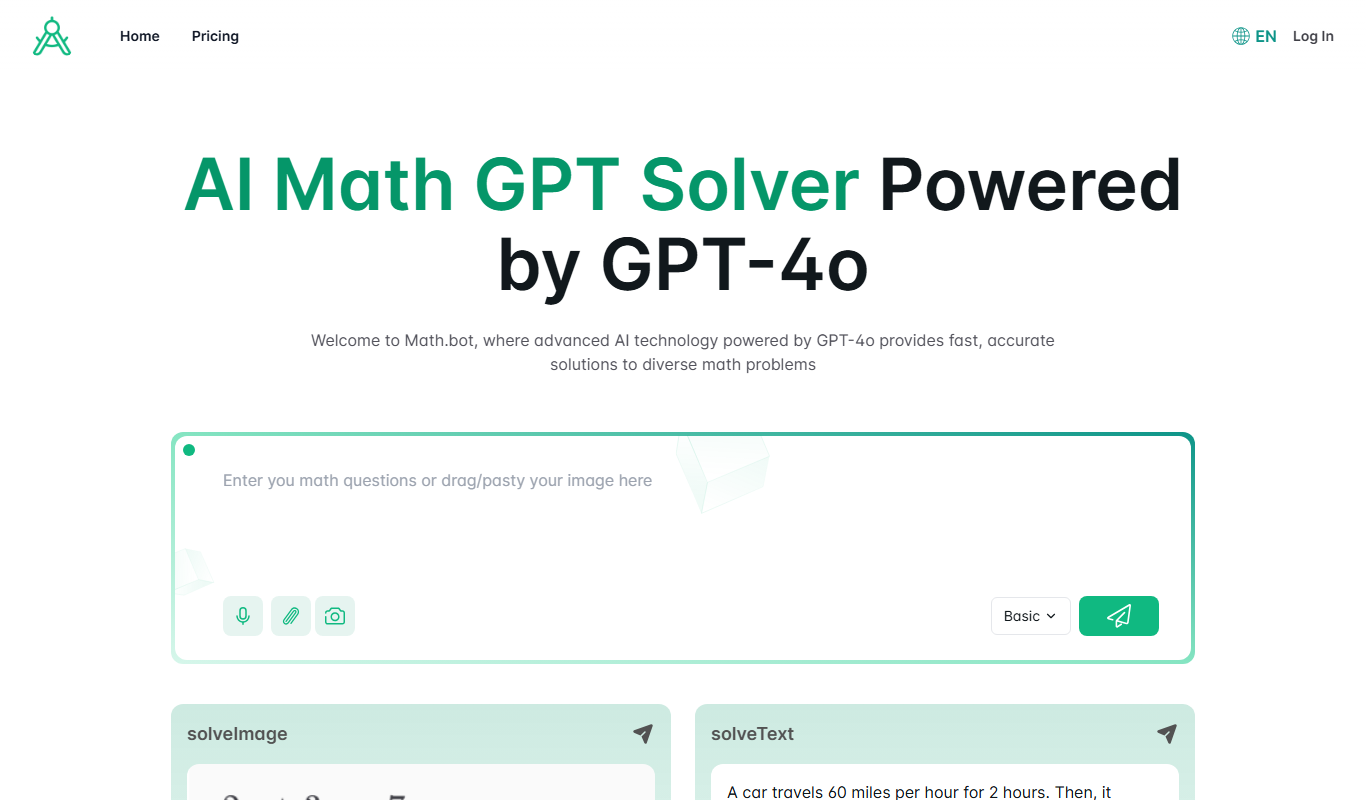
Math.bot: AI Math Solver by GPT-4o
Math.bot is an AI-powered math solver using GPT-4o that provides detailed step-by-step solutions to a wide range of math problems via a web interface.