

HSL to HSLA
Convert HSL color values to HSLA format instantly with our free online converter. Enter your HSL color code and get the accurate HSLA equivalent - perfect for web design, CSS styling, graphic design, and digital art projects.
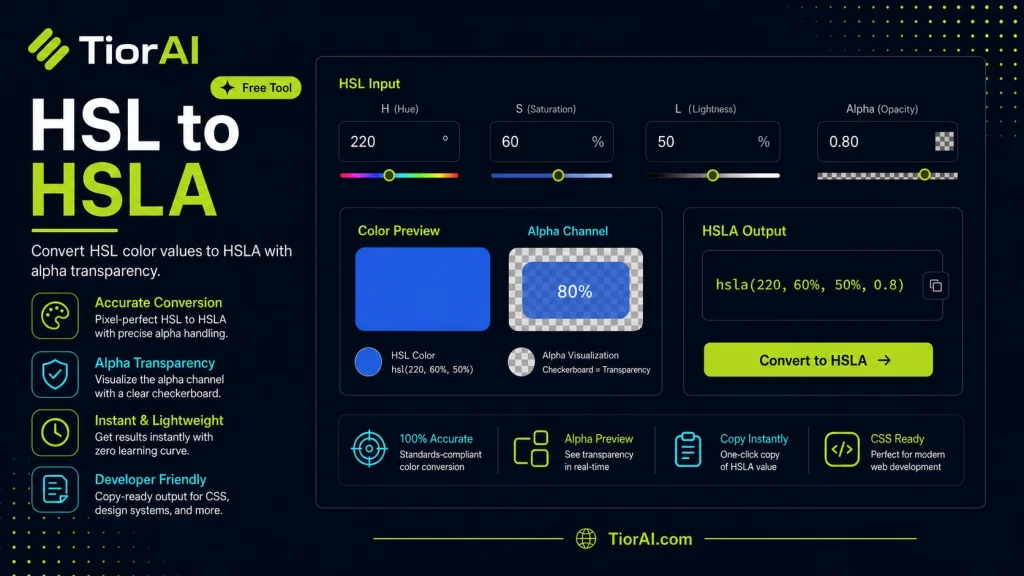
How to use it
- Pick or Enter a Color Use the color picker or enter a color value into the Hsl to Hsla. Supports HEX, RGB, HSL, and more.
- Adjust and Preview Fine-tune your color selection and preview results in real time with instant visual feedback.
- Copy Color Values Copy the generated color codes in your preferred format for use in CSS, design tools, or development.
Tip Save your favorite colors from the Hsl to Hsla to build a consistent brand palette across all projects.
Understanding HSL and HSLA Color Models in CSS
In CSS, colors can be defined using various models, one of which is HSL, standing for Hue, Saturation, and Lightness. This model represents colors in a way that is often more intuitive than RGB, as it separates the color type (hue) from its vividness (saturation) and brightness (lightness). The HSL model is defined by three parameters:
- Hue: The color type, represented as an angle from 0 to 360 degrees on the color wheel (e.g., 0° is red, 120° is green, 240° is blue).
- Saturation: The intensity or purity of the color, expressed as a percentage (0% is grayscale, 100% is full color).
- Lightness: The brightness of the color, also a percentage (0% is black, 100% is white).
While HSL defines colors without transparency, the HSLA model extends HSL by adding an alpha channel, which controls the opacity of the color. The alpha value ranges from 0 (fully transparent) to 1 (fully opaque). This addition allows developers to specify semi-transparent colors directly in CSS, which is useful for layering effects, overlays, and subtle UI designs.
The CSS Color Module Level 3 specification (W3C CSS Color Module Level 3) defines both hsl() and hsla() functions. Modern browsers support both, but the hsla() syntax is necessary when transparency is required.
Developers use HSL and HSLA in real projects to create color schemes that are easier to adjust dynamically. For example, changing the lightness or saturation can generate different shades or tints without recalculating RGB values. Adding alpha transparency with HSLA enables layering colors over backgrounds or images with controlled opacity, improving visual design flexibility.
Converting from HSL to HSLA is straightforward: you keep the hue, saturation, and lightness values the same and add an alpha value. This conversion is often needed when a design requires transparency but the original color is specified only in HSL.
Understanding HSL and HSLA Color Models
HSL (Hue, Saturation, Lightness) is a color model used in CSS to define colors in a way that separates the color type from its intensity and brightness. This makes it easier to manipulate colors compared to RGB, especially when adjusting shades or tints. The HSL model uses three parameters: hue (0-360 degrees), saturation (0%-100%), and lightness (0%-100%).
HSLA extends HSL by adding an alpha channel, which controls the opacity of the color. The alpha value ranges from 0 (fully transparent) to 1 (fully opaque). This allows developers to create semi-transparent colors directly in CSS, which is useful for overlays, shadows, and layered designs.
When to Use HSL to HSLA Conversion
- When you want to add transparency to an existing HSL color without changing its hue, saturation, or lightness.
- When designing UI elements that require semi-transparent backgrounds or overlays.
- When working with CSS animations or transitions that involve fading colors.
Common Mistakes to Avoid
- Omitting the alpha value when converting HSL to HSLA, which results in invalid syntax or default opacity.
- Using alpha values outside the valid range (less than 0 or greater than 1), which CSS ignores or treats as errors.
Understanding the difference between HSL and HSLA and how to convert between them is essential for precise color control in modern web development. Using HSLA allows for more flexible and visually appealing designs by incorporating transparency directly into color definitions.
Common use cases
- Adding 50% opacity to a pure red HSL color
- Converting a muted blue with 75% opacity
Frequently asked questions
Reviews and questions
Whether this tool gave people the answer they needed, and what they asked about it.
Sign in to review this tool.
Sign In to ReviewNo reviews yet
Be the first to say whether this tool gave you what you needed.
Ask how to read the result, or what the tool does with an edge case — or answer someone else.
Sign In to AskNo questions yet
Not sure how to read a result? Be the first to ask.
AI tools related to this topic
Tools from the TiorAI directory that work on the same kind of job.

Code Language Converter
Code Language Converter is an online tool that translates code between 30+ programming languages with AI-powered conversion, with a free plan and a paid PRO plan.

Any Video Converter
Any Video Converter is a multimedia software that converts video files between numerous formats, downloads online videos, and offers basic editing and DVD burning features.

Bank Statement Converter
Bank Statement Converter converts single or multiple PDF bank statements into a single CSV file containing only the transaction data extracted from their tables.

Conversion Blitz
Conversion Blitz is an AI lead generation software suite to find leads, send targeted emails, create a chatbot and more.