

CSS to Less Converter
CSS (Cascading Style Sheets) is the foundational language used to style web pages. It defines how HTML elements appear on screen, including colors, fonts, spacing, and layout. While CSS is powerful, it lacks programming constructs like variables and functions, which can make managing large stylesheets…
How to use it
- Paste or Enter Your Input Paste your code, text, or data into the input field. The tool supports large inputs without performance issues.
- Process and Analyze Click the action button or let the tool auto-process your input. Results appear in real time with highlighted details.
- Copy or Download the Output Review the results and copy the output to clipboard or download as a file for use in your project.
Tip For large inputs, process in sections to validate intermediate results and catch errors early.
Understanding CSS and LESS
CSS (Cascading Style Sheets) is the standard stylesheet language used to describe the presentation of HTML documents. It controls layout, colors, fonts, and other visual aspects of web pages. CSS is a static language, meaning it does not support variables, functions, or logic, which can make managing large stylesheets cumbersome.
LESS is a dynamic stylesheet language that extends CSS by adding features like variables, mixins, nesting, and functions. It compiles down to standard CSS that browsers can understand. LESS helps developers write more maintainable and reusable styles, especially in large projects.
Why Convert CSS to LESS?
Converting existing CSS code to LESS allows developers to leverage these advanced features without rewriting styles from scratch. For example, variables let you define colors or font sizes once and reuse them throughout the stylesheet, making global updates easier. Nesting simplifies selectors by reflecting the HTML structure, improving readability.
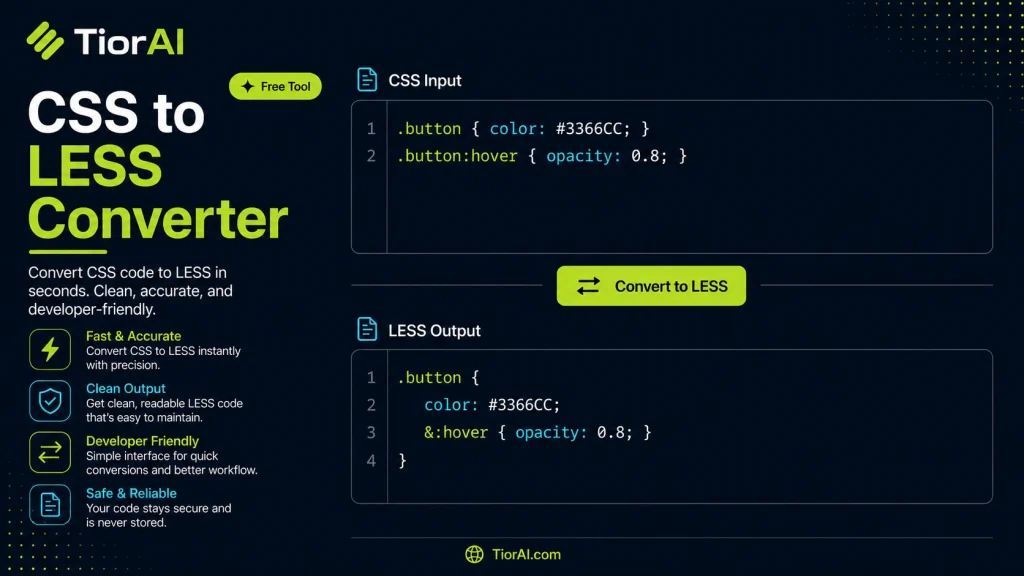
LESS follows a specific syntax that is a superset of CSS, so valid CSS is also valid LESS. However, to fully utilize LESS features, the code must be adapted to include variables, mixins, and other constructs. A CSS to LESS converter automates the initial step by transforming plain CSS into a LESS-compatible format, preparing it for further enhancement.
Technical Standards and Usage
- CSS is standardized by the W3C with specifications like CSS Level 2 and 3.
- LESS is a preprocessor language developed by Alexis Sellier and others; it compiles to CSS but is not a W3C standard.
- LESS files typically use the
.lessextension and require a compiler (client-side or build tool) to convert to CSS.
Developers integrate LESS into projects using build tools like Webpack, Gulp, or command-line compilers. Frameworks such as Bootstrap originally used LESS, demonstrating its practical application in large-scale UI development.
What is CSS and LESS?
CSS (Cascading Style Sheets) is the foundational language used to style web pages. It defines how HTML elements appear on screen, including colors, fonts, spacing, and layout. While CSS is powerful, it lacks programming constructs like variables and functions, which can make managing large stylesheets difficult.
LESS is a CSS preprocessor that extends CSS by adding features such as variables, nesting, mixins, and functions. These additions help developers write cleaner, more maintainable, and reusable styles. LESS code is compiled into standard CSS before being served to browsers.
When to Use a CSS to LESS Converter
- When you have an existing CSS codebase and want to migrate to LESS to take advantage of its features.
- When integrating with frameworks or projects that use LESS and require stylesheets in that format.
- When you want to introduce variables and nesting into your styles without rewriting everything manually.
- When automating the initial step of converting plain CSS into a LESS-compatible format to speed up development.
Common Mistakes When Using CSS to LESS Converters
- Expecting LESS features like variables or nesting to work directly in browsers without compiling the LESS code to CSS first.
- Not modifying the converted code to utilize LESS features, resulting in plain CSS inside LESS files, which misses the benefits of the preprocessor.
Technical Context
CSS is standardized by the W3C and is interpreted directly by browsers. LESS is a superset of CSS, meaning all valid CSS is valid LESS, but LESS adds syntax that browsers cannot understand without compilation. LESS files use the .less extension and require a compiler to produce CSS.
Developers typically use build tools like Webpack, Gulp, or command-line utilities to compile LESS during development or deployment. This workflow allows leveraging advanced features while delivering standard CSS to users.
Understanding the difference between CSS and LESS and when to convert is essential for maintaining efficient and scalable stylesheets in modern web development.
Common use cases
- Converting basic CSS to LESS with variables
- Nesting selectors in LESS
Frequently asked questions
Reviews and questions
Whether this tool gave people the answer they needed, and what they asked about it.
Sign in to review this tool.
Sign In to ReviewNo reviews yet
Be the first to say whether this tool gave you what you needed.
Ask how to read the result, or what the tool does with an edge case — or answer someone else.
Sign In to AskNo questions yet
Not sure how to read a result? Be the first to ask.
AI tools related to this topic
Tools from the TiorAI directory that work on the same kind of job.

ChatGPT
ChatGPT is an AI chatbot by OpenAI powered by GPT-4o. It handles writing, coding, research, data analysis, and natural conversation. Free tier available, Plus at $20/month.