

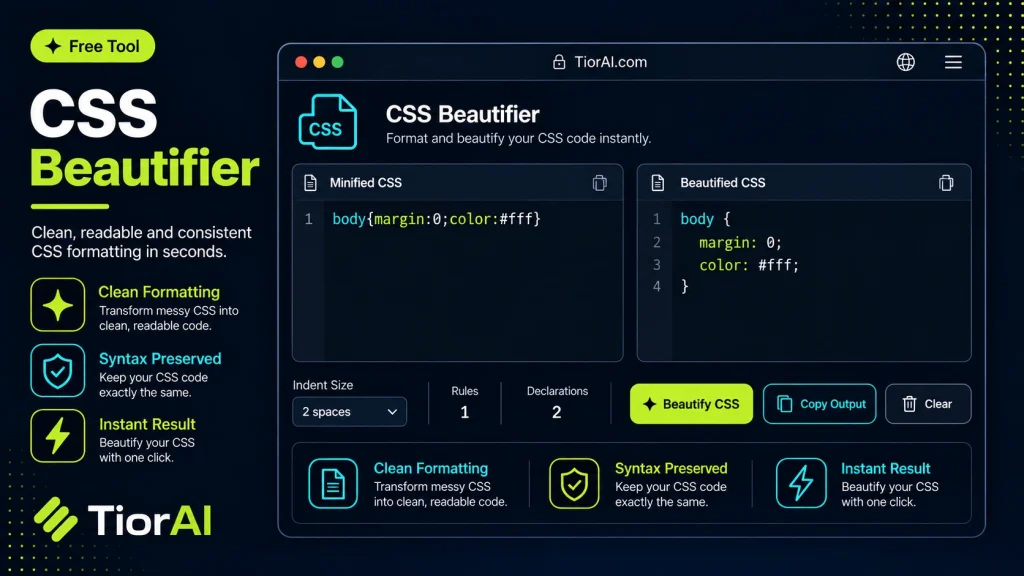
How to use it
- Paste Your Input Paste your code or data into the Css Beautifier. The tool accepts standard input formats and validates your entry.
- Process and Transform Click the action button to process your input. Results are generated instantly with proper formatting.
- Export the Output Copy the processed output to your clipboard or download it for use in your development workflow.
Tip Pair the Css Beautifier with other developer tools on TiorAI to build a complete online development toolkit.
What is CSS Beautification?
CSS beautification is the process of formatting Cascading Style Sheets (CSS) code to make it more readable and organized without changing its functionality. CSS is used to style HTML elements on web pages, but often, CSS code can become minified, compressed, or poorly formatted during development or deployment. Beautifying CSS involves adding proper indentation, line breaks, and spacing to improve clarity.
This process is essential because well-formatted CSS helps developers quickly understand and maintain stylesheets, especially in large projects or when collaborating with others. It also aids in debugging by making the structure and hierarchy of CSS rules clearer.
Common situations where CSS beautification is used include:
- Reformatting minified CSS files received from external sources.
- Cleaning up CSS after automated generation or compilation from preprocessors.
- Preparing CSS code for review or editing by team members.
- Improving readability before integrating styles into a project.
By converting compressed or messy CSS into a clean, readable format, developers save time and reduce errors during development and maintenance.
Understanding CSS Beautification
CSS beautification is the process of formatting CSS code to improve its readability without altering its functionality. This involves adding consistent indentation, line breaks, and spacing to make the stylesheet easier to read and maintain. Developers often encounter minified or poorly formatted CSS, which can be difficult to understand and debug. Beautifying the code helps clarify the structure and hierarchy of CSS rules.
When to Use a CSS Beautifier
- When you receive compressed or minified CSS that is hard to read.
- Before sharing CSS code with teammates for review or collaboration.
- After generating CSS from preprocessors like Sass or Less to clean up the output.
- When debugging complex stylesheets to quickly locate specific rules.
Common Mistakes to Avoid
- Expecting a beautifier to fix syntax errors—it only formats code.
- Using inconsistent formatting settings, which can result in uneven code style.
Using a CSS beautifier is a practical step in the development workflow to keep stylesheets organized and maintainable. While beautified CSS is great for development, remember to minify your CSS for production to optimize website performance.
Frequently asked questions
Reviews and questions
Whether this tool gave people the answer they needed, and what they asked about it.
Sign in to review this tool.
Sign In to ReviewNo reviews yet
Be the first to say whether this tool gave you what you needed.
Ask how to read the result, or what the tool does with an edge case — or answer someone else.
Sign In to AskNo questions yet
Not sure how to read a result? Be the first to ask.