

Fuel Consumption Converter
Fuel consumption conversion involves changing fuel efficiency values from one unit to another, such as from miles per gallon (mpg) to liters per 100 kilometers (L/100km). Different countries and industries use different units to express how efficiently a vehicle uses fuel. Because these units measure…
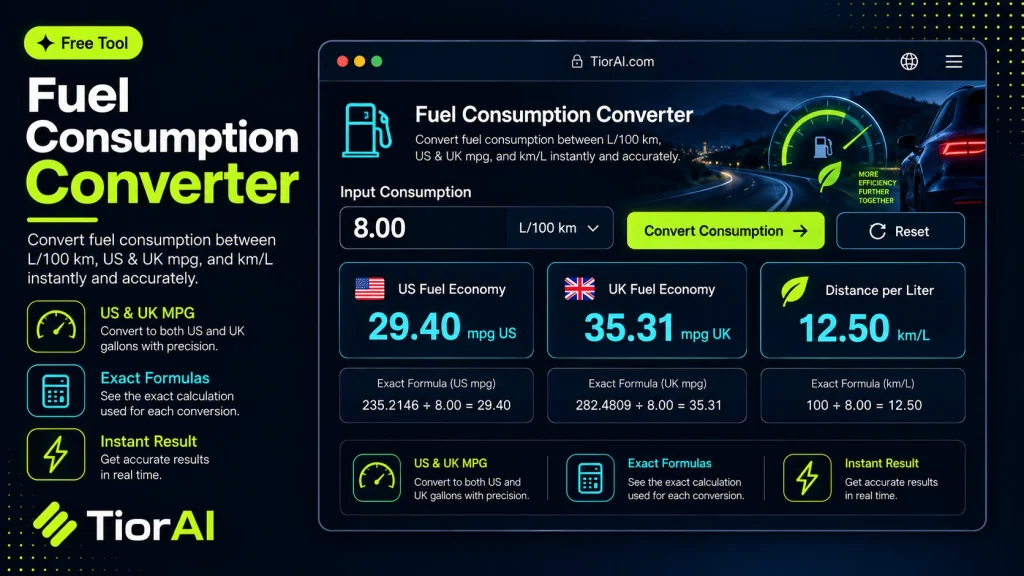
How to use it
- Enter Source Value Type or paste the value you want to convert into the Fuel Consumption Converter. The tool accepts a wide range of input formats.
- Select Target Format Choose your desired output format or unit from the available options. The conversion starts automatically.
- Copy the Result Review the converted output and click copy to use it in your project, document, or workflow.
Tip Switch between source and target formats in the Fuel Consumption Converter to quickly verify conversions in both directions.
Understanding Fuel Consumption Conversion
Fuel consumption measures how much fuel a vehicle uses to travel a certain distance. Different regions and industries use various units to express this, such as miles per gallon (mpg), liters per 100 kilometers (L/100km), or kilometers per liter (km/L). Converting between these units is essential for comparing vehicle efficiency, planning fuel costs, or complying with local regulations.
Why conversions matter:
mpgis common in the United States and the UK, but the UK and US gallons differ.L/100kmis widely used in Europe and many other countries.km/Lis popular in some Asian countries.
Because these units express fuel consumption differently—some as distance per volume, others as volume per distance—direct comparison requires conversion. For example, a lower L/100km value means better fuel efficiency, while a higher mpg means the same. Accurate conversion helps consumers make informed decisions and allows manufacturers to present consistent data globally.
What Is Fuel Consumption Conversion?
Fuel consumption conversion involves changing fuel efficiency values from one unit to another, such as from miles per gallon (mpg) to liters per 100 kilometers (L/100km). Different countries and industries use different units to express how efficiently a vehicle uses fuel. Because these units measure fuel consumption in different ways—some as distance per volume, others as volume per distance—converting between them is necessary for accurate comparisons.
When Should You Use a Fuel Consumption Converter?
- When comparing vehicles from countries that use different measurement systems.
- Planning fuel expenses for trips abroad where fuel consumption units differ.
- Interpreting manufacturer specifications or vehicle manuals that use unfamiliar units.
- Reporting or recording fuel efficiency data in a standardized format.
- Calculating environmental impact based on consistent fuel consumption metrics.
Common Mistakes to Avoid
- Mixing up miles per gallon and kilometers per liter without proper conversion.
- Overlooking the difference between US and Imperial gallons, which affects mpg values.
- Misinterpreting the meaning of higher or lower numbers depending on the unit type.
Understanding these concepts ensures you use fuel consumption data correctly and make informed decisions about vehicle efficiency and fuel costs.
Frequently asked questions
Reviews and questions
Whether this tool gave people the answer they needed, and what they asked about it.
Sign in to review this tool.
Sign In to ReviewNo reviews yet
Be the first to say whether this tool gave you what you needed.
Ask how to read the result, or what the tool does with an edge case — or answer someone else.
Sign In to AskNo questions yet
Not sure how to read a result? Be the first to ask.
AI tools related to this topic
Tools from the TiorAI directory that work on the same kind of job.

Any Video Converter
Any Video Converter is a multimedia software that converts video files between numerous formats, downloads online videos, and offers basic editing and DVD burning features.

Bank Statement Converter
Bank Statement Converter is an online tool that converts PDF bank statements into Excel and CSV formats, enabling easy data extraction and financial management.

Code Language Converter
Code Language Converter is a free web-based tool that translates code snippets between multiple programming languages, helping developers convert syntax quickly and learn language differences.