

Angle Converter
Angle conversion involves changing an angle measurement from one unit to another, such as from degrees to radians or from decimal degrees to degrees-minutes-seconds. This process is important because different fields and tools use different units to represent angles. For example, degrees are common in…
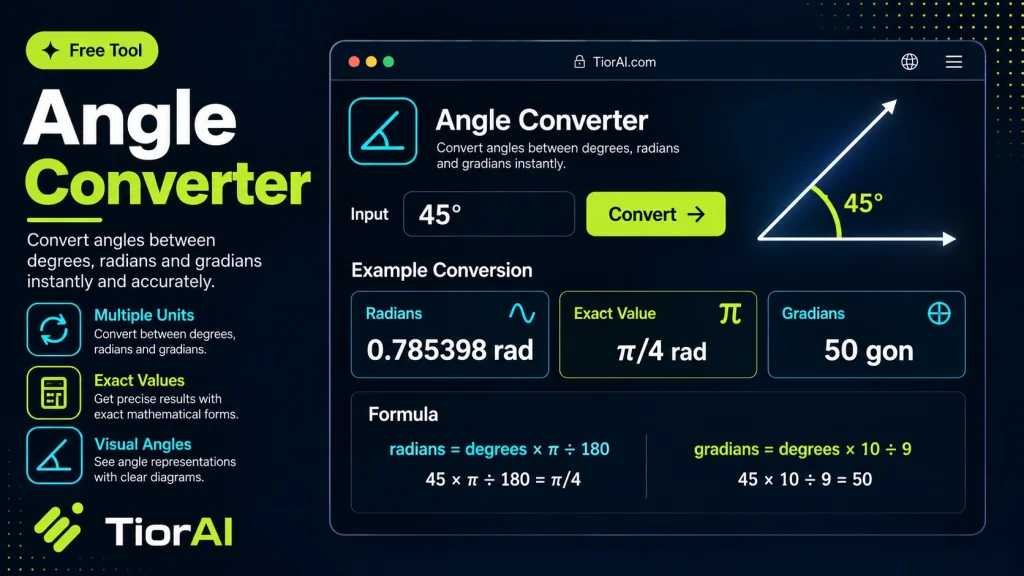
Angle Converter
Converted Values
How to use it
- Enter Source Value Type or paste the value you want to convert into the Angle Converter. The tool accepts a wide range of input formats.
- Select Target Format Choose your desired output format or unit from the available options. The conversion starts automatically.
- Copy the Result Review the converted output and click copy to use it in your project, document, or workflow.
Tip Keep the Angle Converter open in a browser tab for instant access during development sessions.
Understanding Angle Measurement Units
Angles are a fundamental concept in geometry, trigonometry, and various fields of science and engineering. They represent the amount of rotation between two intersecting lines or planes. To quantify angles, several units are commonly used, including degrees, radians, and gradians. Each unit provides a different way to express the same angular measurement.
Degrees divide a full circle into 360 equal parts, making them intuitive for everyday use. Radians are based on the radius of a circle and are the standard unit in higher mathematics and physics because they simplify many formulas. One radian equals the angle subtended by an arc equal in length to the radius of the circle, approximately 57.2958 degrees. Gradians divide a circle into 400 parts and are used in some surveying and engineering contexts.
Converting between these units is essential because different disciplines and tools may require angles in specific units. For example, programming languages often use radians for trigonometric functions, while navigation and construction might use degrees. Additionally, angles can be expressed in degrees, minutes, and seconds for precision, especially in fields like astronomy and cartography.
Using an angle converter helps avoid manual calculation errors and saves time when switching between units. It ensures consistency and accuracy in measurements, which is critical in technical applications.
What is Angle Conversion?
Angle conversion involves changing an angle measurement from one unit to another, such as from degrees to radians or from decimal degrees to degrees-minutes-seconds. This process is important because different fields and tools use different units to represent angles. For example, degrees are common in navigation and everyday use, while radians are preferred in mathematics and programming.
When Should You Use an Angle Converter?
- When writing code that requires angles in radians instead of degrees.
- When working with survey data that uses degrees, minutes, and seconds.
- When converting between units for engineering or physics calculations.
- When preparing graphical rotations that require radians.
- When precise angle measurements are needed in astronomy or cartography.
Common Mistakes to Avoid
- Mixing up degrees and radians without converting, which leads to incorrect results.
- Failing to specify the unit of the input angle, causing confusion in conversion.
- Not distinguishing between decimal degrees and degrees-minutes-seconds formats.
Understanding the differences between angle units and when to convert them ensures accuracy in calculations and communication across different technical fields.
Frequently asked questions
Reviews and questions
Whether this tool gave people the answer they needed, and what they asked about it.
Sign in to review this tool.
Sign In to ReviewNo reviews yet
Be the first to say whether this tool gave you what you needed.
Ask how to read the result, or what the tool does with an edge case — or answer someone else.
Sign In to AskNo questions yet
Not sure how to read a result? Be the first to ask.
AI tools related to this topic
Tools from the TiorAI directory that work on the same kind of job.

Any Video Converter
Any Video Converter is a multimedia software that converts video files between numerous formats, downloads online videos, and offers basic editing and DVD burning features.

Bank Statement Converter
Bank Statement Converter is an online tool that converts PDF bank statements into Excel and CSV formats, enabling easy data extraction and financial management.

Code Language Converter
Code Language Converter is a free web-based tool that translates code snippets between multiple programming languages, helping developers convert syntax quickly and learn language differences.