

Density Converter
Enter a density in any common metric or imperial unit and get the equivalent value in all of them at once.
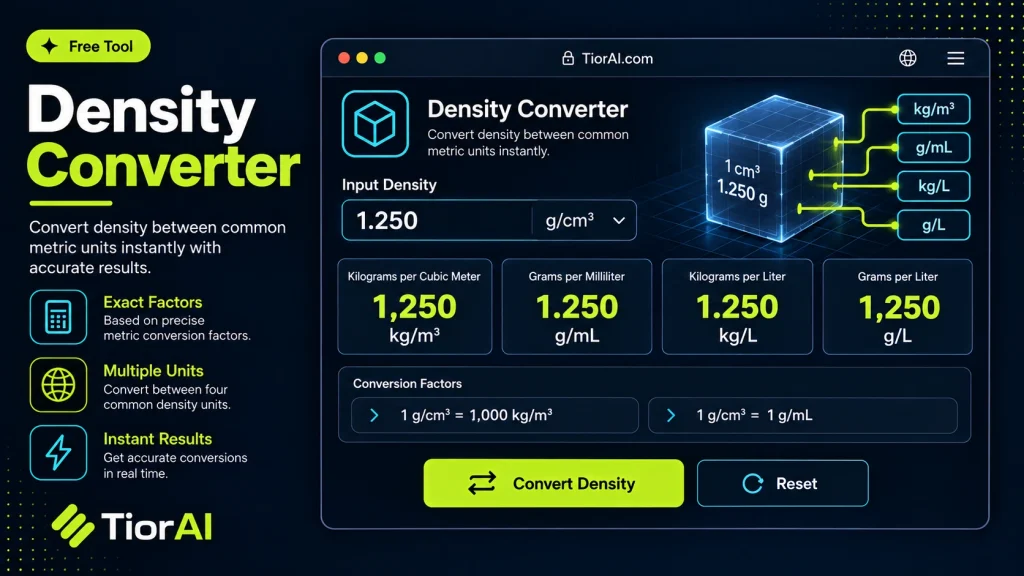
Water at 4 °C is 1000 kg/m³, which is the same as 1 g/cm³.
Common Material Densities
| Material | kg/m³ | g/cm³ |
|---|---|---|
| Air (sea level) | 1.225 | 0.001225 |
| Balsa wood | 160 | 0.16 |
| Ice (0 °C) | 917 | 0.917 |
| Water (4 °C) | 1000 | 1.000 |
| Concrete | 2400 | 2.400 |
| Aluminium | 2700 | 2.700 |
| Steel | 7850 | 7.850 |
| Copper | 8960 | 8.960 |
| Lead | 11340 | 11.340 |
| Gold | 19320 | 19.320 |
g/cm³, g/mL and kg/L are numerically identical — one gram per cubic centimetre is one kilogram per litre. Values shift slightly with temperature and pressure, most noticeably for gases.
How to use it
- Enter Source Value Type or paste the value you want to convert into the Density Converter. The tool accepts a wide range of input formats.
- Select Target Format Choose your desired output format or unit from the available options. The conversion starts automatically.
- Copy the Result Review the converted output and click copy to use it in your project, document, or workflow.
Tip Switch between source and target formats in the Density Converter to quickly verify conversions in both directions.
Understanding Density and Its Conversion
Density is a physical property that measures how much mass is contained in a given volume of a substance. It is commonly expressed as mass per unit volume, such as grams per cubic centimeter (g/cm³) or kilograms per liter (kg/L).
Density conversion involves changing the numerical value of density from one unit system to another without altering the actual physical property. This is necessary because different industries, scientific fields, and regions use various units depending on their standards and measurement systems.
Common density units include:
g/cm³(grams per cubic centimeter)kg/m³(kilograms per cubic meter)lb/ft³(pounds per cubic foot)oz/in³(ounces per cubic inch)
Converting between these units requires understanding the relationship between mass units (grams, kilograms, pounds, ounces) and volume units (cubic centimeters, cubic meters, cubic feet, cubic inches). This is essential in fields like material science, engineering, chemistry, and manufacturing where precise density values impact calculations, quality control, and product specifications.
For example, a chemist working with solutions might need to convert density from g/mL to kg/m³ to align with international standards. Similarly, an engineer might convert density values to lb/ft³ when working with construction materials in the US customary system.
What Is Density Conversion?
Density measures how much mass exists in a specific volume of a material. Because density can be expressed in many unit combinations—such as grams per cubic centimeter or pounds per cubic foot—converting between these units is essential for accurate communication and calculation.
Density conversion involves changing the numeric value from one unit system to another while preserving the physical meaning. This process requires understanding the relationship between mass units and volume units, including their prefixes and measurement systems.
When to Use a Density Converter
- When working across metric and imperial systems in engineering or manufacturing.
- When comparing material data from different sources that use different units.
- During scientific experiments that require standardized reporting.
- To ensure product specifications meet client or regulatory requirements.
- When calculating physical properties like buoyancy or fluid flow that depend on density.
Common Mistakes to Avoid
- Mixing mass and volume units incorrectly, such as confusing pounds with cubic feet.
- Ignoring unit prefixes like milli- or kilo-, which can cause scale errors.
- Assuming density values are directly comparable without converting units.
- Entering inconsistent units that combine metric and imperial measures improperly.
Understanding these points helps ensure accurate density conversions, which are critical in many technical and scientific fields.
Frequently asked questions
Reviews and questions
Whether this tool gave people the answer they needed, and what they asked about it.
Sign in to review this tool.
Sign In to ReviewNo reviews yet
Be the first to say whether this tool gave you what you needed.
Ask how to read the result, or what the tool does with an edge case — or answer someone else.
Sign In to AskNo questions yet
Not sure how to read a result? Be the first to ask.
AI tools related to this topic
Tools from the TiorAI directory that work on the same kind of job.

Any Video Converter
Any Video Converter is a multimedia software that converts video files between numerous formats, downloads online videos, and offers basic editing and DVD burning features.

Bank Statement Converter
Bank Statement Converter is an online tool that converts PDF bank statements into Excel and CSV formats, enabling easy data extraction and financial management.

Code Language Converter
Code Language Converter is a free web-based tool that translates code snippets between multiple programming languages, helping developers convert syntax quickly and learn language differences.