

Calorie Calculator
Estimate your resting and daily calorie needs from the Mifflin-St Jeor equation, then see the intake each weight goal implies.
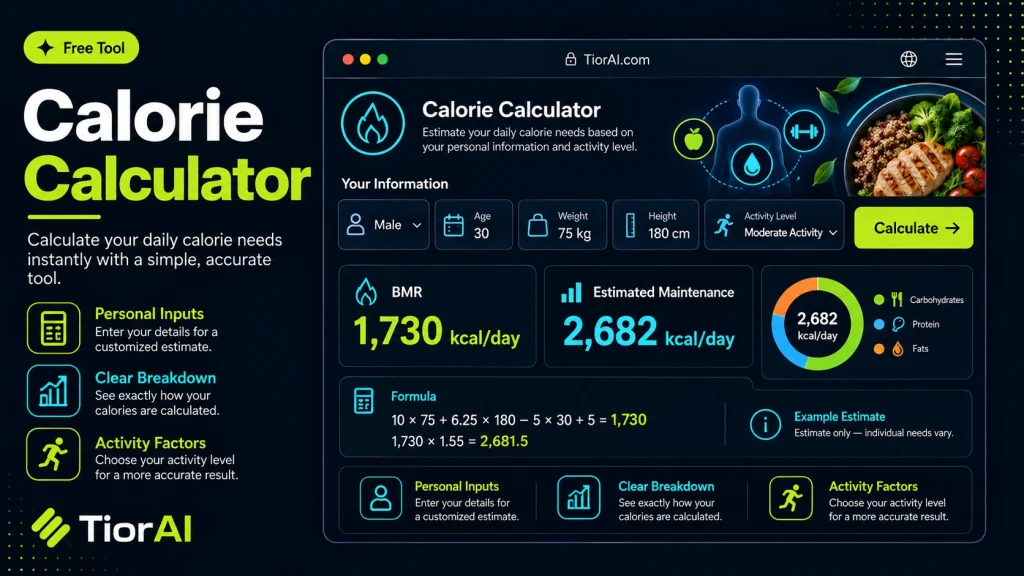
Sedentary is desk work with no exercise; moderately active is roughly three to five sessions a week; extra active is daily hard training or a physically demanding job.
How These Numbers Are Worked Out
- BMR (male)
10 × kg + 6.25 × cm − 5 × age + 5- BMR (female)
10 × kg + 6.25 × cm − 5 × age − 161- TDEE
BMR × activity multiplier- Weight change
7,700 kcal ≈ 1 kg · 3,500 kcal ≈ 1 lb- Activity multipliers
1.2 · 1.375 · 1.55 · 1.725 · 1.9
BMR is what your body burns at complete rest. TDEE adds everyday movement and exercise on top, which is why the activity level changes the answer so much — the difference between sedentary and extra active is often more than 1,000 kcal a day.
Mifflin-St Jeor is a population average. It does not know your body composition, so a very muscular or very lean person will burn more than it predicts. Treat the figure as a starting point, track real results for two or three weeks, and adjust from there.
This tool is an estimate for general information only and is not medical advice. Speak to a doctor or dietitian before starting a significant change in diet, particularly if you are pregnant, under 18, or managing a health condition.
How to use it
- Enter Your Values Input your numbers or parameters into the Calorie Calculator. Fill in all required fields for an accurate calculation.
- Calculate Results Click the calculate button to process your inputs. The Calorie Calculator delivers instant, accurate results.
- Review and Use Review your calculated results, explore the breakdown, and copy or share the output for your needs.
Tip Bookmark the Calorie Calculator page for quick access whenever you need to run calculations on the go.
Understanding Calorie Calculation
A calorie calculator estimates the number of calories your body needs daily to maintain, lose, or gain weight. It uses personal data such as age, gender, weight, height, and activity level to calculate your Basal Metabolic Rate (BMR) and Total Daily Energy Expenditure (TDEE). BMR represents the calories your body burns at rest to maintain vital functions like breathing and circulation. TDEE adds calories burned through physical activity.
Calculating calorie needs is essential for managing diet and fitness goals. People use calorie calculators to create meal plans, set weight loss targets, or optimize athletic performance. Since calorie requirements vary widely among individuals, these calculators provide personalized estimates rather than one-size-fits-all numbers.
Common situations where calorie calculators are used include starting a new diet, adjusting food intake after lifestyle changes, or tracking progress in weight management programs. They help translate abstract nutritional concepts into actionable daily calorie targets.
What Is a Calorie Calculator?
A calorie calculator estimates the number of calories your body requires daily based on personal factors like age, gender, weight, height, and activity level. It calculates your Basal Metabolic Rate (BMR), which is the energy your body uses at rest, and your Total Daily Energy Expenditure (TDEE), which includes calories burned through physical activity.
When to Use a Calorie Calculator
- Planning a diet to lose, maintain, or gain weight tailored to your body and lifestyle.
- Starting a new fitness program and needing to understand your energy needs.
- Adjusting calorie intake after changes in your activity level or body composition.
Common Mistakes to Avoid
- Entering inaccurate or outdated personal information, such as weight or activity level, which can skew results.
- Assuming the calculator provides exact calorie needs rather than an estimate to guide your nutrition decisions.
Technical Context
Calorie calculators rely on established formulas like the Harris-Benedict or Mifflin-St Jeor equations to estimate BMR. They then multiply BMR by an activity factor to estimate TDEE. While these formulas provide useful guidance, individual metabolic rates can vary due to genetics, muscle mass, and health conditions, so results should be used as a starting point rather than an absolute measure.
Frequently asked questions
Reviews and questions
Whether this tool gave people the answer they needed, and what they asked about it.
Sign in to review this tool.
Sign In to ReviewNo reviews yet
Be the first to say whether this tool gave you what you needed.
Ask how to read the result, or what the tool does with an edge case — or answer someone else.
Sign In to AskNo questions yet
Not sure how to read a result? Be the first to ask.
AI tools related to this topic
Tools from the TiorAI directory that work on the same kind of job.

Calorie AI
Calorie AI is an AI-powered nutrition tracking app that simplifies calorie counting and diet management by using photo recognition and personalized recommendations.

Calorie Calculator
Calorie Calculator is a free web tool that estimates your daily calorie needs based on personal data and activity level to support weight management and nutrition planning.

Calorie Tracker
Calorie Tracker is an AI-powered web app that helps users log meals, track calories, analyze nutrition, and manage diet goals through personalized recommendations and progress visualization.

track-calories.com
Track-calories.com is a free, no-signup web tool that allows users to log food intake, calculate calories, and track nutrition to support diet and weight management.