

BMR Calculator
Calculate your Basal Metabolic Rate (BMR) using the Mifflin-St Jeor equation.
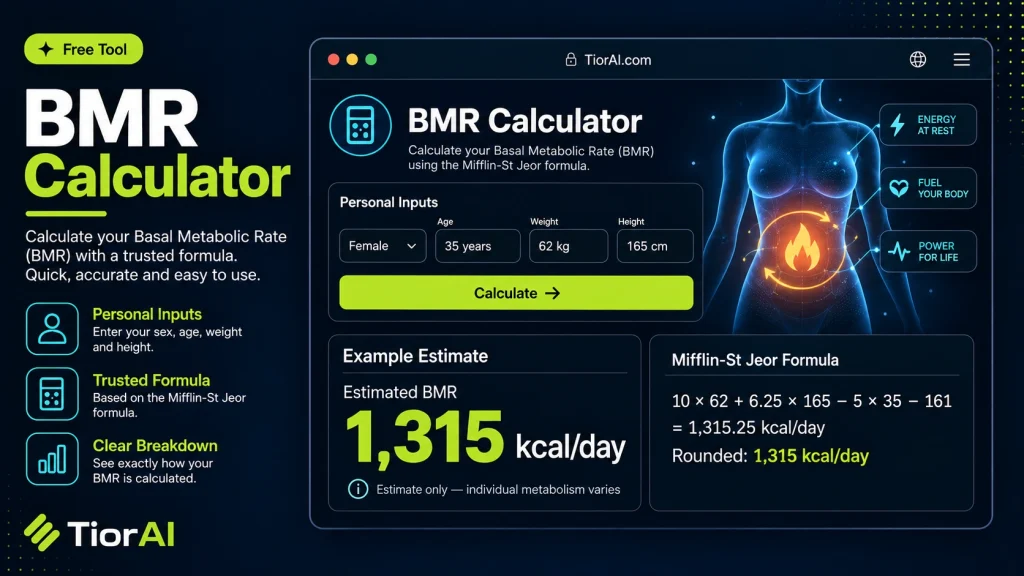
BMR Calculator
Your Metabolic Results
| Basal Metabolic Rate (BMR) | kcal/day |
|---|---|
| Equation |
Total Daily Energy Expenditure (TDEE)
| Activity Level | Typical Week | Calories to Maintain Weight |
|---|---|---|
| Sedentary | Little or no exercise | |
| Lightly Active | Exercise 1-3 days a week | |
| Moderately Active | Exercise 3-5 days a week | |
| Very Active | Exercise 6-7 days a week | |
| Extra Active | Hard daily exercise or a physical job |
How BMR and TDEE are calculated
- Mifflin-St Jeor (male)
BMR = 10×kg + 6.25×cm − 5×age + 5- Mifflin-St Jeor (female)
BMR = 10×kg + 6.25×cm − 5×age − 161- TDEE
BMR × 1.2 to 1.9 depending on activity
BMR is what your body burns completely at rest. TDEE adds everyday movement and training, so it is the number to work from when planning intake.
For informational purposes only. Consult a healthcare professional before making dietary changes.
How to use it
- Enter Your Values Input your numbers or parameters into the Bmr Calculator. Fill in all required fields for an accurate calculation.
- Calculate Results Click the calculate button to process your inputs. The Bmr Calculator delivers instant, accurate results.
- Review and Use Review your calculated results, explore the breakdown, and copy or share the output for your needs.
Tip Share your Bmr Calculator results by copying the output — great for reports, homework, or team discussions.
Understanding Basal Metabolic Rate (BMR)
Basal Metabolic Rate (BMR) is the number of calories your body needs to maintain basic physiological functions while at rest. These functions include breathing, circulation, cell production, and maintaining body temperature. BMR represents the minimum energy expenditure required to keep your body alive without any physical activity.
Calculating BMR is important because it helps estimate your daily calorie needs. Knowing your BMR allows you to tailor your diet and exercise plans more effectively, whether your goal is weight loss, maintenance, or muscle gain.
Common methods to calculate BMR use formulas such as the Harris-Benedict or Mifflin-St Jeor equations, which take into account factors like age, sex, weight, and height. These formulas provide an estimate rather than an exact number because individual metabolism can vary.
Why is BMR calculation needed?
- To understand your body’s baseline energy requirements.
- To create personalized nutrition and fitness plans.
- To differentiate between calories burned at rest and through activity.
People commonly use BMR calculators when starting a new diet, planning a workout regimen, or tracking metabolic health. It is a foundational metric in health and fitness assessments.
What is Basal Metabolic Rate (BMR)?
Basal Metabolic Rate (BMR) is the number of calories your body requires to maintain essential functions like breathing and circulation while at rest. It represents the minimum energy your body needs to survive without any physical activity.
Calculating BMR helps you understand your baseline calorie needs, which is crucial for managing weight and designing nutrition plans. BMR is estimated using formulas that consider your age, sex, weight, and height, providing a useful starting point for calorie calculations.
When to Use a BMR Calculator
- Planning a diet to align calorie intake with your body’s resting energy needs.
- Starting a fitness program to gauge how many calories you burn at rest.
- Estimating daily calorie requirements for weight loss, maintenance, or gain.
- Monitoring metabolic changes due to aging or health conditions.
Common Mistakes with BMR Calculations
- Mixing up BMR with Total Daily Energy Expenditure (TDEE), which includes all activity calories.
- Entering incorrect personal data like weight or age, leading to inaccurate results.
- Assuming the calculator gives an exact number rather than an estimate influenced by individual differences.
Understanding your BMR is a foundational step in managing your health and fitness. While calculators provide useful estimates, remember that factors like muscle mass and metabolism can cause variations. Use BMR as a guide, not an absolute measure, to make informed decisions about your diet and exercise.
Frequently asked questions
Reviews and questions
Whether this tool gave people the answer they needed, and what they asked about it.
Sign in to review this tool.
Sign In to ReviewNo reviews yet
Be the first to say whether this tool gave you what you needed.
Ask how to read the result, or what the tool does with an edge case — or answer someone else.
Sign In to AskNo questions yet
Not sure how to read a result? Be the first to ask.