

Calories Burned Calculator
How Calories Burned Calculators Work Calories burned calculators estimate the energy your body uses during physical activities by combining your weight, exercise type, intensity, and duration. They use metabolic equivalent (MET) values, which represent how much energy an activity consumes compared to resting. This helps…
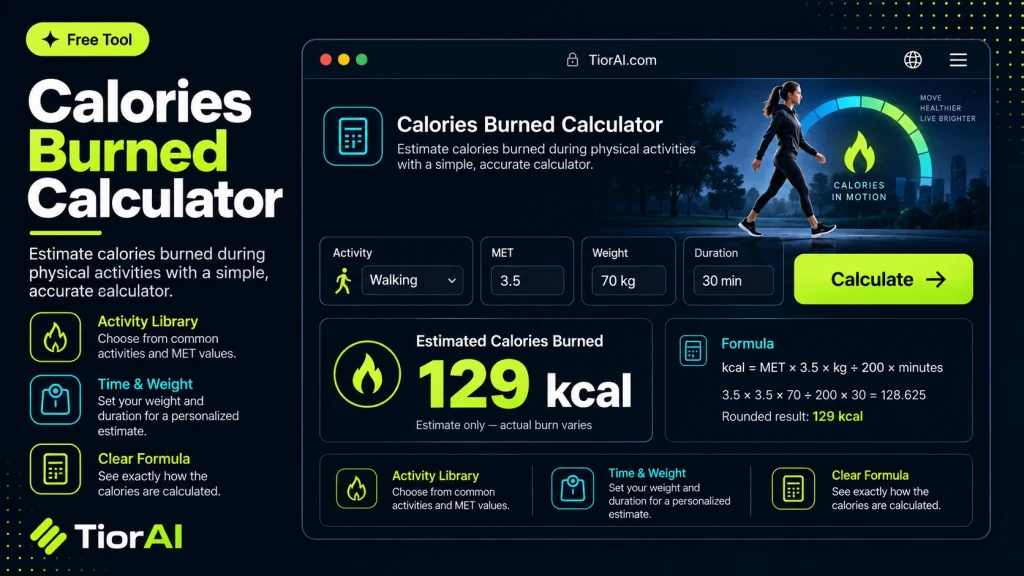
| Detail | Value |
|---|---|
| Calories Burned | - |
| Activity | - |
| MET Value | - |
| Duration | - |
| Weight Used | - |
| Burn Rate | - |
| Equivalent Food | - |
How It Works
- Calories
kcal = MET × weight (kg) × hours- Pounds to kilograms
kg = lb × 0.45359237
MET (Metabolic Equivalent of Task) is the standard measure of how hard an activity is compared with sitting still. The values come from the Compendium of Physical Activities and describe an average adult, so your real burn depends on fitness, age, and intensity.
Food equivalents assume 95 kcal per medium apple and 105 kcal per medium banana.
How to use it
- Enter Your Values Input your numbers or parameters into the Calories Burned Calculator. Fill in all required fields for an accurate calculation.
- Calculate Results Click the calculate button to process your inputs. The Calories Burned Calculator delivers instant, accurate results.
- Review and Use Review your calculated results, explore the breakdown, and copy or share the output for your needs.
Tip Try different input values with the Calories Burned Calculator to compare scenarios side by side before making decisions.
Understanding Calories Burned Calculation
Calories burned calculators estimate the amount of energy your body uses during physical activities. This calculation is based on factors such as your weight, the type of exercise, its intensity, and duration. The underlying concept relies on metabolic equivalents (METs), which quantify the energy cost of activities compared to resting metabolism.
Why is this important? Knowing how many calories you burn helps manage weight, plan nutrition, and optimize fitness routines. It provides a measurable way to track energy expenditure beyond just time spent exercising.
Common uses include:
- Weight loss programs to create calorie deficits.
- Fitness tracking to balance calorie intake and output.
- Rehabilitation and health monitoring to ensure appropriate activity levels.
These calculators use standardized MET values from research, combined with your personal data, to estimate calorie burn. While not perfectly precise due to individual metabolic differences, they offer a practical approximation for everyday use.
How Calories Burned Calculators Work
Calories burned calculators estimate the energy your body uses during physical activities by combining your weight, exercise type, intensity, and duration. They use metabolic equivalent (MET) values, which represent how much energy an activity consumes compared to resting. This helps you understand how much energy you expend beyond just the time spent exercising.
When to Use a Calories Burned Calculator
- When planning workouts to estimate energy expenditure and optimize your routine.
- To track daily calorie burn for weight management or fitness goals.
- To compare different exercises and select the most effective for your needs.
Common Mistakes to Avoid
- Entering inaccurate personal data like weight or exercise duration, which skews results.
- Assuming the calculator accounts for all individual factors such as metabolism or fitness level, which it does not.
While these calculators provide useful estimates, remember they are approximations based on average metabolic rates and standardized activity values. Use them as a guide to support your health and fitness decisions rather than an exact measurement.
Frequently asked questions
Reviews and questions
Whether this tool gave people the answer they needed, and what they asked about it.
Sign in to review this tool.
Sign In to ReviewNo reviews yet
Be the first to say whether this tool gave you what you needed.
Ask how to read the result, or what the tool does with an edge case — or answer someone else.
Sign In to AskNo questions yet
Not sure how to read a result? Be the first to ask.
AI tools related to this topic
Tools from the TiorAI directory that work on the same kind of job.

track-calories.com
Track-calories.com is a free, no-signup web tool that allows users to log food intake, calculate calories, and track nutrition to support diet and weight management.