

Frequency Converter
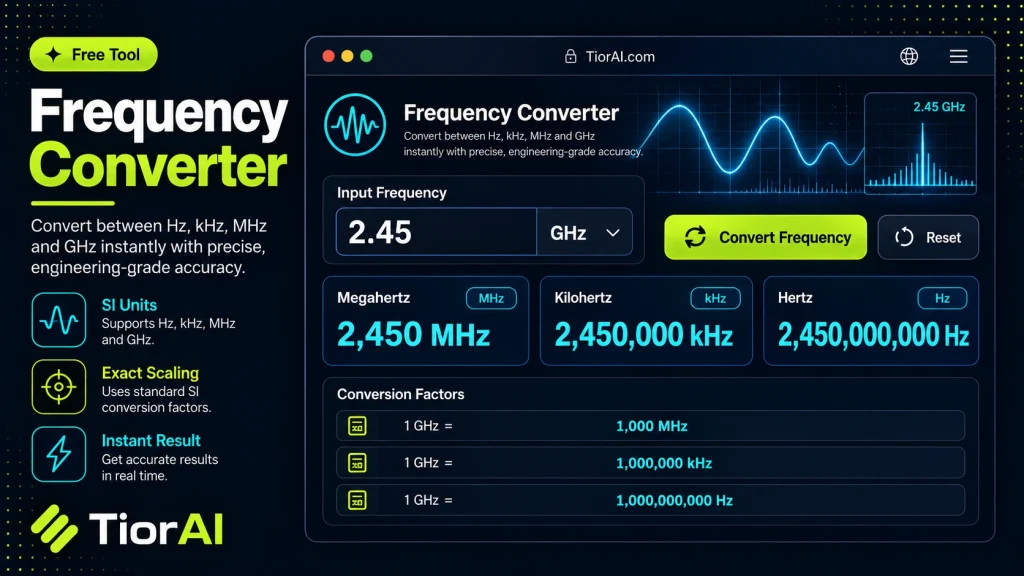
Frequency measures how often a repeating event occurs per second, commonly expressed in hertz (Hz). However, depending on the application, frequency values may be represented in different units such as kilohertz (kHz), megahertz (MHz), or gigahertz (GHz). Frequency conversion is the process of changing a…
| Unit | Value |
|---|---|
| Hz | |
| kHz | |
| MHz | |
| GHz | |
| THz | |
| RPM |
How to use it
- Enter Source Value Type or paste the value you want to convert into the Frequency Converter. The tool accepts a wide range of input formats.
- Select Target Format Choose your desired output format or unit from the available options. The conversion starts automatically.
- Copy the Result Review the converted output and click copy to use it in your project, document, or workflow.
Tip Keep the Frequency Converter open in a browser tab for instant access during development sessions.
Understanding Frequency Conversion
Frequency is a fundamental physical quantity that measures how often a repeating event occurs per unit time, typically expressed in hertz (Hz). However, depending on the context, frequency values might be represented in different units such as kilohertz (kHz), megahertz (MHz), gigahertz (GHz), or even cycles per second. A frequency converter is a tool that allows you to convert between these various units accurately and quickly.
Why is frequency conversion important? Different fields and applications use different frequency units. For example, radio communications often use MHz or GHz, while audio signals might be measured in Hz or kHz. Converting between these units ensures proper interpretation, calculation, and communication of frequency values.
Common situations where frequency conversion is needed include:
- Engineering and electronics design, where signal frequencies must be specified in the correct unit.
- Scientific research, to standardize measurements across different datasets.
- Telecommunications, for tuning and configuring devices operating at various frequency bands.
- Education, to help students understand the relationships between frequency units.
Frequency conversion is a straightforward mathematical process involving multiplication or division by powers of 10, but accuracy and convenience are key, especially when dealing with very large or very small values.
What is Frequency Conversion?
Frequency measures how often a repeating event occurs per second, commonly expressed in hertz (Hz). However, depending on the application, frequency values may be represented in different units such as kilohertz (kHz), megahertz (MHz), or gigahertz (GHz). Frequency conversion is the process of changing a frequency value from one unit to another, which is essential for accurate communication and analysis across various fields.
When to Use a Frequency Converter
- Converting signal frequencies for electronic circuit design and documentation.
- Standardizing frequency data in scientific research.
- Configuring telecommunications equipment operating at different frequency bands.
- Preparing inputs for simulation software that requires specific frequency units.
- Learning or teaching frequency concepts with clear unit conversions.
Common Mistakes to Avoid
- Mixing up frequency units with angular frequency units like radians per second, which require different conversion methods.
- Applying incorrect conversion factors, such as using 100,000 instead of 1,000,000 when converting MHz to Hz.
Frequency conversion is a simple but vital task in many technical and scientific contexts. Using a reliable frequency converter tool ensures accuracy and saves time when working with different frequency units.
Frequently asked questions
Reviews and questions
Whether this tool gave people the answer they needed, and what they asked about it.
Sign in to review this tool.
Sign In to ReviewNo reviews yet
Be the first to say whether this tool gave you what you needed.
Ask how to read the result, or what the tool does with an edge case — or answer someone else.
Sign In to AskNo questions yet
Not sure how to read a result? Be the first to ask.
AI tools related to this topic
Tools from the TiorAI directory that work on the same kind of job.

Any Video Converter
Any Video Converter is a multimedia software that converts video files between numerous formats, downloads online videos, and offers basic editing and DVD burning features.

Bank Statement Converter
Bank Statement Converter is an online tool that converts PDF bank statements into Excel and CSV formats, enabling easy data extraction and financial management.

Code Language Converter
Code Language Converter is an online tool that translates code between 30+ programming languages with AI-powered conversion, with a free plan and a paid PRO plan.