

HSV to HSL
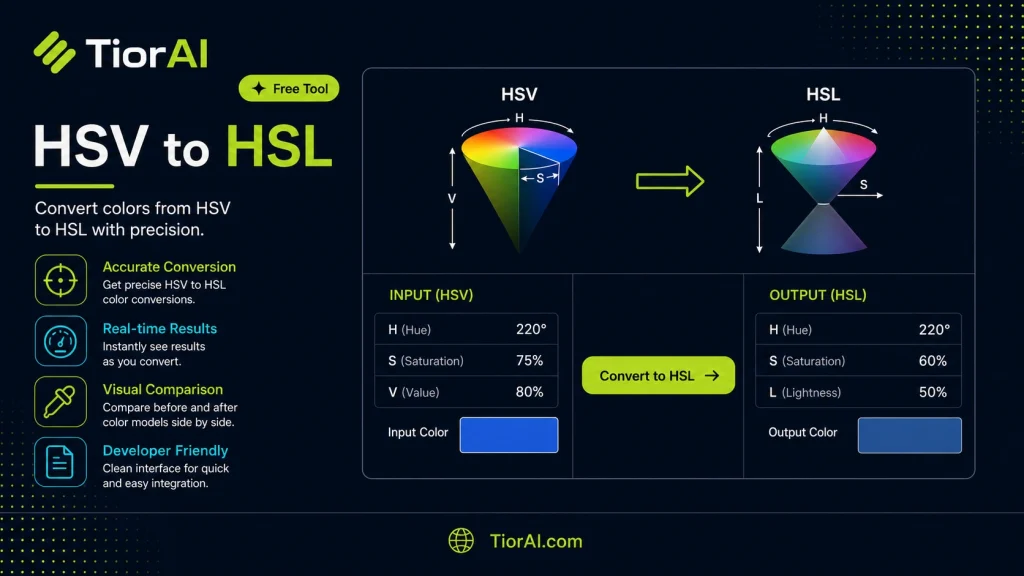
Convert HSV color values to HSL format instantly with our free online converter. Enter your HSV color code and get the accurate HSL equivalent - perfect for web design, CSS styling, graphic design, and digital art projects.
How to use it
- Pick or Enter a Color Use the color picker or enter a color value into the Hsv to Hsl. Supports HEX, RGB, HSL, and more.
- Adjust and Preview Fine-tune your color selection and preview results in real time with instant visual feedback.
- Copy Color Values Copy the generated color codes in your preferred format for use in CSS, design tools, or development.
Tip Save your favorite colors from the Hsv to Hsl to build a consistent brand palette across all projects.
Understanding HSV and HSL Color Models
HSV (Hue, Saturation, Value) and HSL (Hue, Saturation, Lightness) are two popular cylindrical-coordinate representations of colors used in digital graphics and web development. Both models describe colors in terms of hue, saturation, and a third component that relates to brightness, but they differ in how they define and calculate these components.
Hue is the same in both models and represents the color type, measured in degrees from 0 to 360 on the color wheel (e.g., 0° is red, 120° is green, 240° is blue).
Saturation in HSV measures the intensity or purity of the color, while in HSL it also represents color intensity but is calculated differently to fit the lightness model.
Value in HSV corresponds to the brightness of the color, ranging from black (0) to full brightness (1). In contrast, Lightness in HSL is the average of the brightest and darkest parts of the color, ranging from black (0) through the pure color (0.5) to white (1).
Why Convert Between HSV and HSL?
Developers often need to convert between HSV and HSL because different tools, libraries, or CSS properties may require colors in one format or the other. For example, some color pickers output HSV values, but CSS preprocessors or design systems might prefer HSL for easier manipulation of lightness and saturation.
Conversion between HSV and HSL is not a simple one-to-one mapping because the two models interpret saturation and brightness/lightness differently. The conversion involves mathematical formulas that adjust saturation and the third component (value or lightness) to maintain the perceived color.
Technical Details and Standards
Both HSV and HSL are not formal W3C standards but are widely supported in CSS and design tools. CSS supports HSL natively via the hsl() and hsla() functions, allowing developers to specify colors with hue, saturation, and lightness directly. HSV is less commonly supported in CSS but is popular in graphics software and color pickers.
Conversion formulas typically use normalized values (0 to 1) for saturation, value, and lightness. For example, to convert HSV to HSL:
- Calculate lightness as
L = V × (1 - S / 2) - Calculate saturation as
S_L = (V - L) / min(L, 1 - L)ifLis not 0 or 1, else 0
These formulas ensure that the hue remains constant while adjusting saturation and lightness/value to match the visual perception of the color.
Understanding these differences and conversions helps developers maintain color consistency across different platforms and tools.
Understanding HSV and HSL Color Models
HSV (Hue, Saturation, Value) and HSL (Hue, Saturation, Lightness) are two color models widely used in digital design and development to represent colors in a way that aligns with human perception. Both models describe colors using three components: hue, saturation, and a third parameter related to brightness, but they differ in how they calculate and interpret these components.
Hue is consistent across both models and represents the type of color, measured in degrees from 0 to 360 on the color wheel. Saturation and the third component—value in HSV and lightness in HSL—are calculated differently, which affects how colors appear and are manipulated.
When to Use HSV to HSL Conversion
- If you receive color values from a tool or library that outputs HSV but need to use HSL in CSS, conversion is necessary.
- When you want to adjust lightness or saturation in CSS, which supports HSL natively, but your source colors are in HSV.
- When working across different design and development environments that use different color models, converting ensures color consistency.
Common Mistakes When Converting HSV to HSL
- Assuming HSV and HSL saturation values are interchangeable without conversion, which leads to unexpected color shifts.
- Using HSV values directly in CSS without converting to HSL, resulting in incorrect color rendering since CSS does not support HSV.
Technical Context
HSV and HSL are not formal standards but are widely supported in design tools and CSS (which supports HSL). The conversion involves formulas that adjust saturation and brightness/lightness to maintain the perceived color. For example, lightness in HSL is calculated from HSV’s value and saturation to reflect the midpoint between black and white, while saturation is recalculated to fit this lightness model.
Understanding these differences is important for developers to maintain color accuracy and consistency when working with colors across different platforms and tools.
Common use cases
- Converting a bright red from HSV to HSL
- Converting a medium green from HSV to HSL
Frequently asked questions
Reviews and questions
Whether this tool gave people the answer they needed, and what they asked about it.
Sign in to review this tool.
Sign In to ReviewNo reviews yet
Be the first to say whether this tool gave you what you needed.
Ask how to read the result, or what the tool does with an edge case — or answer someone else.
Sign In to AskNo questions yet
Not sure how to read a result? Be the first to ask.
AI tools related to this topic
Tools from the TiorAI directory that work on the same kind of job.

Code Language Converter
Code Language Converter is a free web-based tool that translates code snippets between multiple programming languages, helping developers convert syntax quickly and learn language differences.

Any Video Converter
Any Video Converter is a multimedia software that converts video files between numerous formats, downloads online videos, and offers basic editing and DVD burning features.

Bank Statement Converter
Bank Statement Converter is an online tool that converts PDF bank statements into Excel and CSV formats, enabling easy data extraction and financial management.

Conversion Blitz
Conversion Blitz is a web-based landing page builder that helps marketers create optimized pages with drag-and-drop tools and A/B testing to increase conversions.