

Cone Calculator
Understanding Cone Calculations A cone is a 3D shape with a circular base tapering to a point called the apex. Calculating its volume, surface area, and slant height is important in many practical applications, from manufacturing to education. The volume formula V = (1/3) ×…
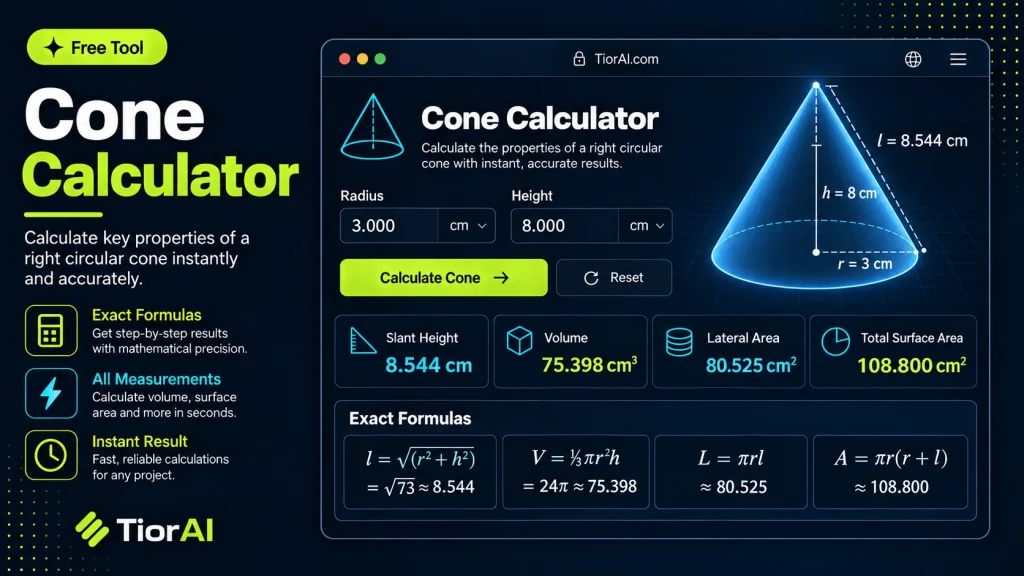
Cone Calculator
Calculate cone properties including volume, surface area, and slant height. Enter the radius and height to compute all values.
Results
Formulas Used
V = ⅓πr²h— Volume of a cones = √(r² + h²)— Slant height (Pythagorean theorem)L = πrs— Lateral surface areaB = πr²— Base areaT = L + B = πr(s + r)— Total surface areaC = 2πr— Base circumference
How to use it
- Enter Your Values Input your numbers or parameters into the Cone Calculator. Fill in all required fields for an accurate calculation.
- Calculate Results Click the calculate button to process your inputs. The Cone Calculator delivers instant, accurate results.
- Review and Use Review your calculated results, explore the breakdown, and copy or share the output for your needs.
Tip Try different input values with the Cone Calculator to compare scenarios side by side before making decisions.
Understanding Cone Geometry and Calculations
A cone is a three-dimensional geometric shape with a circular base that tapers smoothly to a single point called the apex. Calculating properties like volume, surface area, and slant height is essential in various fields such as engineering, architecture, and manufacturing.
Volume calculation determines how much space the cone occupies. It is calculated using the formula V = (1/3) × π × r² × h, where r is the radius of the base and h is the height perpendicular from the base to the apex.
Surface area includes the base area plus the lateral (side) area. The total surface area formula is A = π × r × (r + l), where l is the slant height. The slant height is the distance from the apex to any point on the circular edge along the cone’s side, calculated by l = √(r² + h²).
These calculations are crucial when designing objects like funnels, ice cream cones, or conical tanks, where precise measurements affect material usage and functionality. Using a cone calculator automates these computations, reducing errors and saving time.
Understanding Cone Calculations
A cone is a 3D shape with a circular base tapering to a point called the apex. Calculating its volume, surface area, and slant height is important in many practical applications, from manufacturing to education.
The volume formula V = (1/3) × π × r² × h measures the space inside the cone, where r is the base radius and h is the height. The surface area includes the base and the lateral side, calculated as A = π × r × (r + l), where l is the slant height. The slant height itself is found by l = √(r² + h²).
When to Use a Cone Calculator
- Designing or building conical objects requiring precise volume or surface area measurements.
- Checking homework or learning geometric properties in math classes.
- Estimating material needs for construction projects involving cones.
- Converting between cone dimensions, such as finding slant height from radius and height.
Common Mistakes to Avoid
- Mixing up slant height and vertical height, especially when calculating surface area.
- Using inconsistent units for radius and height, which leads to incorrect results.
- Omitting the one-third factor in the volume formula, causing volume overestimation.
Using a cone calculator helps automate these calculations, ensuring accuracy and saving time in both professional and educational contexts.
Frequently asked questions
Reviews and questions
Whether this tool gave people the answer they needed, and what they asked about it.
Sign in to review this tool.
Sign In to ReviewNo reviews yet
Be the first to say whether this tool gave you what you needed.
Ask how to read the result, or what the tool does with an edge case — or answer someone else.
Sign In to AskNo questions yet
Not sure how to read a result? Be the first to ask.