

Volume Flow Rate Converter
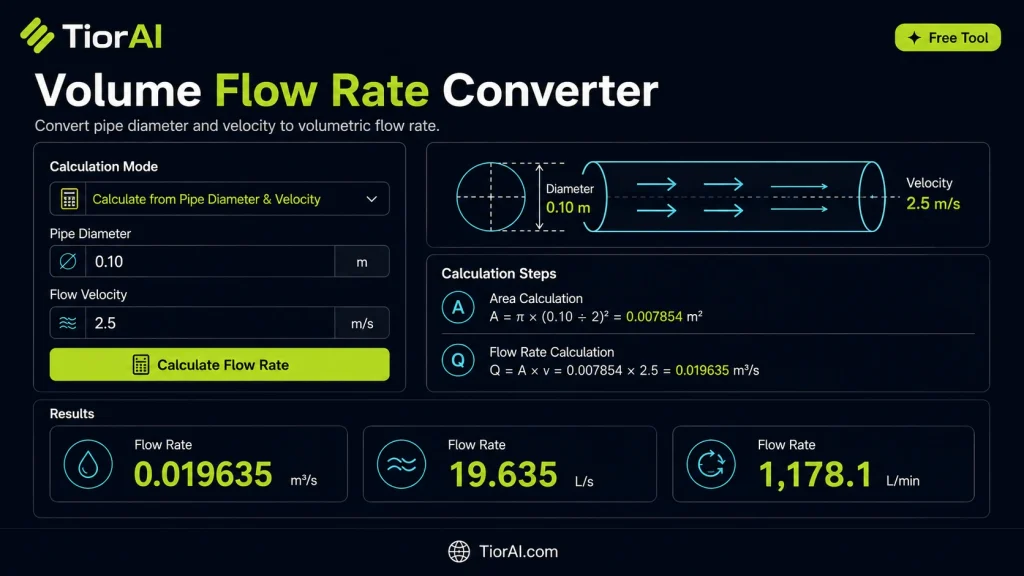
Volume flow rate quantifies the amount of fluid passing through a point in a given time, typically expressed in units like cubic meters per second or liters per minute. It is a fundamental parameter in fluid mechanics and engineering. When to Use a Volume Flow…
| Unit | Value |
|---|---|
| L/s | - |
| L/min | - |
| L/h | - |
| m³/s | - |
| m³/h | - |
| GPM (US) | - |
| CFM | - |
| cm³/s | - |
How to use it
- Enter Your Input Value Type or paste the value you want to convert into the input field. The tool accepts any numeric value.
- Select Units and Convert Choose your source and target units from the dropdown menus. The converted result appears instantly.
- Copy or Use the Result Click copy to grab the converted value for use in your project, document, or calculation.
Tip Need the reverse conversion? Swap source and target to convert in the opposite direction instantly.
Understanding Volume Flow Rate and Its Conversion
Volume flow rate measures the volume of fluid passing through a point per unit time. It is commonly expressed in units like cubic meters per second (m³/s), liters per minute (L/min), gallons per minute (GPM), and cubic feet per second (ft³/s).
Converting between these units is essential because different industries and regions use different measurement standards. For example, engineers in the US often use gallons per minute, while scientific research typically uses cubic meters per second.
Why conversions matter:
- Ensuring consistency in calculations when working with international data or equipment.
- Facilitating communication between teams using different unit systems.
- Accurately sizing pumps, pipes, and hydraulic systems based on flow requirements.
Volume flow rate conversion involves multiplying the given value by a conversion factor that relates the source unit to the target unit. These factors depend on the volume unit and the time unit involved.
Common situations requiring volume flow rate conversion include fluid dynamics studies, HVAC system design, water treatment processes, and automotive engine testing.
What is Volume Flow Rate?
Volume flow rate quantifies the amount of fluid passing through a point in a given time, typically expressed in units like cubic meters per second or liters per minute. It is a fundamental parameter in fluid mechanics and engineering.
When to Use a Volume Flow Rate Converter
- Designing fluid transport systems requiring consistent units.
- Selecting pumps based on manufacturer flow specifications.
- Interpreting sensor data output in various units.
- Comparing flow rates from different sources or standards.
Common Mistakes to Avoid
- Mixing volume flow rate with mass flow rate units, which measure different properties.
- Neglecting the time unit during conversion, such as converting volume units only.
- Using rough approximations instead of precise conversion factors, risking calculation errors.
Technical Context
Volume flow rate conversion relies on fixed relationships between volume units and time units. For example, converting from cubic meters per second to liters per minute involves multiplying by 60,000 because 1 cubic meter equals 1000 liters and 1 second equals 1/60 of a minute. Accurate conversions are critical in engineering fields like hydraulics, HVAC, and fluid transport to ensure system performance and safety.
Frequently asked questions
Reviews and questions
Whether this tool gave people the answer they needed, and what they asked about it.
Sign in to review this tool.
Sign In to ReviewNo reviews yet
Be the first to say whether this tool gave you what you needed.
Ask how to read the result, or what the tool does with an edge case — or answer someone else.
Sign In to AskNo questions yet
Not sure how to read a result? Be the first to ask.
AI tools related to this topic
Tools from the TiorAI directory that work on the same kind of job.

Wolfram Alpha
Wolfram Alpha is a computational knowledge engine that answers factual queries by performing computations on curated data, offering detailed solutions, visualizations, and an API for developers.

ChatGPT
ChatGPT is an AI chatbot by OpenAI powered by GPT-4o. It handles writing, coding, research, data analysis, and natural conversation. Free tier available, Plus at $20/month.