

Volume Converter
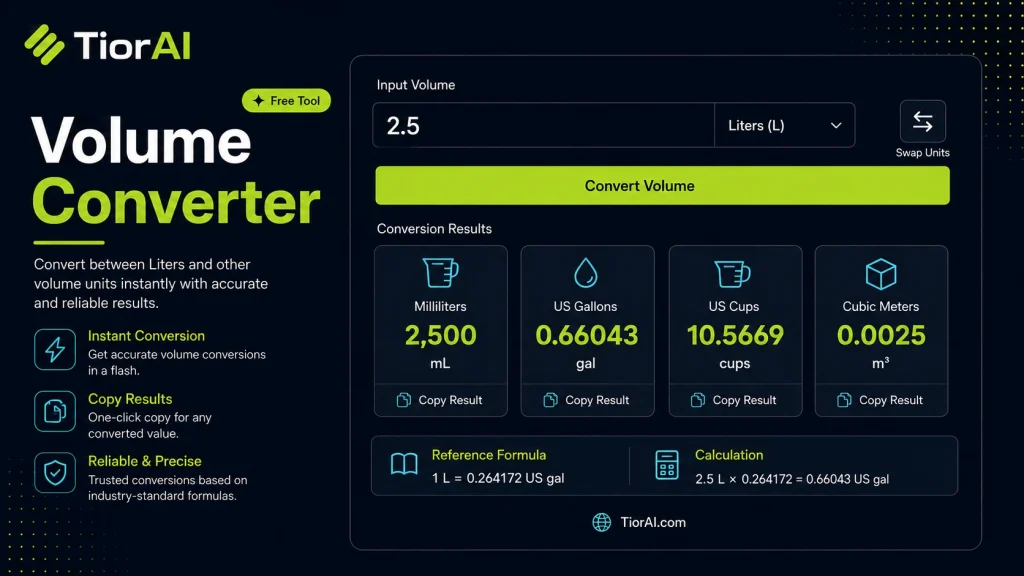
Convert between Millilitres, Litres, Cubic Centimetres, Cubic Metres, Cubic Inches, Cubic Feet, Cubic Yards, and US Gallons.
| Unit | Value |
|---|---|
| Millilitres (ml) | - |
| Litres (l) | - |
| Cubic Centimetres (cm³) | - |
| Cubic Metres (m³) | - |
| Cubic Inches (in³) | - |
| Cubic Feet (ft³) | - |
| Cubic Yards (yd³) | - |
| US Gallons (gal) | - |
How to use it
- Enter Your Input Value Type or paste the value you want to convert into the input field. The tool accepts any numeric value.
- Select Units and Convert Choose your source and target units from the dropdown menus. The converted result appears instantly.
- Copy or Use the Result Click copy to grab the converted value for use in your project, document, or calculation.
Tip Chain multiple conversions by copying the output and pasting it as the next input - works seamlessly.
Understanding Volume Conversion
Volume conversion is the process of changing a measurement of space occupied by a substance from one unit to another. This is essential because volume can be expressed in many units depending on the system of measurement, such as liters, milliliters, gallons, cubic meters, or fluid ounces. Converting between these units allows for clear communication, accurate calculations, and proper measurement in various fields.
Why is volume conversion important?
- Cooking and baking often require converting between cups, milliliters, and liters to follow recipes accurately.
- In science and engineering, precise volume measurements are critical for experiments, manufacturing, and quality control.
- Everyday tasks like filling a car’s gas tank or measuring liquids for cleaning products require understanding volume units.
Common volume units and their relationships:
1 liter (L)= 1000 milliliters (mL)1 gallon (US)≈ 3.785 liters1 cubic meter (m³)= 1000 liters
Volume conversion tools automate the calculations needed to switch between these units, reducing errors and saving time.
What is Volume Conversion?
Volume conversion involves changing a measurement of space occupied by a substance from one unit to another. Since volume can be expressed in various units like liters, milliliters, gallons, or cubic meters, converting between these units is necessary for clarity and accuracy in many fields.
Common volume units include:
Liters (L)Milliliters (mL)Gallons (US and UK)Cubic meters (m³)
Each unit serves different purposes depending on the context, such as cooking, scientific measurements, or industrial applications.
When to Use a Volume Converter
- When a recipe lists ingredients in units different from what you have available.
- During laboratory experiments requiring precise volume measurements.
- When buying or measuring liquids sold in unfamiliar units.
- In industries needing to switch between metric and imperial volume units.
Common Mistakes to Avoid
- Mixing volume units from different measurement systems without proper conversion, like confusing US and UK gallons.
- Performing calculations without converting all volumes to the same unit first.
- Confusing volume units with weight units, which measure different properties.
Using a volume converter tool helps prevent these errors by automating the conversion process, ensuring accurate and consistent results across different units.
Frequently asked questions
Reviews and questions
Whether this tool gave people the answer they needed, and what they asked about it.
Sign in to review this tool.
Sign In to ReviewNo reviews yet
Be the first to say whether this tool gave you what you needed.
Ask how to read the result, or what the tool does with an edge case — or answer someone else.
Sign In to AskNo questions yet
Not sure how to read a result? Be the first to ask.
AI tools related to this topic
Tools from the TiorAI directory that work on the same kind of job.

Wolfram Alpha
Wolfram Alpha is a computational knowledge engine that answers factual queries by performing computations on curated data, offering detailed solutions, visualizations, and an API for developers.

ChatGPT
ChatGPT is an AI chatbot by OpenAI powered by GPT-4o. It handles writing, coding, research, data analysis, and natural conversation. Free tier available, Plus at $20/month.