

UPI QR Code Generator
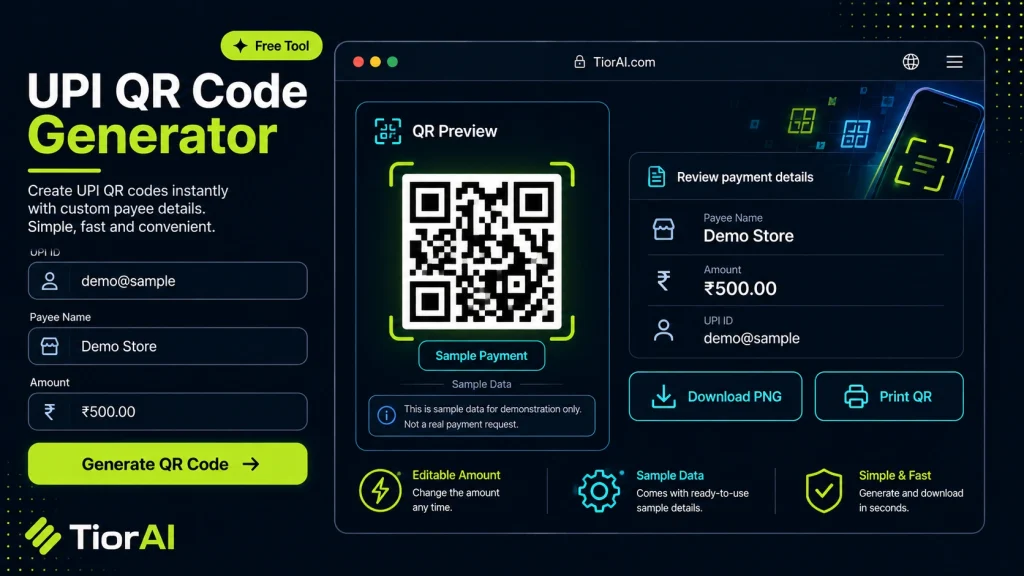
Generate a UPI payment QR code from a UPI ID and amount.
How to use it
- Paste Your Input Paste your code or data into the Upi Qr Code Generator. The tool accepts standard input formats and validates your entry.
- Process and Transform Click the action button to process your input. Results are generated instantly with proper formatting.
- Export the Output Copy the processed output to your clipboard or download it for use in your development workflow.
Tip Paste minified code into the Upi Qr Code Generator to instantly format and debug it without installing any extensions.
Understanding UPI QR Codes and Their Role in Digital Payments
The Unified Payments Interface (UPI) is a real-time payment system developed by the National Payments Corporation of India (NPCI) that facilitates instant money transfers between bank accounts using a mobile device. One of the key innovations that simplify UPI transactions is the use of QR codes, which encode payment information in a machine-readable format.
What is a UPI QR Code? A UPI QR code is a two-dimensional barcode that contains a standardized string representing a UPI payment address (also called a Virtual Payment Address or VPA), along with optional metadata such as the payee’s name, transaction amount, and transaction note. When scanned by a UPI-enabled app, the QR code automatically populates the payment details, eliminating the need for manual entry and reducing errors.
Technical Standards Behind UPI QR Codes
EMVCo QR Code Specification:Many UPI QR codes follow the EMVCo standard, which is a global specification for payment QR codes ensuring interoperability across different payment systems and apps.UPI QR Code Format:NPCI defines a specific format for encoding UPI payment information, including the payee’s VPA, transaction amount, and other optional parameters, embedded within the QR code data string.
How Developers Use UPI QR Codes
Developers integrate UPI QR code generation into websites, point-of-sale (POS) systems, and mobile apps to enable seamless payment acceptance. By generating a QR code dynamically with the correct UPI details, merchants can allow customers to scan and pay instantly without sharing sensitive information like bank account numbers.
For example, an e-commerce platform can generate a UPI QR code at checkout with the exact amount to be paid, streamlining the payment process. Similarly, physical stores can print static or dynamic QR codes for customers to scan and pay using their preferred UPI app.
Benefits of Using UPI QR Codes
- Security: The QR code encodes only the VPA and transaction details, minimizing exposure of sensitive data.
- Convenience: Users avoid manual entry of payment details, reducing errors and speeding up transactions.
- Interoperability: A single QR code can be scanned by multiple UPI apps, ensuring broad compatibility.
In summary, UPI QR codes are a standardized, secure, and user-friendly way to facilitate digital payments in India, widely adopted by developers to enhance payment workflows.
What is a UPI QR Code?
A UPI QR code is a two-dimensional barcode that encodes payment information compliant with the Unified Payments Interface (UPI) system. It contains the payee’s virtual payment address (VPA) and optionally the amount and transaction details. This code can be scanned by any UPI-enabled app to initiate a payment without manual data entry.
Technical Context and Standards
UPI QR codes typically follow the EMVCo QR code specification, a global standard for payment QR codes, ensuring interoperability across different apps and devices. The encoded data string uses a URI format defined by NPCI, such as upi://pay?pa=payee@upi&pn=PayeeName&am=100.00&cu=INR. This standardization allows seamless integration and consistent user experience.
When to Use a UPI QR Code Generator
- Integrate into e-commerce platforms to generate payment requests with exact amounts.
- Display static QR codes in physical stores for customers to scan and pay.
- Generate dynamic QR codes in billing or invoicing systems for precise transaction tracking.
- Embed in mobile apps to facilitate quick payments without manual input.
Common Mistakes to Avoid
- Failing to use the correct UPI ID format, which causes payment failures.
- Omitting the transaction amount in dynamic QR codes, leading to user confusion.
- Using static QR codes when variable amounts are needed, forcing manual entry and increasing errors.
Summary
UPI QR codes are a standardized, secure, and efficient method to facilitate digital payments in India. Developers use them to streamline payment workflows by encoding payment details into a scannable format compatible with all major UPI apps. Understanding the technical standards and common pitfalls ensures smooth integration and a better user experience.
Common use cases
- Static UPI QR Code for Merchant Payment
- Dynamic UPI QR Code with Amount for Online Checkout
Frequently asked questions
Reviews and questions
Whether this tool gave people the answer they needed, and what they asked about it.
Sign in to review this tool.
Sign In to ReviewNo reviews yet
Be the first to say whether this tool gave you what you needed.
Ask how to read the result, or what the tool does with an edge case — or answer someone else.
Sign In to AskNo questions yet
Not sure how to read a result? Be the first to ask.
AI tools related to this topic
Tools from the TiorAI directory that work on the same kind of job.

Code to Flow: Visualize your code
Code to Flow is a web tool that automatically converts source code into flowcharts, helping developers visualize and understand code logic easily.