

Sound Level Converter
Sound level conversion involves translating sound measurements between different units, primarily decibels (dB) and bels (B). Decibels are a logarithmic unit used to express sound intensity relative to a reference level, making them suitable for representing the wide range of audible sounds. Bels are less…
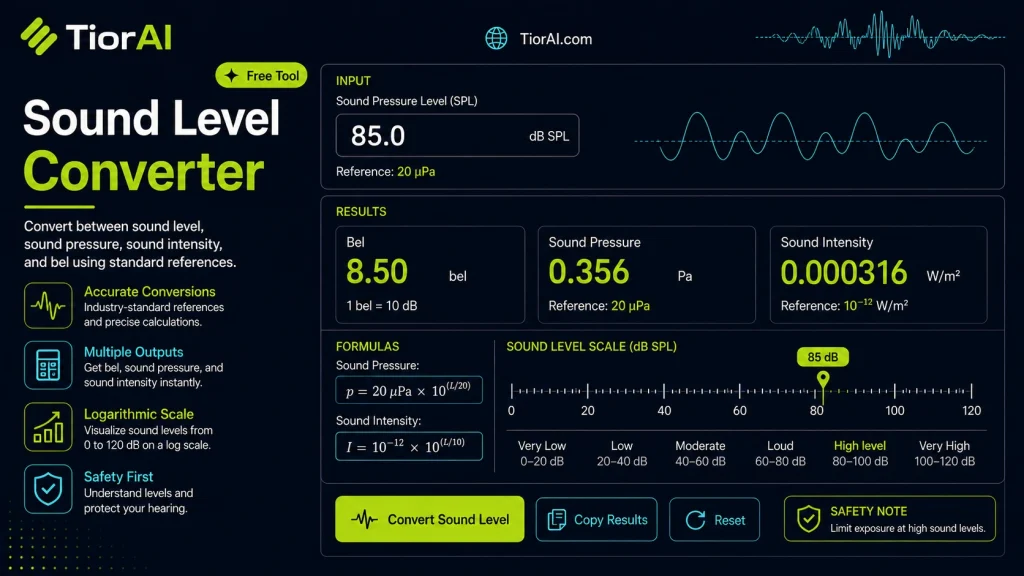
| Pressure (Pa) | - |
|---|---|
| Intensity (W/m^2) | - |
Common Sound Levels
| Source | Level |
|---|---|
| Whisper | 30 dB |
| Conversation | 60 dB |
| Traffic | 80 dB |
| Concert | 110 dB |
| Jet engine (close) | 130 dB |
How to use it
- Enter Your Input Value Type or paste the value you want to convert into the input field. The tool accepts any numeric value.
- Select Units and Convert Choose your source and target units from the dropdown menus. The converted result appears instantly.
- Copy or Use the Result Click copy to grab the converted value for use in your project, document, or calculation.
Tip Bookmark this converter - it handles edge cases like zero values and very large numbers accurately.
Understanding Sound Level Conversion
Sound levels are commonly measured in decibels (dB), a logarithmic unit that quantifies sound intensity relative to a reference level. Because sound intensity spans a vast range, from the faintest whisper to loud machinery, using a logarithmic scale like decibels helps represent these differences in a manageable way.
Sound level converters are tools that translate between different units of sound measurement, such as decibels (dB), bels (B), and sometimes other related units like sound pressure level (SPL). The conversion is important because different fields or standards may use different units, and understanding the relationships helps in interpreting measurements correctly.
Why is this conversion needed?
- Decibels are often used in acoustics, audio engineering, and noise regulation.
- Bels are less common but sometimes used in telecommunications and signal processing; 1 bel equals 10 decibels.
- Converting between units ensures consistency when comparing measurements or complying with regulations.
Common situations where sound level conversion is useful include calibrating audio equipment, assessing environmental noise levels, and interpreting scientific data. Since decibels are logarithmic, converting between units requires understanding the mathematical relationship rather than simple multiplication or division.
What is Sound Level Conversion?
Sound level conversion involves translating sound measurements between different units, primarily decibels (dB) and bels (B). Decibels are a logarithmic unit used to express sound intensity relative to a reference level, making them suitable for representing the wide range of audible sounds. Bels are less commonly used but represent the same concept on a different scale, where 1 bel equals 10 decibels.
When to Use a Sound Level Converter
- When you need to compare sound measurements reported in different units.
- During audio equipment calibration where specifications may be given in bels or decibels.
- For environmental noise assessments requiring standardized reporting units.
- When interpreting scientific or engineering data involving sound levels.
Common Mistakes to Avoid
- Trying to convert sound levels using simple arithmetic without accounting for the logarithmic nature of decibels.
- Confusing bels and decibels and neglecting the factor of 10 difference.
- Failing to consider the reference level used in measurements, which can affect accuracy.
Understanding these concepts ensures accurate interpretation and conversion of sound levels, which is essential in fields like acoustics, audio engineering, and environmental noise control.
Frequently asked questions
Reviews and questions
Whether this tool gave people the answer they needed, and what they asked about it.
Sign in to review this tool.
Sign In to ReviewNo reviews yet
Be the first to say whether this tool gave you what you needed.
Ask how to read the result, or what the tool does with an edge case — or answer someone else.
Sign In to AskNo questions yet
Not sure how to read a result? Be the first to ask.
AI tools related to this topic
Tools from the TiorAI directory that work on the same kind of job.

Wolfram Alpha
Wolfram Alpha is a computational knowledge engine that answers factual queries by performing computations on curated data, offering detailed solutions, visualizations, and an API for developers.

ChatGPT
ChatGPT is an AI chatbot by OpenAI powered by GPT-4o. It handles writing, coding, research, data analysis, and natural conversation. Free tier available, Plus at $20/month.