

Proportion Calculator
Solve proportions of the form a/b = c/d. Enter any three values and leave one blank to solve for the missing value.
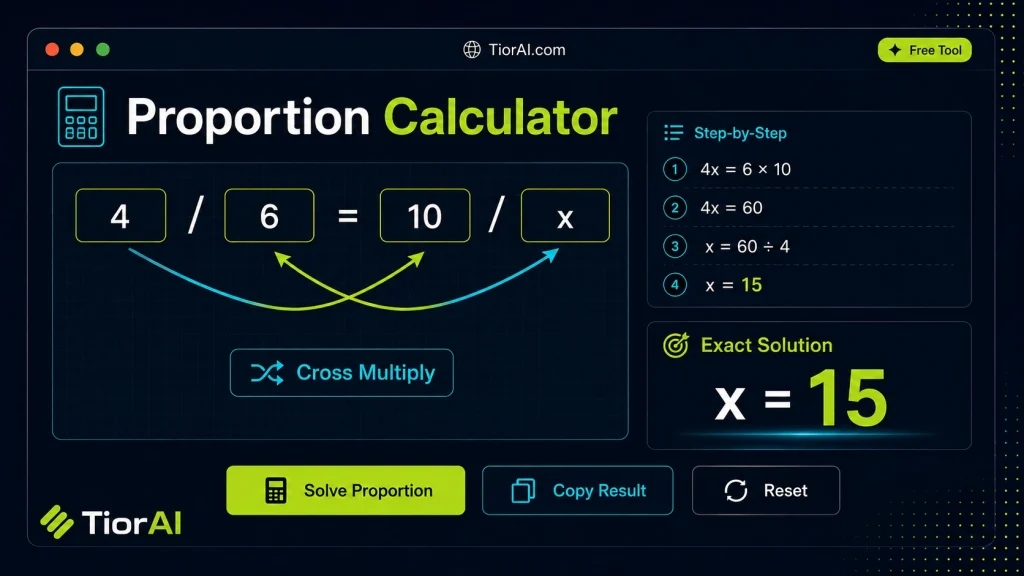
Leave exactly one field empty — that is the value being solved for.
How to use it
- Enter Your Values Input your numbers or parameters into the Proportion Calculator. Fill in all required fields for an accurate calculation.
- Calculate Results Click the calculate button to process your inputs. The Proportion Calculator delivers instant, accurate results.
- Review and Use Review your calculated results, explore the breakdown, and copy or share the output for your needs.
Tip Bookmark the Proportion Calculator page for quick access whenever you need to run calculations on the go.
Understanding Proportions
A proportion is an equation that states two ratios or fractions are equal. It expresses a relationship where two quantities increase or decrease at the same rate. For example, if 2 apples cost $4, then 4 apples cost $8, maintaining the same ratio of cost to quantity.
Proportions are fundamental in many fields such as mathematics, science, finance, and everyday problem-solving. They allow you to find an unknown value when three values are known, by setting up an equality between two ratios.
Why Use Proportion Calculations?
Calculating proportions manually can be error-prone, especially when dealing with decimals or large numbers. A proportion calculator automates this process, ensuring accuracy and saving time. It solves for the unknown term in the proportion quickly by cross-multiplying and dividing.
Common Situations for Proportion Calculations
- Adjusting recipes when changing serving sizes
- Converting units, such as miles to kilometers
- Scaling models or drawings
- Solving problems involving speed, distance, and time
- Financial calculations like interest rates or currency conversions
What is a Proportion?
A proportion is a statement that two ratios are equal. It shows how one quantity relates to another in a consistent way. For example, if 3 pencils cost $6, then 6 pencils cost $12, maintaining the same ratio of cost to quantity.
When to Use a Proportion Calculator
- Finding an unknown value in a proportional relationship
- Adjusting recipe ingredients for different serving sizes
- Converting measurements between units with fixed ratios
- Scaling drawings, maps, or models accurately
Common Mistakes to Avoid
- Entering values in the wrong order, which can lead to incorrect answers
- Mixing units without converting them first
- Assuming a proportional relationship when quantities do not increase or decrease at the same rate
- Not simplifying ratios before input, which can cause confusion
Using a proportion calculator helps eliminate manual errors by automating the cross-multiplication process. It is a practical tool for students, professionals, and anyone working with ratios and scaling problems.
Frequently asked questions
Reviews and questions
Whether this tool gave people the answer they needed, and what they asked about it.
Sign in to review this tool.
Sign In to ReviewNo reviews yet
Be the first to say whether this tool gave you what you needed.
Ask how to read the result, or what the tool does with an edge case — or answer someone else.
Sign In to AskNo questions yet
Not sure how to read a result? Be the first to ask.