

Pressure Converter
Pressure measures the force applied over an area and is expressed in various units worldwide. Because different fields and regions use different units, converting pressure values accurately is crucial for clear communication and precise calculations. Pressure units include pascals (Pa), atmospheres (atm), bars, psi, and…
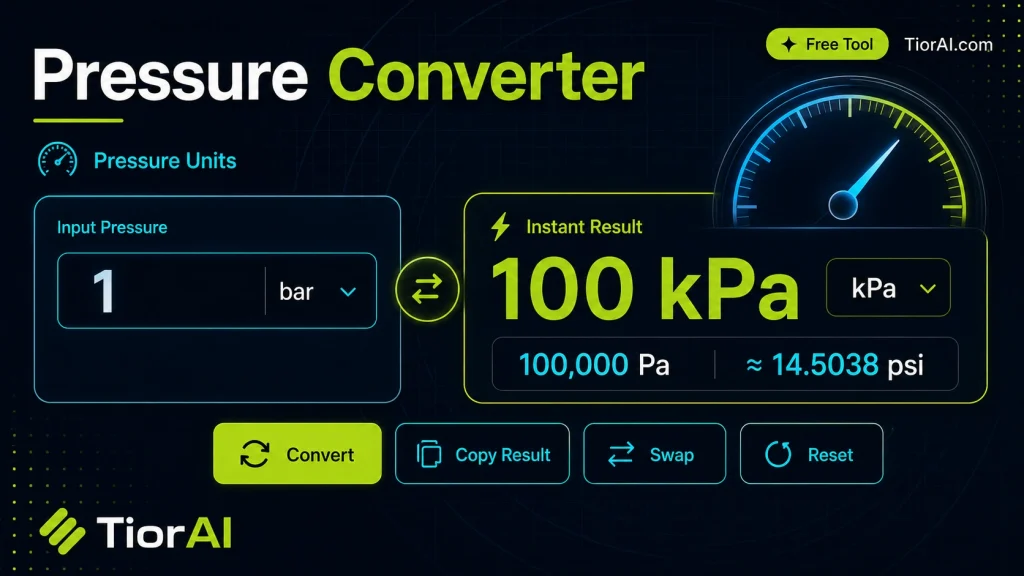
How to use it
- Enter Your Input Value Type or paste the value you want to convert into the input field. The tool accepts any numeric value.
- Select Units and Convert Choose your source and target units from the dropdown menus. The converted result appears instantly.
- Copy or Use the Result Click copy to grab the converted value for use in your project, document, or calculation.
Tip Bookmark this converter - it handles edge cases like zero values and very large numbers accurately.
Understanding Pressure and Unit Conversion
Pressure is a physical quantity that measures the force applied perpendicular to the surface of an object per unit area. It is commonly expressed in various units depending on the context, such as pascals (Pa), atmospheres (atm), bars, pounds per square inch (psi), and millimeters of mercury (mmHg).
Converting between these units is essential because different industries, countries, and scientific fields use different standards. For example, engineers in the United States often use psi, while scientists typically use pascals. Accurate pressure conversion ensures consistency and correctness in calculations, designs, and experiments.
Why is pressure conversion needed?
- To interpret data from instruments calibrated in different units.
- To comply with international standards in engineering and manufacturing.
- To compare measurements from different sources or regions.
- To perform calculations that require uniform units.
Common situations requiring pressure conversion include HVAC system design, fluid mechanics calculations, weather data analysis, and medical applications like blood pressure measurement. Understanding how to convert pressure units accurately helps avoid errors that could affect safety, performance, or scientific validity.
What is Pressure Conversion?
Pressure measures the force applied over an area and is expressed in various units worldwide. Because different fields and regions use different units, converting pressure values accurately is crucial for clear communication and precise calculations.
Pressure units include pascals (Pa), atmospheres (atm), bars, psi, and mmHg, among others. Each unit has a specific scale and context of use. For example, psi is common in automotive and industrial applications, while pascals are standard in scientific research.
When to Use a Pressure Converter
- Comparing pressure readings from different instruments or standards.
- Performing engineering or scientific calculations requiring uniform units.
- Preparing documentation or reports for international audiences.
- Interpreting data from weather stations or medical devices.
Common Mistakes to Avoid
- Mixing gauge and absolute pressure units without adjustment, which can cause errors.
- Ignoring unit prefixes like kilo- or milli-, leading to incorrect magnitude in conversions.
Understanding these points ensures accurate and reliable pressure conversions for practical and technical applications.
Frequently asked questions
Reviews and questions
Whether this tool gave people the answer they needed, and what they asked about it.
Sign in to review this tool.
Sign In to ReviewNo reviews yet
Be the first to say whether this tool gave you what you needed.
Ask how to read the result, or what the tool does with an edge case — or answer someone else.
Sign In to AskNo questions yet
Not sure how to read a result? Be the first to ask.
AI tools related to this topic
Tools from the TiorAI directory that work on the same kind of job.

Wolfram Alpha
Wolfram Alpha is a computational knowledge engine that answers factual queries by performing computations on curated data, offering detailed solutions, visualizations, and an API for developers.

ChatGPT
ChatGPT is an AI chatbot by OpenAI powered by GPT-4o. It handles writing, coding, research, data analysis, and natural conversation. Free tier available, Plus at $20/month.