

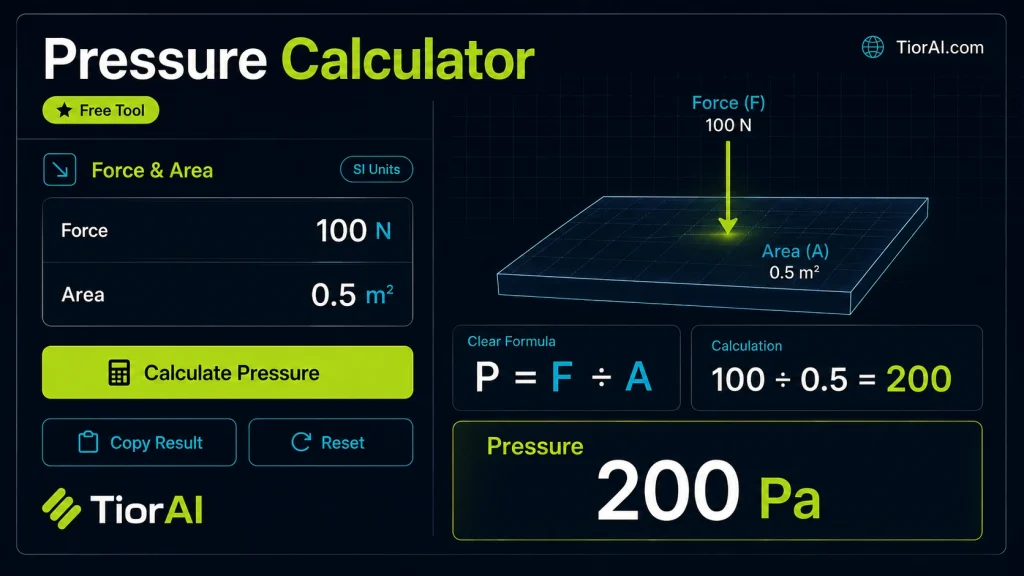
| Solved For | - |
|---|---|
| Result | - |
| Pressure (Pa) | - |
| Force (N) | - |
| Area (m²) | - |
| Formula | P = F / A |
How to use it
- Enter Your Values Input your numbers or parameters into the Pressure Calculator. Fill in all required fields for an accurate calculation.
- Calculate Results Click the calculate button to process your inputs. The Pressure Calculator delivers instant, accurate results.
- Review and Use Review your calculated results, explore the breakdown, and copy or share the output for your needs.
Tip Double-check critical calculations by adjusting one variable at a time in the Pressure Calculator to spot trends.
Understanding Pressure and Its Measurement
Pressure is a physical quantity that describes the force applied perpendicular to the surface of an object per unit area. It is commonly measured in units such as pascals (Pa), atmospheres (atm), bars, pounds per square inch (psi), and millimeters of mercury (mmHg).
Pressure measurement and conversion are essential in many fields including engineering, meteorology, medicine, and manufacturing. Different industries and regions use various units, so converting between these units accurately is crucial for communication, safety, and design.
Why convert pressure units? Because pressure can be expressed in multiple units depending on the context, converting between them ensures compatibility and correctness. For example, a weather report might use millibars, while a tire pressure gauge uses psi.
Common situations requiring pressure conversion include:
- Calibrating instruments that display pressure in different units
- Interpreting scientific data from international sources
- Designing systems that must meet standards specified in particular units
- Comparing pressure readings from different devices
Pressure calculators automate these conversions by applying precise formulas and constants, reducing manual errors and saving time.
What is Pressure and Why Convert Its Units?
Pressure measures the force applied over a specific area and is expressed in various units worldwide. Because different industries and regions use different units, converting pressure values accurately is essential for clear communication and safe operation.
When to Use a Pressure Calculator
- Converting tire pressure from psi to bar for vehicle maintenance
- Interpreting weather data reported in millibars when your instruments use pascals
- Designing hydraulic or pneumatic systems with pressure limits specified in different units
- Comparing pressure readings from devices calibrated in different unit systems
Common Mistakes to Avoid
- Mixing gauge pressure and absolute pressure without adjusting for atmospheric pressure
- Entering incorrect units or confusing similar units like mmHg and torr
- Assuming all pressure units are directly interchangeable without considering their reference points
Using a pressure calculator helps eliminate manual conversion errors by applying precise formulas. Always double-check the units you input and understand whether your pressure values are gauge or absolute to ensure accurate results.
Frequently asked questions
Reviews and questions
Whether this tool gave people the answer they needed, and what they asked about it.
Sign in to review this tool.
Sign In to ReviewNo reviews yet
Be the first to say whether this tool gave you what you needed.
Ask how to read the result, or what the tool does with an edge case — or answer someone else.
Sign In to AskNo questions yet
Not sure how to read a result? Be the first to ask.