

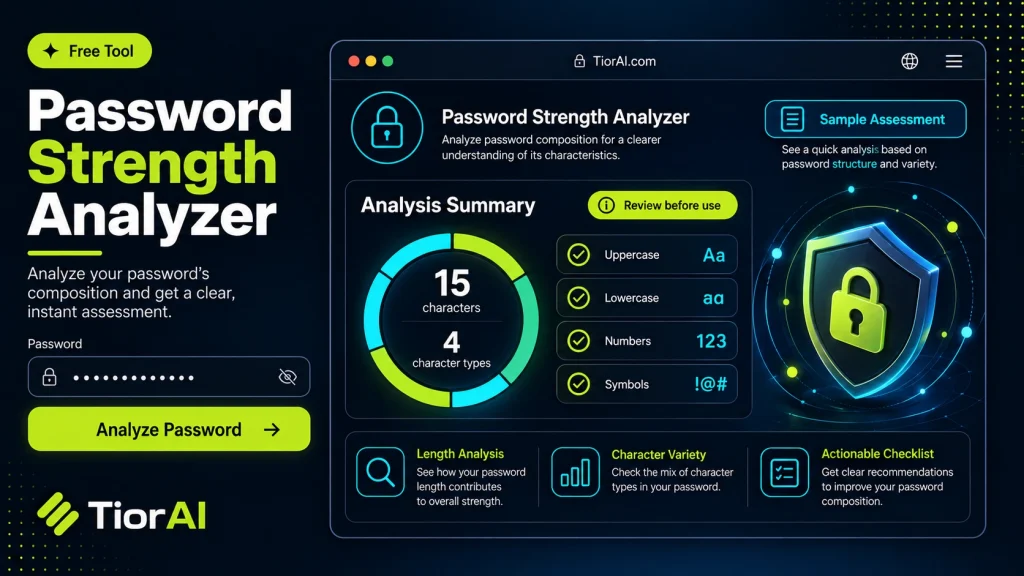
Password Strength Analyzer
Password strength analysis is a method used to evaluate how secure a password is against common attack methods. It helps developers and security teams ensure that users create passwords that are difficult to guess or crack. This process involves checking password length, character diversity, and…
| Score | 0 |
|---|---|
| Label | Very Weak |
| Entropy | 0 bits |
| Charset | - |
| Time to crack | - |
| # | Recommendation |
|---|
How to use it
- Configure Settings Set your preferences and parameters in the Password Strength Analyzer. Customize the output to match your specific requirements.
- Generate Output Click generate to create your result. The tool processes your settings and produces output instantly.
- Copy or Download Review the generated output, then copy it to your clipboard or download it for immediate use.
Tip Regenerate multiple times with the Password Strength Analyzer to compare variations and pick the best output for your needs.
Understanding Password Strength Analysis
Password strength analysis is a process used to evaluate how resistant a password is against guessing or brute-force attacks. The core idea is to measure the complexity and unpredictability of a password to ensure it meets security standards. Developers integrate password strength analyzers into applications to encourage users to create secure passwords, reducing the risk of unauthorized access.
Why is password strength important? Passwords are often the first line of defense for user accounts and sensitive data. Weak passwords can be easily cracked using dictionary attacks, brute-force methods, or common pattern recognition. By analyzing password strength, developers can enforce policies that require users to create passwords that are harder to compromise.
How does a password strength analyzer work? These tools typically assess several factors:
Length: Longer passwords are generally stronger.Character variety: Use of uppercase, lowercase, numbers, and special characters increases complexity.Common patterns: Detection of repeated characters, sequences (like ‘1234’ or ‘abcd’), or keyboard patterns.Dictionary words: Checking against lists of common passwords or dictionary words to avoid easily guessable passwords.Entropy estimation: Calculating the randomness or unpredictability of the password.
Some advanced analyzers also consider context, such as user-specific information (names, birthdays) to detect weak passwords related to personal data.
Standards and specifications related to password strength include NIST Special Publication 800-63B, which provides guidelines on digital identity authentication and password policies. It recommends allowing longer passwords, screening against commonly used or compromised passwords, and avoiding composition rules that frustrate users without improving security.
Use in real projects: Developers embed password strength analyzers in signup forms, password reset flows, and security audits. This helps enforce minimum security requirements and educates users on creating better passwords. Some systems provide real-time feedback, showing strength meters or suggestions to improve password quality.
What is Password Strength Analysis?
Password strength analysis is a method used to evaluate how secure a password is against common attack methods. It helps developers and security teams ensure that users create passwords that are difficult to guess or crack. This process involves checking password length, character diversity, and the presence of common patterns or dictionary words.
When to Use a Password Strength Analyzer
- During user registration to enforce secure password creation.
- In password reset flows to prevent weak password reuse.
- As part of security audits to assess password policy effectiveness.
- When building authentication systems that must comply with security standards like NIST SP 800-63B.
Common Mistakes When Using Password Strength Analyzers
- Focusing only on password length without considering character variety or common patterns.
- Using outdated dictionaries that miss new common or leaked passwords.
- Implementing overly complex rules that frustrate users and lead to predictable substitutions.
Technical Context
Password strength analyzers often calculate entropy, a measure of randomness, to estimate password strength. They also compare passwords against known weak password lists and detect patterns like repeated characters or sequences. Standards such as NIST SP 800-63B guide developers on best practices, recommending screening against compromised passwords and avoiding strict composition rules that do not improve security.
In real-world applications, integrating a password strength analyzer provides immediate feedback to users, helping them create stronger passwords and reducing the risk of account compromise. It is a critical component in modern authentication workflows and security compliance.
Common use cases
- Weak password with common patterns
- Strong password with high entropy
Frequently asked questions
Reviews and questions
Whether this tool gave people the answer they needed, and what they asked about it.
Sign in to review this tool.
Sign In to ReviewNo reviews yet
Be the first to say whether this tool gave you what you needed.
Ask how to read the result, or what the tool does with an edge case — or answer someone else.
Sign In to AskNo questions yet
Not sure how to read a result? Be the first to ask.
AI tools related to this topic
Tools from the TiorAI directory that work on the same kind of job.

AI Face Analyzer-Beauty Score Calculator
AI Face Analyzer-Beauty Score Calculator is a free web tool that uses AI to analyze facial features and generate a beauty score based on symmetry and proportions.

AI Web Page Analyzer (AI WPA)
AI Web Page Analyzer is an AI-powered tool that evaluates website SEO, performance, and technical issues to provide actionable recommendations for optimization.

Peak Strength
Peak Strength is a mobile app designed to help users create personalized strength training plans, log workouts, and track progress with detailed analytics.