

String Obfuscator
Speed up your development workflow with the string obfuscator. This free browser-based tool processes your code instantly with no plugins or IDE extensions required.

How to use it
- Paste Your Input Paste your code or data into the String Obfuscator. The tool accepts standard input formats and validates your entry.
- Process and Transform Click the action button to process your input. Results are generated instantly with proper formatting.
- Export the Output Copy the processed output to your clipboard or download it for use in your development workflow.
Tip Speed up debugging by using the String Obfuscator to isolate and test specific code fragments outside your IDE.
Understanding String Obfuscation in Software Development
String obfuscation is a technique used to transform readable text strings in source code into a form that is difficult for humans to understand but still usable by the program at runtime. This method is primarily employed to protect sensitive information such as API keys, passwords, or proprietary logic embedded as strings within software applications.
Why is string obfuscation important? In compiled or interpreted code, strings often remain in plain text, making it easy for attackers or reverse engineers to extract valuable information by inspecting binaries or source files. String obfuscation helps mitigate this risk by encoding or encrypting strings, thereby increasing the effort required to analyze or tamper with the code.
How does string obfuscation work technically? Common approaches include encoding strings using base64, hexadecimal, or custom algorithms, and then decoding them at runtime. More advanced methods may use encryption with keys embedded in the code or dynamically generated. The obfuscation process must balance between complexity and performance, ensuring the program can still retrieve the original string efficiently when needed.
Standards and specifications: While there is no formal standard specifically for string obfuscation, it is often part of broader code obfuscation practices guided by software protection principles. Developers may combine string obfuscation with other techniques like control flow obfuscation or symbol renaming to enhance overall security.
Use in real projects: Developers use string obfuscation in scenarios where code is distributed publicly or to third parties, such as in mobile apps, desktop software, or JavaScript delivered to browsers. For example, a mobile app might obfuscate API endpoint URLs or secret tokens to prevent easy extraction. However, it is important to note that string obfuscation is not a foolproof security measure but rather a layer of defense that raises the difficulty of reverse engineering.
What is String Obfuscation?
String obfuscation is a security technique used by developers to hide readable text strings within source code. These strings might include sensitive information such as API keys, passwords, or proprietary data. By transforming these strings into an encoded or encrypted form, string obfuscation makes it harder for attackers or reverse engineers to extract meaningful information from the code.
How Does String Obfuscation Work?
At its core, string obfuscation encodes or encrypts strings so they are not stored in plain text within the codebase or compiled binaries. When the program runs, it decodes or decrypts these strings back to their original form just in time for use. Common encoding methods include base64, hexadecimal, or custom algorithms. More advanced implementations use encryption with keys embedded or generated dynamically.
This approach increases the difficulty of static analysis and reverse engineering, as the strings are not plainly visible in the code or binary. However, since the program must be able to decode the strings at runtime, the obfuscation is inherently reversible by design.
When Should Developers Use String Obfuscation?
- When embedding sensitive credentials such as API keys or tokens in client-side code like JavaScript or mobile applications.
- To protect proprietary configuration strings or algorithm parameters in distributed software.
- When distributing software to untrusted environments where reverse engineering is a concern.
Common Mistakes to Avoid
- Relying solely on string obfuscation for security without additional protections like encryption, secure storage, or server-side validation.
- Using weak or easily reversible obfuscation methods that provide little real protection against determined attackers.
Technical Context
String obfuscation is part of a broader set of code protection techniques. While there is no formal standard specifically for string obfuscation, it aligns with software protection best practices. Developers often combine string obfuscation with other methods such as control flow obfuscation, symbol renaming, or packing to increase the overall difficulty of reverse engineering.
It is important to understand that string obfuscation increases the effort required to analyze code but does not guarantee absolute security. Skilled attackers with sufficient time and tools can often bypass obfuscation. Therefore, it should be considered one layer in a defense-in-depth strategy rather than a standalone solution.
Common use cases
- Obfuscating an API key in JavaScript
- Obfuscating a database connection string
Frequently asked questions
Reviews and questions
Whether this tool gave people the answer they needed, and what they asked about it.
Sign in to review this tool.
Sign In to ReviewNo reviews yet
Be the first to say whether this tool gave you what you needed.
Ask how to read the result, or what the tool does with an edge case — or answer someone else.
Sign In to AskNo questions yet
Not sure how to read a result? Be the first to ask.
AI tools related to this topic
Tools from the TiorAI directory that work on the same kind of job.

Ask String
Ask String is an AI chatbot platform that enables businesses to build and deploy conversational chatbots without coding, automating customer support and engagement.
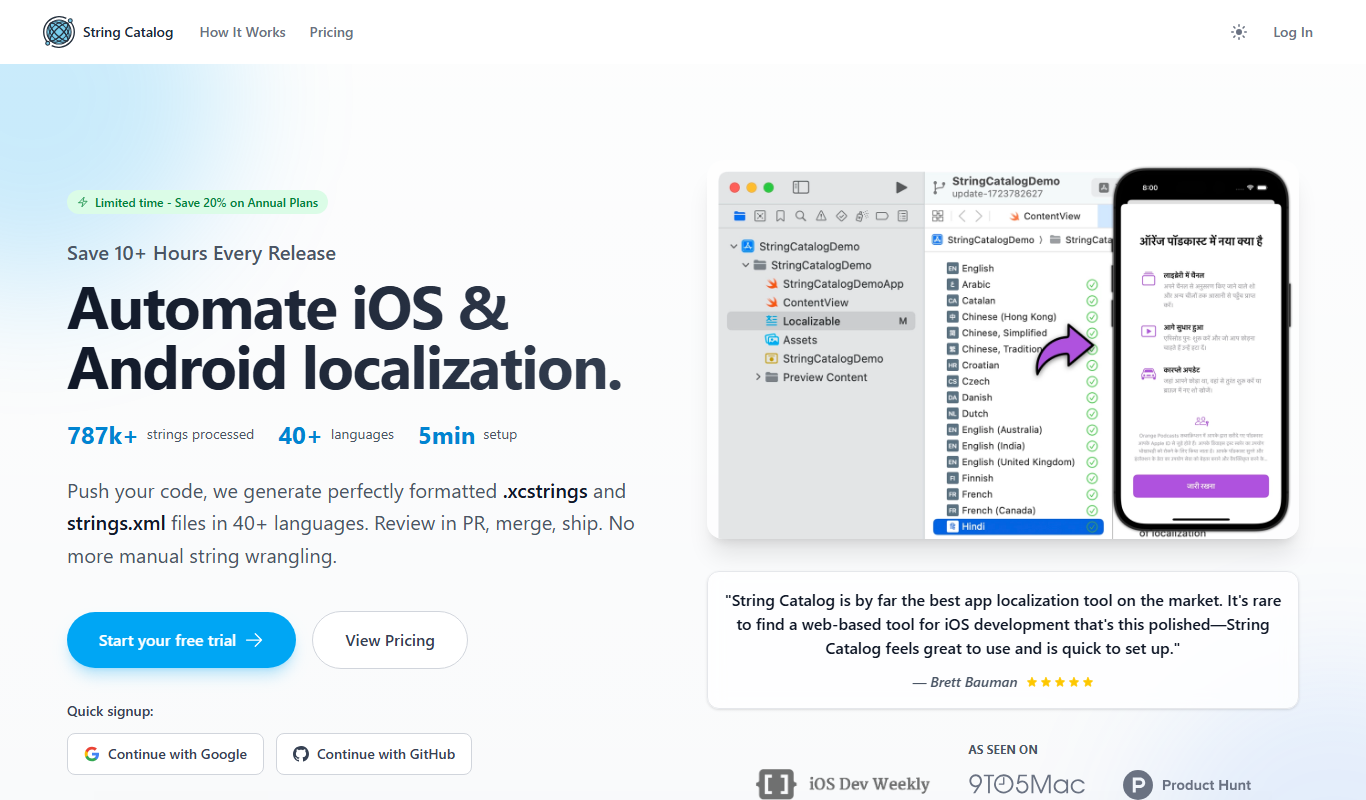
String Catalog
String Catalog is a web platform that centralizes software string management and streamlines localization workflows by enabling collaboration between developers and translators, automating translation processes, and ensuring quality control.