

Illuminance Converter
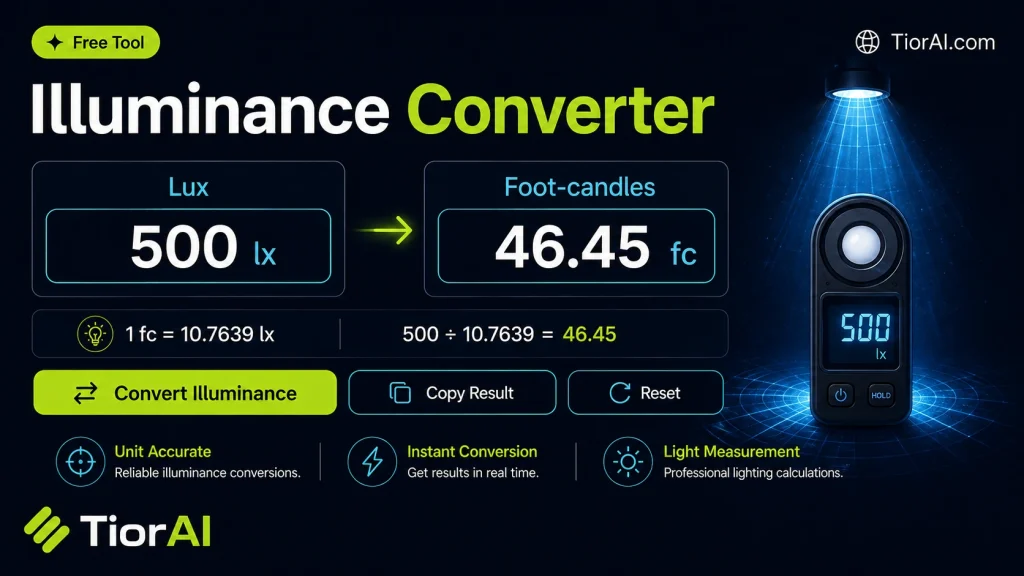
Illuminance quantifies how much light hits a surface, measured in units like lux and foot-candle. These units help professionals understand and control lighting conditions for safety, comfort, and functionality. Since different fields and regions use different units, converting between them is essential for consistency. When…
How to use it
- Enter Your Input Value Type or paste the value you want to convert into the input field. The tool accepts any numeric value.
- Select Units and Convert Choose your source and target units from the dropdown menus. The converted result appears instantly.
- Copy or Use the Result Click copy to grab the converted value for use in your project, document, or calculation.
Tip Chain multiple conversions by copying the output and pasting it as the next input - works seamlessly.
Understanding Illuminance and Its Measurement
Illuminance measures the amount of light incident on a surface per unit area. It quantifies how brightly a surface is lit and is expressed in units such as lux (lx) and foot-candle (fc). Lux is the SI unit, defined as one lumen per square meter, while foot-candle is an imperial unit, defined as one lumen per square foot.
Converting between illuminance units is essential because different industries and regions use different standards. For example, architects and lighting designers often use lux, while photographers and some engineers may prefer foot-candles. Accurate conversion ensures consistent lighting specifications across projects and helps maintain proper illumination levels for safety, comfort, and functionality.
Common situations requiring illuminance conversion include:
- Designing lighting layouts for buildings or outdoor spaces where standards specify illuminance in a particular unit.
- Calibrating light meters or sensors that report readings in one unit but need to be interpreted in another.
- Photography and cinematography, where precise lighting control is critical and units may vary by equipment or region.
Understanding the relationship between these units and converting accurately helps professionals maintain consistent lighting quality and comply with regulations.
What is Illuminance and Why Convert It?
Illuminance quantifies how much light hits a surface, measured in units like lux and foot-candle. These units help professionals understand and control lighting conditions for safety, comfort, and functionality. Since different fields and regions use different units, converting between them is essential for consistency.
When to Use an Illuminance Converter
- Designing lighting systems where specifications are given in different units.
- Calibrating light meters that report in one unit but require interpretation in another.
- Ensuring consistent lighting in photography and cinematography across equipment and regions.
- Comparing lighting data from international sources.
Common Mistakes to Avoid
- Mixing up illuminance with related but distinct concepts like luminous intensity or luminance.
- Using rough conversion factors that reduce accuracy, especially in professional contexts.
Understanding illuminance and converting it correctly helps maintain proper lighting standards and improves communication across industries and regions.
Frequently asked questions
Reviews and questions
Whether this tool gave people the answer they needed, and what they asked about it.
Sign in to review this tool.
Sign In to ReviewNo reviews yet
Be the first to say whether this tool gave you what you needed.
Ask how to read the result, or what the tool does with an edge case — or answer someone else.
Sign In to AskNo questions yet
Not sure how to read a result? Be the first to ask.
AI tools related to this topic
Tools from the TiorAI directory that work on the same kind of job.

Wolfram Alpha
Wolfram Alpha is a computational knowledge engine that answers factual queries by performing computations on curated data, offering detailed solutions, visualizations, and an API for developers.

ChatGPT
ChatGPT is an AI chatbot by OpenAI powered by GPT-4o. It handles writing, coding, research, data analysis, and natural conversation. Free tier available, Plus at $20/month.