

Frequency to Wavelength Converter
Frequency and wavelength describe different aspects of wave behavior. Frequency measures how many wave cycles occur per second, while wavelength measures the physical length of one cycle. These two are connected by the wave speed, which for electromagnetic waves in vacuum is the speed of…
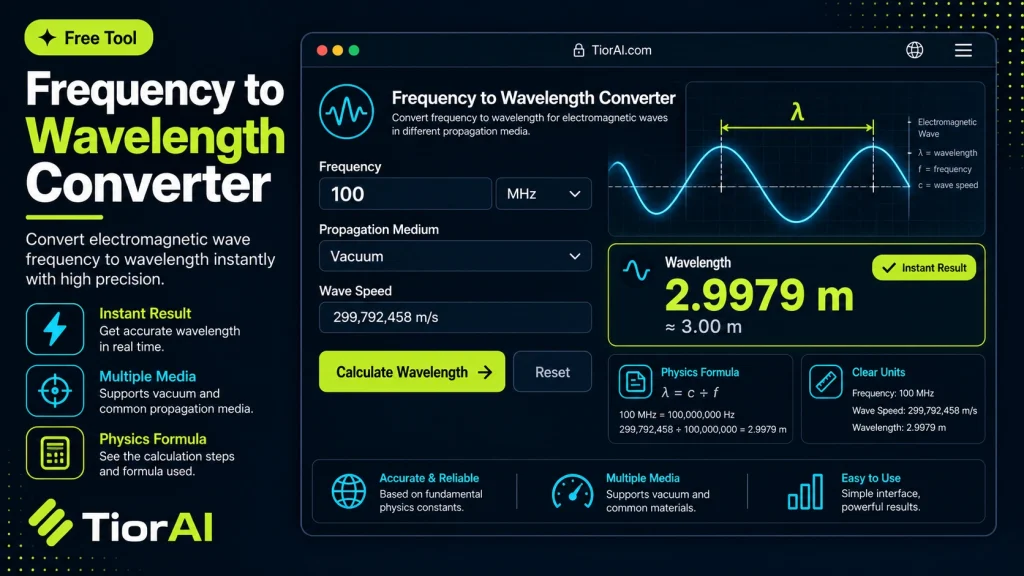
Formula: λ = c / f
Result: -
How to use it
- Paste or Enter Your Input Paste your code, text, or data into the input field. The tool supports large inputs without performance issues.
- Process and Analyze Click the action button or let the tool auto-process your input. Results appear in real time with highlighted details.
- Copy or Download the Output Review the results and copy the output to clipboard or download as a file for use in your project.
Tip For large inputs, process in sections to validate intermediate results and catch errors early.
Understanding Frequency and Wavelength
Frequency and wavelength are fundamental properties of waves, including electromagnetic waves like light and radio signals. Frequency refers to how many wave cycles pass a point per second, measured in hertz (Hz). Wavelength is the physical length of one cycle of the wave, typically measured in meters (m).
These two properties are inversely related through the wave speed equation: wavelength = speed / frequency. For electromagnetic waves in a vacuum, the speed is the speed of light (~299,792,458 meters per second). This relationship means that as frequency increases, wavelength decreases, and vice versa.
Converting frequency to wavelength is essential in many fields such as telecommunications, physics, and engineering. For example, radio engineers use this conversion to design antennas tuned to specific frequencies. Physicists convert frequencies of light waves to wavelengths to understand their color or energy. Understanding this conversion helps in analyzing wave behavior and designing systems that rely on wave propagation.
Common units for frequency include hertz (Hz), kilohertz (kHz), megahertz (MHz), and gigahertz (GHz). Wavelengths can range from kilometers in radio waves to nanometers in visible light. Accurate conversion requires consistent units and knowledge of the wave speed in the medium.
What is Frequency to Wavelength Conversion?
Frequency and wavelength describe different aspects of wave behavior. Frequency measures how many wave cycles occur per second, while wavelength measures the physical length of one cycle. These two are connected by the wave speed, which for electromagnetic waves in vacuum is the speed of light.
Converting frequency to wavelength is important in fields like radio communications, optics, and physics. For example, antenna design depends on wavelength to determine size and shape, while understanding light wavelengths helps in color analysis.
When to Use a Frequency to Wavelength Converter
- Designing antennas or radio frequency equipment where wavelength determines physical dimensions.
- Calculating the wavelength of light or other electromagnetic waves for scientific study.
- Analyzing signal properties in telecommunications and signal processing.
- Educational purposes to understand wave relationships and properties.
Common Mistakes to Avoid
- Mixing units, such as inputting frequency in MHz but expecting wavelength in meters without proper conversion.
- Using the speed of light for waves traveling through other media without adjusting for the actual wave speed.
Understanding the relationship between frequency and wavelength helps in practical applications and theoretical studies involving waves. This converter simplifies the calculation by applying the fundamental formula, ensuring accurate and quick results when used correctly.
Frequently asked questions
Reviews and questions
Whether this tool gave people the answer they needed, and what they asked about it.
Sign in to review this tool.
Sign In to ReviewNo reviews yet
Be the first to say whether this tool gave you what you needed.
Ask how to read the result, or what the tool does with an edge case — or answer someone else.
Sign In to AskNo questions yet
Not sure how to read a result? Be the first to ask.
AI tools related to this topic
Tools from the TiorAI directory that work on the same kind of job.

ChatGPT
ChatGPT is an AI chatbot by OpenAI powered by GPT-4o. It handles writing, coding, research, data analysis, and natural conversation. Free tier available, Plus at $20/month.