

Fibonacci Calculator
The Fibonacci sequence is a series of numbers where each number is the sum of the two preceding numbers, starting with 0 and 1. This sequence is fundamental in mathematics and appears in various natural patterns, such as flower petals and shell spirals. When to…
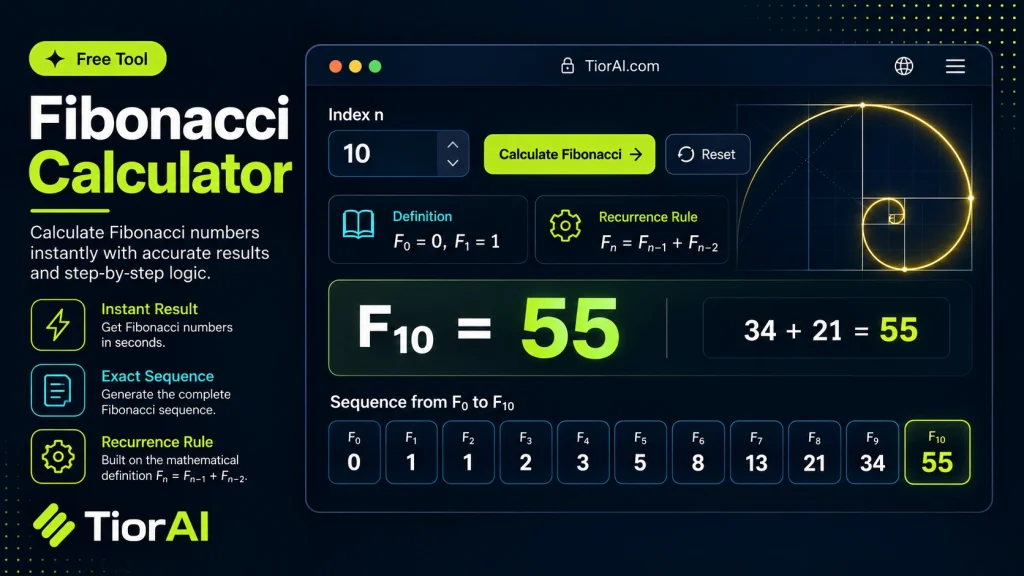
How to use it
- Enter Your Values Input your numbers or parameters into the Fibonacci Calculator. Fill in all required fields for an accurate calculation.
- Calculate Results Click the calculate button to process your inputs. The Fibonacci Calculator delivers instant, accurate results.
- Review and Use Review your calculated results, explore the breakdown, and copy or share the output for your needs.
Tip Bookmark the Fibonacci Calculator page for quick access whenever you need to run calculations on the go.
Understanding the Fibonacci Sequence
The Fibonacci sequence is a series of numbers where each number is the sum of the two preceding ones, usually starting with 0 and 1. Mathematically, it is defined as F(n) = F(n-1) + F(n-2) with initial values F(0) = 0 and F(1) = 1. This sequence appears in various natural phenomena, such as the arrangement of leaves on a stem, branching in trees, and the pattern of pine cones.
Calculating Fibonacci numbers manually can become tedious as the sequence grows rapidly. A Fibonacci calculator automates this process, providing quick and accurate results for any position in the sequence. This is especially useful in fields like computer science, mathematics, and finance, where Fibonacci numbers are applied in algorithms, data structures, and technical analysis.
Why use a Fibonacci calculator?
- To efficiently compute large Fibonacci numbers without manual calculation errors.
- To explore mathematical properties and patterns within the sequence.
- To support learning and teaching of recursive sequences and algorithmic thinking.
What is the Fibonacci Sequence?
The Fibonacci sequence is a series of numbers where each number is the sum of the two preceding numbers, starting with 0 and 1. This sequence is fundamental in mathematics and appears in various natural patterns, such as flower petals and shell spirals.
When to Use a Fibonacci Calculator
Use a Fibonacci calculator when you need to quickly find the value of the nth Fibonacci number without manual computation. This is especially helpful in educational settings, algorithm development, or analyzing patterns in nature and finance.
Common Mistakes to Avoid
- Inputting negative or non-integer values, which are not valid for the standard Fibonacci sequence.
- Assuming the sequence always starts with 1 and 1; some definitions start with 0 and 1, affecting results.
Technical Context
Calculating Fibonacci numbers can be done using recursive formulas, iterative loops, or closed-form expressions like Binet’s formula. Online calculators use optimized algorithms to provide instant and accurate results, even for large positions in the sequence, which would be impractical to compute by hand.
Frequently asked questions
Reviews and questions
Whether this tool gave people the answer they needed, and what they asked about it.
Sign in to review this tool.
Sign In to ReviewNo reviews yet
Be the first to say whether this tool gave you what you needed.
Ask how to read the result, or what the tool does with an edge case — or answer someone else.
Sign In to AskNo questions yet
Not sure how to read a result? Be the first to ask.