

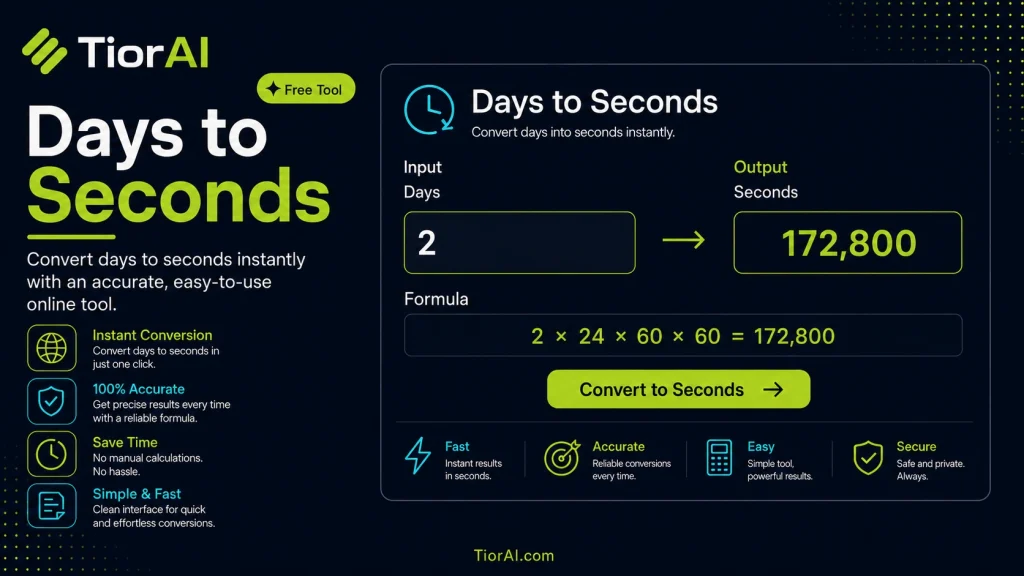
Formula: seconds = days × 86400
How to use it
- Enter Source Value Type or paste the value you want to convert into the Days to Seconds. The tool accepts a wide range of input formats.
- Select Target Format Choose your desired output format or unit from the available options. The conversion starts automatically.
- Copy the Result Review the converted output and click copy to use it in your project, document, or workflow.
Tip Paste large blocks of content into the Days to Seconds — there's no size limit on input for most conversions.
Understanding Time Unit Conversion: Days to Seconds
Time measurement is fundamental in many fields such as science, engineering, programming, and everyday life. Converting between different units of time allows for precise calculations and comparisons. One common conversion is from days to seconds. Since days represent a larger time unit and seconds a smaller one, this conversion helps in contexts where fine-grained time measurement is necessary.
The conversion is based on the fixed relationship between these units: 1 day equals 24 hours, 1 hour equals 60 minutes, and 1 minute equals 60 seconds. Multiplying these together gives the total seconds in a day:
- 1 day = 24 hours
- 1 hour = 60 minutes
- 1 minute = 60 seconds
- Therefore, 1 day = 24 × 60 × 60 = 86,400 seconds
This conversion is essential in many practical scenarios. For example, in programming, durations are often handled in seconds for precision and compatibility with system clocks. Scientists may convert days to seconds when measuring time intervals in experiments. Project managers might need to convert days into seconds to calculate deadlines or elapsed time in automated systems.
Overall, converting days to seconds is a straightforward but crucial operation that bridges human-friendly time units with machine-level precision.
Understanding Days to Seconds Conversion
Converting days to seconds is a fundamental time conversion used in many technical and practical applications. Since one day consists of 24 hours, each hour has 60 minutes, and each minute has 60 seconds, the total number of seconds in a day is 86,400. This conversion allows you to express longer durations in a smaller, more precise unit.
This conversion is especially useful in programming, scientific calculations, and project management where time intervals need to be handled with precision. For example, when setting timers or calculating elapsed time in software, seconds are often the required unit.
When to Use This Conversion
- Programming time intervals that require seconds as input.
- Calculating precise durations in experiments or simulations.
- Converting project timelines into seconds for automated tracking.
- Estimating elapsed time when only days are known.
- Preparing data for systems that accept time values exclusively in seconds.
Common Mistakes to Avoid
- Not multiplying all components correctly, leading to wrong total seconds.
- Confusing calendar days with exact 24-hour periods, especially around daylight saving time changes.
- Using approximate values instead of the exact 86,400 seconds per day.
Understanding these points ensures accurate and reliable time conversions for your needs.
Frequently asked questions
Reviews and questions
Whether this tool gave people the answer they needed, and what they asked about it.
Sign in to review this tool.
Sign In to ReviewNo reviews yet
Be the first to say whether this tool gave you what you needed.
Ask how to read the result, or what the tool does with an edge case — or answer someone else.
Sign In to AskNo questions yet
Not sure how to read a result? Be the first to ask.
AI tools related to this topic
Tools from the TiorAI directory that work on the same kind of job.

Any Video Converter
Any Video Converter is a multimedia software that converts video files between numerous formats, downloads online videos, and offers basic editing and DVD burning features.

Bank Statement Converter
Bank Statement Converter is an online tool that converts PDF bank statements into Excel and CSV formats, enabling easy data extraction and financial management.

Code Language Converter
Code Language Converter is a free web-based tool that translates code snippets between multiple programming languages, helping developers convert syntax quickly and learn language differences.