

Cylinder Calculator
Understanding Cylinder Calculations A cylinder is a common 3D shape characterized by two parallel circular bases connected by a curved surface. Calculating its volume and surface area is fundamental in many practical applications such as designing containers, pipes, and mechanical parts. The volume tells you…
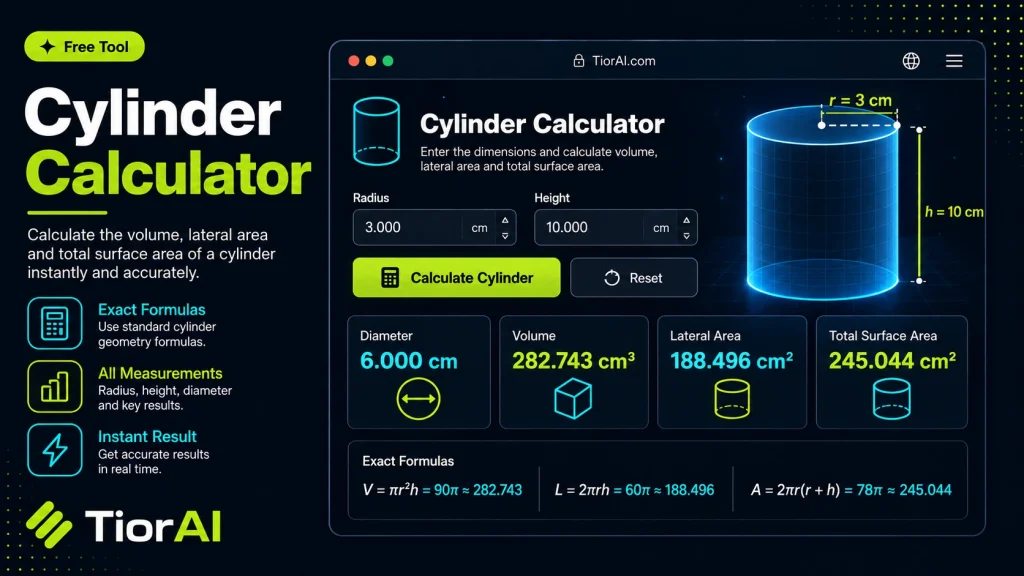
Cylinder Calculator
Calculate cylinder properties including volume and surface area. Enter the radius and height to compute all values.
Results
Formulas Used
V = πr²h— Volume of a cylinderL = 2πrh— Lateral surface areaB = πr²— Base area (one end)T = L + 2B = 2πr(h + r)— Total surface areaC = 2πr— Base circumferenced = 2r— Diameter
How to use it
- Enter Your Values Input your numbers or parameters into the Cylinder Calculator. Fill in all required fields for an accurate calculation.
- Calculate Results Click the calculate button to process your inputs. The Cylinder Calculator delivers instant, accurate results.
- Review and Use Review your calculated results, explore the breakdown, and copy or share the output for your needs.
Tip Run the Cylinder Calculator multiple times with edge-case values to stress-test your assumptions before committing.
Understanding Cylinders and Their Measurements
A cylinder is a three-dimensional geometric shape with two parallel circular bases connected by a curved surface. Calculating properties like volume and surface area is essential in fields such as engineering, manufacturing, and construction. These calculations help determine material requirements, capacity, and structural dimensions.
Volume measures the amount of space inside the cylinder and is calculated using the formula V = πr²h, where r is the radius of the base and h is the height. This is useful when you need to know how much liquid a cylindrical container can hold or the capacity of a pipe.
Surface area is the total area covering the outside of the cylinder, including the two circular bases and the curved side. The formula is A = 2πr(h + r). This is important for determining the amount of material needed to cover or paint the cylinder.
People commonly use cylinder calculations in manufacturing tanks, designing mechanical parts, or solving math problems involving cylindrical shapes. Using a cylinder calculator automates these computations, reducing errors and saving time.
Understanding Cylinder Calculations
A cylinder is a common 3D shape characterized by two parallel circular bases connected by a curved surface. Calculating its volume and surface area is fundamental in many practical applications such as designing containers, pipes, and mechanical parts.
The volume tells you how much space is inside the cylinder, calculated by multiplying the base area (π times radius squared) by the height. Surface area measures the total exterior surface, including the two bases and the curved side, which is important for tasks like painting or material estimation.
When to Use a Cylinder Calculator
- When you need to quickly determine the volume or surface area of a standard right circular cylinder.
- During design or manufacturing processes involving cylindrical objects.
- For educational purposes, such as solving geometry problems or learning about 3D shapes.
- When estimating materials required for coating or wrapping cylindrical surfaces.
Common Mistakes to Avoid
- Entering the diameter instead of the radius, which leads to incorrect calculations.
- Using the calculator for irregular or tapered cylinders, which have different formulas.
- Mixing units for radius and height, causing unit inconsistency and wrong results.
Using a cylinder calculator simplifies these computations, ensuring accuracy and saving time compared to manual calculations.
Frequently asked questions
Reviews and questions
Whether this tool gave people the answer they needed, and what they asked about it.
Sign in to review this tool.
Sign In to ReviewNo reviews yet
Be the first to say whether this tool gave you what you needed.
Ask how to read the result, or what the tool does with an edge case — or answer someone else.
Sign In to AskNo questions yet
Not sure how to read a result? Be the first to ask.