

Text to HTML Entities Converter
Convert text characters to HTML entities and decode HTML entities back to text.
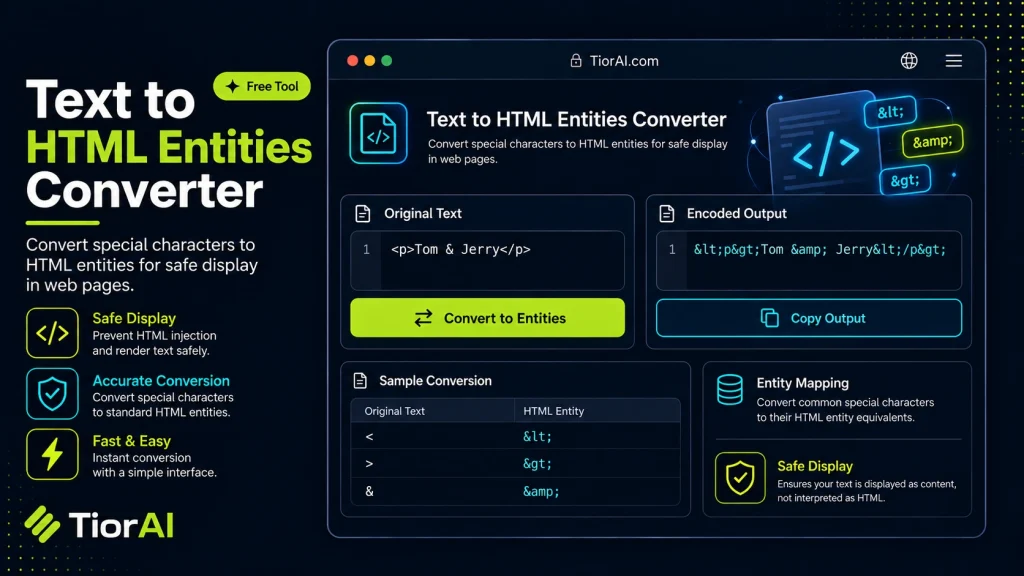
How to use it
- Enter Source Value Type or paste the value you want to convert into the Text to Html Entities Converter. The tool accepts a wide range of input formats.
- Select Target Format Choose your desired output format or unit from the available options. The conversion starts automatically.
- Copy the Result Review the converted output and click copy to use it in your project, document, or workflow.
Tip The Text to Html Entities Converter preserves formatting and structure during conversion, so your output stays clean and usable.
Understanding HTML Entities
HTML entities are a way to represent special characters in HTML documents that either have a reserved meaning in HTML syntax or are not easily typed on a keyboard. They exist because certain characters, like < (less than), > (greater than), and & (ampersand), have specific functions in HTML code. If these characters appear directly in the content, browsers might interpret them as part of the HTML structure rather than as text to display.
To avoid this confusion, HTML entities encode these characters into a format that browsers recognize as literal text. An HTML entity typically starts with an ampersand &, followed by an entity name or a numeric code, and ends with a semicolon ;. For example, the less-than sign is represented as < or <.
Why HTML Entities Exist
- Preventing HTML Parsing Errors: Characters like
<and>define tags in HTML. Using them directly in text can break the document structure. - Displaying Reserved Characters: Some characters have special meanings in HTML and need to be escaped to show them literally.
- Supporting International Characters: Numeric entities allow representing characters from various languages and symbol sets that might not be supported by the document’s character encoding.
How HTML Entities Work Technically
When a browser parses an HTML document, it scans for entities starting with & and ending with ;. It then converts these entities into their corresponding characters before rendering the content. For example, © is rendered as ©, and © is the numeric equivalent.
There are two main types of HTML entities:
- Named Entities: These use a predefined name, such as
for a non-breaking space or"for a double quote. - Numeric Entities: These use the character’s Unicode code point, either in decimal (e.g.,
") or hexadecimal (e.g.,").
Common Real-World Scenarios
- Embedding Code Snippets: When displaying HTML, JavaScript, or other code on a webpage, entities prevent the browser from interpreting code as actual markup.
- Handling User Input: User-generated content often contains characters that need escaping to avoid breaking page layout or causing security issues like cross-site scripting (XSS).
- Internationalization: Entities allow consistent display of special characters across different browsers and encodings.
- Email and URL Encoding: Entities help represent reserved characters safely in HTML emails or links.
What Are HTML Entities?
HTML entities are special codes used in HTML documents to represent characters that either have a reserved meaning in HTML or are difficult to type directly. For example, characters like the less-than sign (<) and ampersand (&) are part of HTML syntax, so if you want to display them as text, you need to use their entity equivalents (< and & respectively).
These entities start with an ampersand (&), followed by a name or a numeric code, and end with a semicolon (;). Browsers interpret these entities and render the corresponding characters on the page.
Why Use HTML Entities?
Using HTML entities is essential to prevent browsers from confusing content with code. For example, if you include a less-than sign directly in your HTML, the browser might think you are starting a tag. Encoding it as < tells the browser to display the character instead.
Entities also help with internationalization by allowing you to represent characters from different languages and symbol sets consistently, regardless of the document’s encoding.
When to Use a Text to HTML Entities Converter
- Displaying Code Snippets: When you want to show HTML or other code on a webpage without it being executed or rendered.
- Sanitizing User Input: To prevent security issues like cross-site scripting (XSS), user input containing special characters should be encoded before being inserted into HTML.
- Preparing Content for HTML: When your text includes characters that could break HTML structure or cause display issues.
- Ensuring Compatibility: When working with legacy systems or browsers that require numeric entity encoding.
Common Mistakes to Avoid
- Double Encoding: Encoding text that is already encoded can lead to entities being displayed literally, such as
&instead of&. - Missing Necessary Encoding: Failing to encode special characters can break your HTML or introduce security vulnerabilities.
- Using Incorrect Entity Names: Not all entity names are supported universally, so using invalid or unsupported names can cause rendering issues.
Technical Context
HTML entities are part of the HTML specification and are supported by all modern browsers. They provide a standardized way to represent characters that otherwise would interfere with HTML parsing. Named entities are easier to read and remember, but numeric entities are more universal and can represent any Unicode character.
When converting text to HTML entities, the process involves scanning the text for characters that need encoding and replacing them with their corresponding entity codes. This ensures that when the HTML is rendered, the intended characters appear correctly without affecting the document structure.
Worked examples
Displaying HTML code in a tutorial
When showing HTML examples on a webpage without the browser rendering the tags.
Before <div>Hello World</div>After <div>Hello World</div>Encoding user input for safe display
When displaying user-submitted text that contains comparison operators and ampersands.
Before 5 > 3 & 2 < 4After 5 > 3 & 2 < 4Representing non-ASCII characters
When including copyright symbols or other special characters in HTML content.
Before © 2024 CompanyAfter © 2024 Company
Frequently asked questions
Reviews and questions
Whether this tool gave people the answer they needed, and what they asked about it.
Sign in to review this tool.
Sign In to ReviewNo reviews yet
Be the first to say whether this tool gave you what you needed.
Ask how to read the result, or what the tool does with an edge case — or answer someone else.
Sign In to AskNo questions yet
Not sure how to read a result? Be the first to ask.
AI tools related to this topic
Tools from the TiorAI directory that work on the same kind of job.

Code Language Converter
Code Language Converter is a free web-based tool that translates code snippets between multiple programming languages, helping developers convert syntax quickly and learn language differences.

Any Video Converter
Any Video Converter is a multimedia software that converts video files between numerous formats, downloads online videos, and offers basic editing and DVD burning features.

Bank Statement Converter
Bank Statement Converter is an online tool that converts PDF bank statements into Excel and CSV formats, enabling easy data extraction and financial management.

HD Photo Converter
HD Photo Converter is a free online tool that allows users to convert images between popular formats like JPG, PNG, BMP, and TIFF while maintaining high quality. It supports batch conversion and requires no installation.
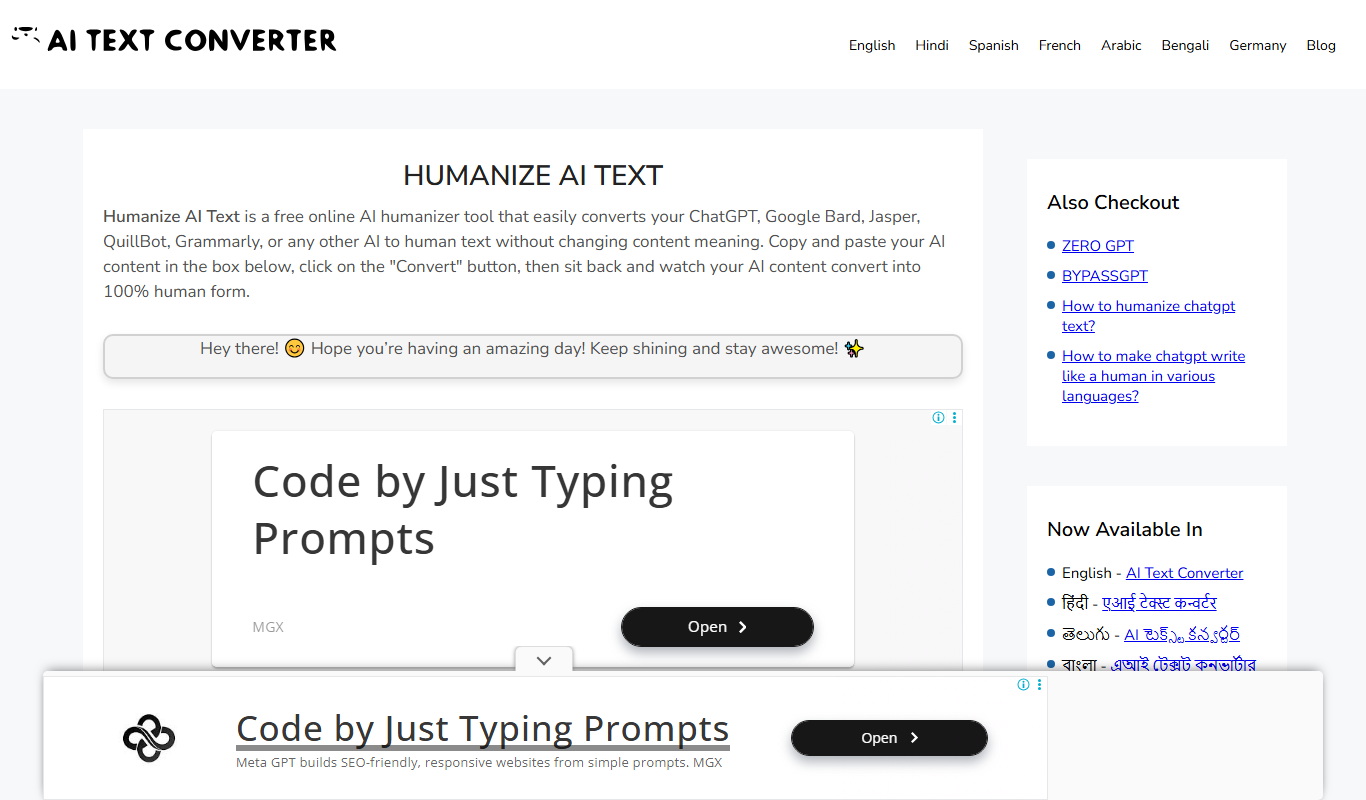
Humanize AI Text Converter
Humanize AI Text Converter is a web tool that rewrites AI-generated text to make it sound more natural and human-like, improving readability and engagement.