

Celsius to Kelvin
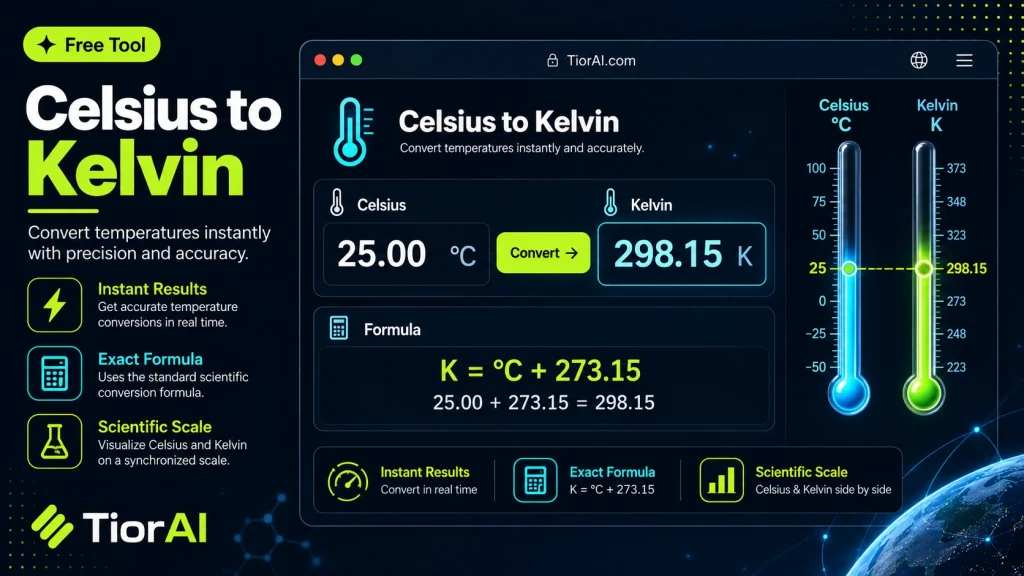
Convert temperatures between Celsius and Kelvin. Formula: K = °C + 273.15
Conversion Formulas
- Celsius to Kelvin
K = °C + 273.15- Kelvin to Celsius
°C = K − 273.15
Absolute zero is 0 Kelvin (-273.15 Celsius). Use Swap to switch the conversion direction.
How to use it
- Enter Source Value Type or paste the value you want to convert into the Celsius to Kelvin. The tool accepts a wide range of input formats.
- Select Target Format Choose your desired output format or unit from the available options. The conversion starts automatically.
- Copy the Result Review the converted output and click copy to use it in your project, document, or workflow.
Tip Switch between source and target formats in the Celsius to Kelvin to quickly verify conversions in both directions.
About Celsius to Kelvin
Temperature conversion between Celsius and Kelvin is a fundamental process in science and engineering. The Celsius scale is commonly used in everyday life and many scientific contexts, while the Kelvin scale is the SI unit for temperature measurement, especially in physics and chemistry.
Why convert Celsius to Kelvin? The Kelvin scale starts at absolute zero, the theoretical point where all molecular motion ceases, defined as 0 K. Unlike Celsius, Kelvin does not use degrees and only has positive values, making it essential for calculations involving thermodynamics, gas laws, and other scientific formulas.
How the conversion works
The conversion between Celsius and Kelvin is straightforward because both scales have the same incremental size. The only difference is their zero points. To convert Celsius to Kelvin, you add 273.15 to the Celsius temperature:
K = °C + 273.15
This formula ensures that 0 °C corresponds to 273.15 K, the freezing point of water.
Common uses of Celsius to Kelvin conversion
- Scientific research requiring absolute temperature values
- Engineering calculations involving heat and energy transfer
- Educational purposes in physics and chemistry classes
- Calibration of instruments that measure temperature in Kelvin
Understanding Celsius to Kelvin Conversion
Converting temperatures from Celsius to Kelvin is essential in many scientific and engineering fields. Both scales measure temperature, but Kelvin is an absolute scale starting at absolute zero, the point where molecular motion stops. This makes Kelvin the preferred unit in physics and chemistry.
The conversion is simple because the size of one degree is the same in both scales. You just add 273.15 to the Celsius temperature to get the Kelvin value. For example, 25 °C equals 298.15 K.
When to Use This Conversion
- In scientific experiments requiring absolute temperature values.
- When applying gas laws or thermodynamic formulas that require Kelvin.
- For converting weather data from Celsius to Kelvin for scientific analysis.
- When calibrating instruments that measure temperature in Kelvin.
Common Mistakes to Avoid
- Adding 273 instead of 273.15, which reduces accuracy.
- Using Celsius values directly in formulas that require Kelvin.
- Subtracting 273.15 instead of adding it when converting Celsius to Kelvin.
Understanding these points ensures accurate temperature conversions and reliable results in scientific and technical work.
Frequently asked questions
Reviews and questions
Whether this tool gave people the answer they needed, and what they asked about it.
Sign in to review this tool.
Sign In to ReviewNo reviews yet
Be the first to say whether this tool gave you what you needed.
Ask how to read the result, or what the tool does with an edge case — or answer someone else.
Sign In to AskNo questions yet
Not sure how to read a result? Be the first to ask.