

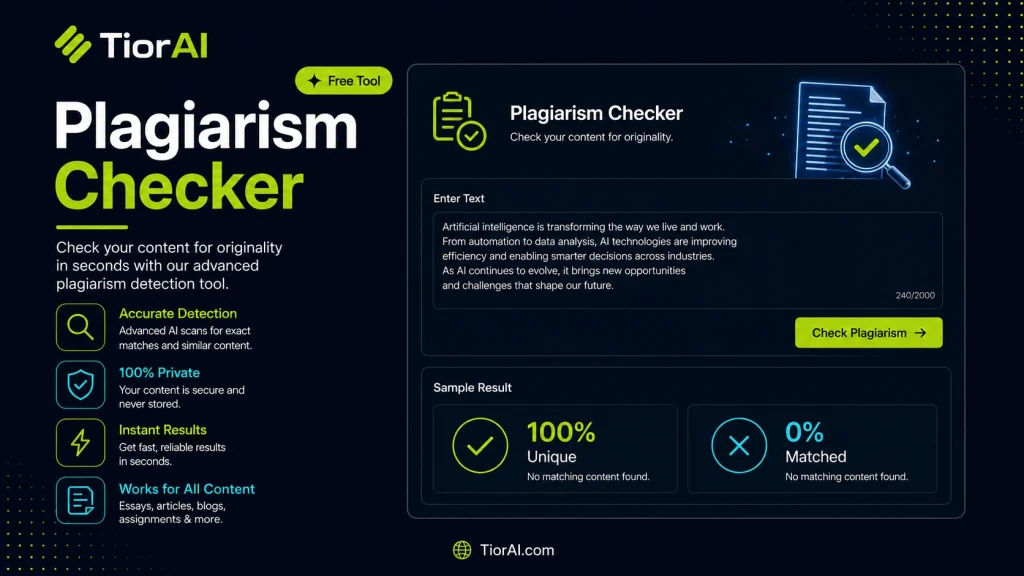
Plagiarism Checker
Content Statistics
Uniqueness Indicators
Disclaimer
This is a basic text analysis tool that evaluates vocabulary diversity, readability and phrase repetition. It does not compare your text against web sources or databases. For comprehensive plagiarism detection, use a dedicated service such as Copyscape, Turnitin or Grammarly.
How to use it
- Enter URL or Keyword Enter your website URL or target keyword into the Plagiarism Checker to begin the analysis process.
- Run the Analysis Click analyze to scan your input. The tool examines multiple SEO factors and compiles the results.
- Review Your Report Examine the detailed report with actionable insights, scores, and recommendations to improve your SEO.
Tip The Plagiarism Checker highlights quick-win opportunities — focus on high-impact, low-effort fixes first.
Understanding Plagiarism Detection Technology
Plagiarism checkers are software tools designed to identify instances of copied or unoriginal content within a text. They work by scanning the submitted content and comparing it against a vast database of existing sources, including web pages, academic papers, and previously submitted documents. The goal is to detect similarities that may indicate plagiarism, whether intentional or accidental.
Why is plagiarism detection important? In academic, professional, and online publishing contexts, originality is critical. Plagiarism can lead to legal issues, damage reputations, and negatively impact search engine rankings. Detecting copied content helps maintain integrity and ensures that creators receive proper credit for their work.
How do plagiarism checkers operate? Most tools use algorithms that break down the text into smaller segments or phrases and then perform pattern matching against indexed content. Advanced checkers use natural language processing to identify paraphrased or slightly altered content, not just exact matches.
Common use cases include:
- Academic institutions verifying student submissions.
- Content creators ensuring originality before publishing.
- SEO professionals checking website content to avoid duplicate content penalties.
- Editors and publishers validating manuscripts.
What Is a Plagiarism Checker?
A plagiarism checker is a utility that scans text to identify copied or unoriginal content by comparing it against a large database of sources. It helps maintain content integrity by detecting similarities that could indicate plagiarism.
When to Use a Plagiarism Checker
- Before publishing website content to ensure originality and avoid SEO penalties.
- When submitting academic papers to confirm proper citation and prevent unintentional plagiarism.
- During content creation to verify that references or research materials have not been copied verbatim.
- To audit existing content for duplicate text that may harm search rankings or credibility.
Common Mistakes to Avoid
- Relying on a single plagiarism checker without cross-checking results can miss some copied content.
- Misunderstanding similarity scores as definitive proof of plagiarism without reviewing context.
- Submitting content with complex formatting or embedded code that can interfere with accurate scanning.
Technical Context
Plagiarism detection tools use algorithms to break down text into smaller units and compare them against indexed content from the web and academic databases. Advanced tools incorporate natural language processing to detect paraphrased content, but no tool guarantees 100% accuracy. Combining automated checks with manual review is the best practice for thorough plagiarism detection.
Frequently asked questions
Reviews and questions
Whether this tool gave people the answer they needed, and what they asked about it.
Sign in to review this tool.
Sign In to ReviewNo reviews yet
Be the first to say whether this tool gave you what you needed.
Ask how to read the result, or what the tool does with an edge case — or answer someone else.
Sign In to AskNo questions yet
Not sure how to read a result? Be the first to ask.
AI tools related to this topic
Tools from the TiorAI directory that work on the same kind of job.

AI Detector & Plagiarism Scan
AI Detector & Plagiarism Scan is a web tool that identifies AI-generated text and checks for plagiarism to ensure content originality.

CopyFind – Plagiarism and AI Detector
CopyFind is an AI-powered tool that detects plagiarism and AI-generated text to ensure content originality.

Free AI Content Detector
Free AI Content Detector by Leap AI is a web-based tool that analyzes text to determine the likelihood it was generated by AI, helping users verify content authenticity quickly and for free.

SEO Content AI
SEO Content AI is a web platform that uses artificial intelligence to generate and optimize SEO-friendly content, integrating keyword research to help improve search engine rankings.