

SCSS to CSS Converter
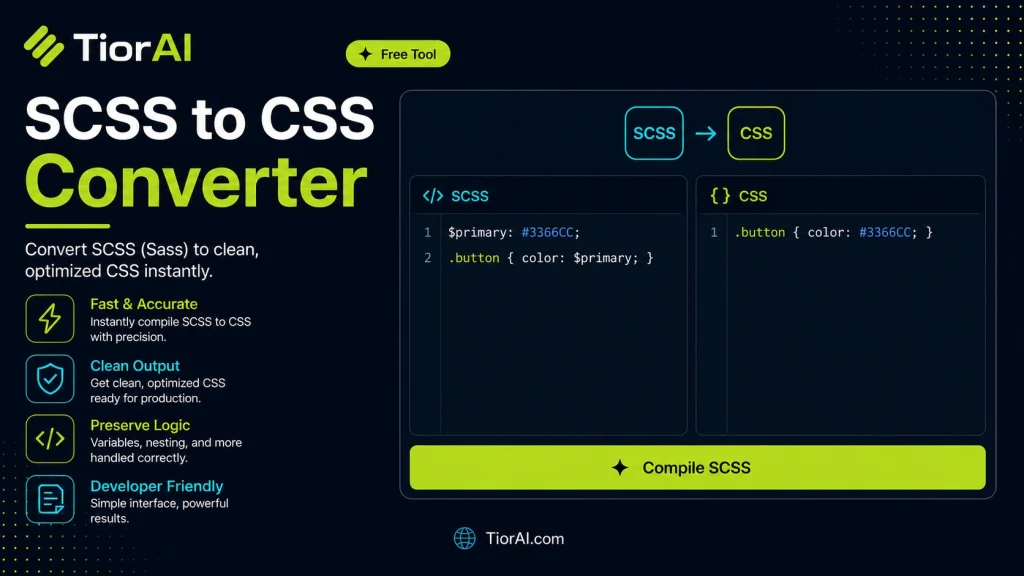
Convert simple SCSS to plain CSS. Handles variables, basic nesting, and strips SCSS-only syntax.
How to use it
- Paste or Enter Your Input Paste your code, text, or data into the input field. The tool supports large inputs without performance issues.
- Process and Analyze Click the action button or let the tool auto-process your input. Results appear in real time with highlighted details.
- Copy or Download the Output Review the results and copy the output to clipboard or download as a file for use in your project.
Tip This tool preserves your input formatting. Check format settings if the output differs from expected.
Understanding SCSS and CSS
SCSS (Sassy CSS) is a syntax of Sass, a CSS preprocessor language that extends the capabilities of standard CSS by introducing features like variables, nesting, mixins, inheritance, and functions. These features help developers write more maintainable, reusable, and organized style code.
Standard CSS, defined by the W3C CSS specifications, is the language browsers understand to style HTML documents. However, CSS lacks programming constructs, which can make managing large stylesheets cumbersome.
SCSS to CSS conversion is the process of transforming SCSS code into plain CSS code that browsers can interpret. This compilation resolves all SCSS-specific syntax and features into valid CSS rules.
Why Use SCSS?
- Variables: Store colors, fonts, or sizes once and reuse them.
- Nesting: Write CSS selectors in a nested manner that mirrors HTML structure.
- Mixins and Functions: Reuse groups of CSS declarations or compute values dynamically.
- Inheritance: Share styles between selectors efficiently.
These features reduce repetition and improve code clarity, especially in large projects.
How SCSS to CSS Conversion Works
The SCSS compiler parses the SCSS syntax, processes variables, mixins, and nesting, then outputs standard CSS. This output CSS is what browsers use to apply styles. The conversion can be done via command-line tools like sass, build tools like Webpack, or online converters.
Developers integrate SCSS compilation into their build process to automate CSS generation whenever SCSS files change, ensuring the latest styles are reflected in the deployed site.
Standards and Compatibility
SCSS is not a web standard but a developer tool. The output CSS must comply with CSS standards to work across browsers. The latest CSS specifications evolve independently, but SCSS helps developers write CSS faster and with fewer errors.
What is SCSS and Why Use It?
SCSS is a syntax of Sass, a CSS preprocessor language that adds programming features to CSS. These features include variables, nesting, mixins, and functions, which help developers write cleaner, more maintainable stylesheets. Unlike plain CSS, SCSS allows you to reuse code and organize styles in a way that mirrors your HTML structure.
For example, variables let you define colors or font sizes once and reuse them throughout your stylesheet. Nesting lets you write selectors inside other selectors, reducing repetition and improving readability.
How SCSS to CSS Conversion Works
Browsers do not understand SCSS directly. To use SCSS in a web project, you must convert it to standard CSS. This process is called compilation. A SCSS compiler reads your SCSS files, processes all variables, mixins, and nested rules, and outputs plain CSS files that browsers can interpret.
This conversion can be done using command-line tools, build systems like Webpack or Gulp, or online converters. Automating this step ensures your CSS is always up to date with your SCSS source.
When to Use an SCSS to CSS Converter
- When working on large projects that benefit from modular and reusable styles.
- When you want to maintain consistent design tokens like colors and spacing using variables.
- When collaborating with a team to enforce coding standards and reduce duplication.
- When you need to prototype complex UI components with nested styles.
- When integrating SCSS compilation into your build or deployment process.
Common Mistakes to Avoid
- Writing SCSS code but forgetting to compile it, resulting in browsers receiving raw SCSS that they cannot render.
- Using SCSS features directly in CSS files without conversion, which leads to syntax errors.
- Neglecting to recompile after changes, causing outdated styles to appear on the site.
Understanding the role of SCSS as a preprocessor and the necessity of conversion to CSS is essential for effective front-end development.
Common use cases
- Basic SCSS with Variables and Nesting
- Using Mixins for Reusable Styles
Frequently asked questions
Reviews and questions
Whether this tool gave people the answer they needed, and what they asked about it.
Sign in to review this tool.
Sign In to ReviewNo reviews yet
Be the first to say whether this tool gave you what you needed.
Ask how to read the result, or what the tool does with an edge case — or answer someone else.
Sign In to AskNo questions yet
Not sure how to read a result? Be the first to ask.
AI tools related to this topic
Tools from the TiorAI directory that work on the same kind of job.

ChatGPT
ChatGPT is an AI chatbot by OpenAI powered by GPT-4o. It handles writing, coding, research, data analysis, and natural conversation. Free tier available, Plus at $20/month.