

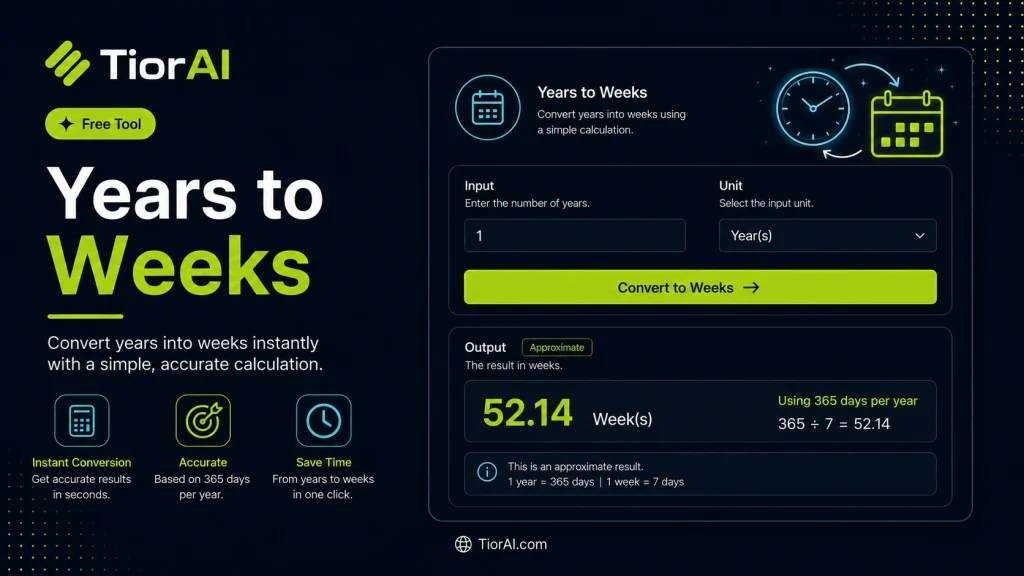
Formula: weeks = years × 365.25 ÷ 7
How to use it
- Enter Your Input Value Type or paste the value you want to convert into the input field. The tool accepts any numeric value.
- Select Units and Convert Choose your source and target units from the dropdown menus. The converted result appears instantly.
- Copy or Use the Result Click copy to grab the converted value for use in your project, document, or calculation.
Tip Chain multiple conversions by copying the output and pasting it as the next input - works seamlessly.
Understanding Time Unit Conversion: Years to Weeks
Converting years to weeks is a common task in date and time calculations, especially when dealing with durations that need to be expressed in smaller time units. A year is a larger unit of time, typically based on the Earth’s orbit around the Sun, while a week is a smaller, standardized unit consisting of 7 days.
This conversion is essential because many applications, such as project planning, age calculations, or financial interest computations, require expressing time intervals in weeks rather than years for greater precision or relevance.
The basic conversion relies on the fact that one year is approximately 52 weeks. More precisely, a common year has 365 days, which equals 52 weeks and 1 day, while a leap year has 366 days. For simplicity, many converters use the average year length of 365.25 days to account for leap years, resulting in about 52.18 weeks per year.
Common situations where converting years to weeks is useful include:
- Calculating the number of weeks in a person’s age for medical or educational purposes.
- Breaking down long-term project timelines into weekly milestones.
- Converting annual interest rates or durations into weekly equivalents for financial analysis.
Understanding Years to Weeks Conversion
Converting years to weeks involves translating a larger time unit (years) into a smaller one (weeks). This is useful when you need more granular time measurements for planning, analysis, or reporting. Since one week equals 7 days and one year is approximately 365.25 days (accounting for leap years), the conversion factor is roughly 52.18 weeks per year.
When to Use a Years to Weeks Converter
- Breaking down long-term durations into weekly segments for project management.
- Calculating weekly averages or rates from annual data.
- Expressing age or experience in weeks for medical or educational records.
- Converting annual financial terms into weekly periods for budgeting or forecasting.
- Ensuring consistent time units when comparing or combining different time spans.
Common Mistakes to Avoid
- Assuming every year has exactly 52 weeks, which ignores leap years and causes minor errors.
- Confusing weeks with other time units like months or days during conversion.
- Using integer math that truncates decimals, reducing accuracy.
Understanding these points helps ensure accurate and meaningful time conversions in your work or personal projects.
Frequently asked questions
Reviews and questions
Whether this tool gave people the answer they needed, and what they asked about it.
Sign in to review this tool.
Sign In to ReviewNo reviews yet
Be the first to say whether this tool gave you what you needed.
Ask how to read the result, or what the tool does with an edge case — or answer someone else.
Sign In to AskNo questions yet
Not sure how to read a result? Be the first to ask.
AI tools related to this topic
Tools from the TiorAI directory that work on the same kind of job.

Wolfram Alpha
Wolfram Alpha is a computational knowledge engine that answers factual queries by performing computations on curated data, offering detailed solutions, visualizations, and an API for developers.

ChatGPT
ChatGPT is an AI chatbot by OpenAI powered by GPT-4o. It handles writing, coding, research, data analysis, and natural conversation. Free tier available, Plus at $20/month.