

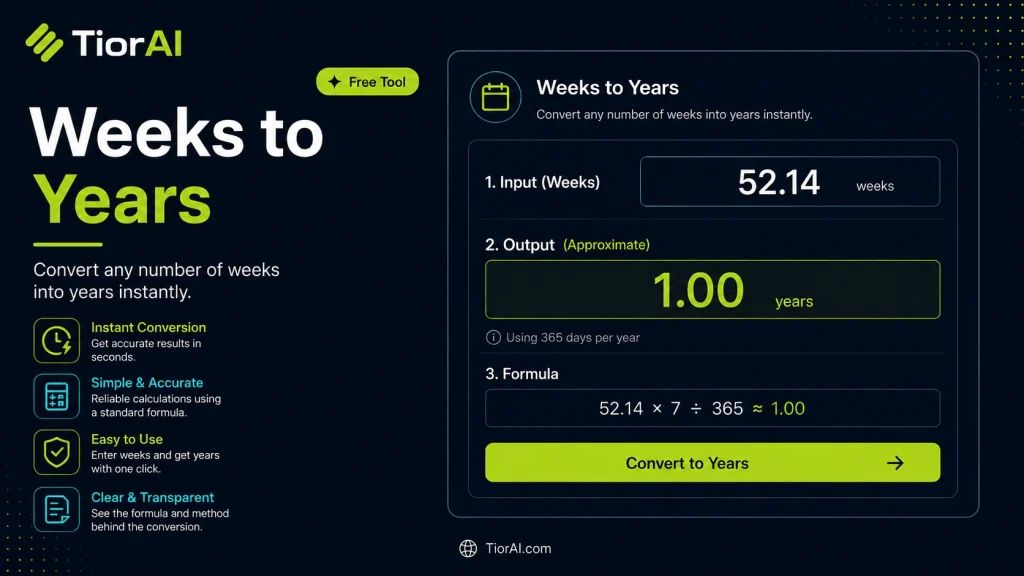
Formula: years = weeks ÷ 52.178571
How to use it
- Enter Your Input Value Type or paste the value you want to convert into the input field. The tool accepts any numeric value.
- Select Units and Convert Choose your source and target units from the dropdown menus. The converted result appears instantly.
- Copy or Use the Result Click copy to grab the converted value for use in your project, document, or calculation.
Tip Chain multiple conversions by copying the output and pasting it as the next input - works seamlessly.
About Weeks to Years
Converting weeks to years is a common time conversion that helps translate a duration expressed in weeks into an equivalent span in years. Since a year is a larger unit of time than a week, this conversion involves dividing the number of weeks by the average number of weeks in a year.
Why is this conversion needed? Many fields such as project management, finance, healthcare, and education require understanding durations in different time units. For example, a project timeline might be given in weeks, but stakeholders often prefer to see it in years for a clearer long-term perspective.
How is the conversion done? The standard approach uses the average number of weeks in a year, which is approximately 52.1429 weeks (365.25 days divided by 7). This accounts for leap years by averaging the extra day every four years.
Common situations where weeks to years conversion is useful:
- Calculating age or experience when given in weeks
- Estimating long-term financial investments or loan durations
- Planning academic or medical treatment schedules
- Converting data for reports that require consistent time units
Understanding Weeks to Years Conversion
Converting weeks to years involves translating a smaller unit of time (weeks) into a larger one (years). This is done by dividing the total weeks by the average number of weeks in a year, approximately 52.1429. This average accounts for leap years, making the conversion more accurate than simply using 52 weeks.
When to Use Weeks to Years Conversion
- When you need to express durations given in weeks as years for clearer communication.
- For financial or project planning that requires yearly timeframes.
- To calculate age or experience from weeks into years in medical or HR contexts.
- When preparing reports that consolidate weekly data into annual summaries.
Common Mistakes to Avoid
- Assuming exactly 52 weeks in a year, which ignores leap years and causes minor inaccuracies.
- Mixing calendar weeks with workweeks, which have fewer days and require different calculations.
Understanding these details ensures accurate conversions and better interpretation of time spans across different units.
Frequently asked questions
Reviews and questions
Whether this tool gave people the answer they needed, and what they asked about it.
Sign in to review this tool.
Sign In to ReviewNo reviews yet
Be the first to say whether this tool gave you what you needed.
Ask how to read the result, or what the tool does with an edge case — or answer someone else.
Sign In to AskNo questions yet
Not sure how to read a result? Be the first to ask.
AI tools related to this topic
Tools from the TiorAI directory that work on the same kind of job.

Wolfram Alpha
Wolfram Alpha is a computational knowledge engine that answers factual queries by performing computations on curated data, offering detailed solutions, visualizations, and an API for developers.

ChatGPT
ChatGPT is an AI chatbot by OpenAI powered by GPT-4o. It handles writing, coding, research, data analysis, and natural conversation. Free tier available, Plus at $20/month.