

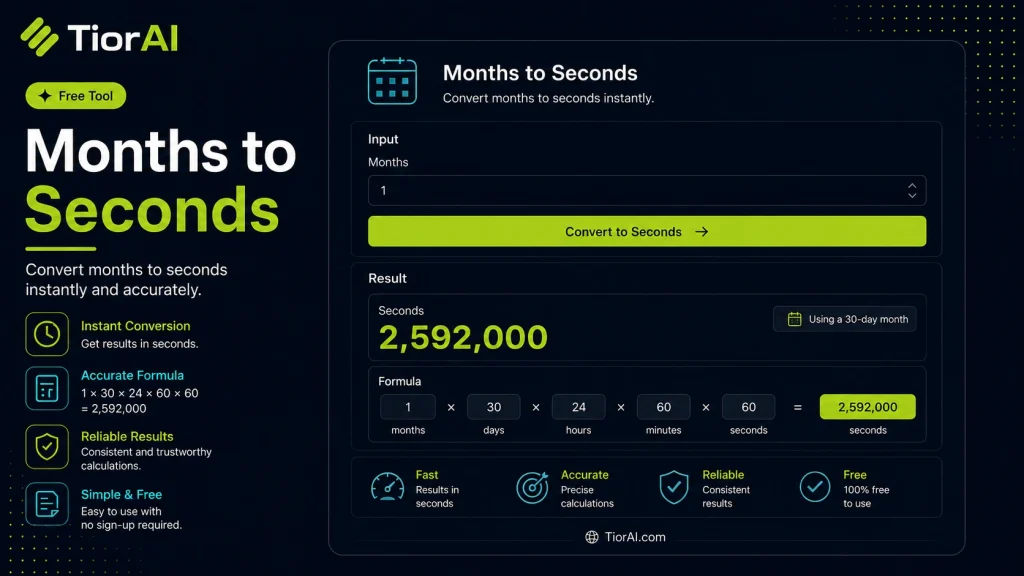
Formula: seconds = months × 2629800
How to use it
- Enter Your Input Value Type or paste the value you want to convert into the input field. The tool accepts any numeric value.
- Select Units and Convert Choose your source and target units from the dropdown menus. The converted result appears instantly.
- Copy or Use the Result Click copy to grab the converted value for use in your project, document, or calculation.
Tip Bookmark this converter - it handles edge cases like zero values and very large numbers accurately.
Understanding Time Unit Conversion: Months to Seconds
Converting months to seconds involves translating a larger, less precise unit of time (months) into a smaller, exact unit (seconds). This type of conversion is essential in fields like programming, data analysis, and project planning where precise time measurements are required.
Why convert months to seconds? Months vary in length—some have 28, 29, 30, or 31 days—so converting them to seconds requires choosing an average or specific month length. This conversion helps standardize time intervals for calculations, simulations, or scheduling.
Common situations for this conversion include:
- Calculating time durations in software applications that require seconds as input.
- Estimating time intervals for scientific experiments or financial models.
- Converting user input in months into seconds for backend processing.
Since months are not uniform in length, conversions often use an average month length (e.g., 30.44 days) to approximate seconds. This balance between precision and practicality makes the conversion useful but requires awareness of its limitations.
Understanding Months to Seconds Conversion
Converting months to seconds is a common requirement when working with time intervals in computing, finance, or scientific research. Since months vary in length, this conversion uses an average month duration to approximate the total seconds.
Months can have 28, 29, 30, or 31 days, so a fixed conversion is not straightforward. The average month length is approximately 30.44 days, which translates to about 2,629,746 seconds. This average accounts for the varying days across months and leap years.
When to Use This Conversion
- Programming applications that require time intervals in seconds but accept input in months.
- Financial models calculating interest or payments on a monthly basis but needing precise timing.
- Scientific data analysis where consistent time units are necessary.
- Billing systems converting subscription periods from months to seconds.
Common Mistakes to Avoid
- Assuming all months have the same number of days, which leads to inaccurate results.
- Failing to specify whether the conversion uses an average month length or a specific month’s days.
Understanding these nuances ensures accurate and meaningful time conversions when working with months and seconds.
Frequently asked questions
Reviews and questions
Whether this tool gave people the answer they needed, and what they asked about it.
Sign in to review this tool.
Sign In to ReviewNo reviews yet
Be the first to say whether this tool gave you what you needed.
Ask how to read the result, or what the tool does with an edge case — or answer someone else.
Sign In to AskNo questions yet
Not sure how to read a result? Be the first to ask.
AI tools related to this topic
Tools from the TiorAI directory that work on the same kind of job.

Wolfram Alpha
Wolfram Alpha is a computational knowledge engine that answers factual queries by performing computations on curated data, offering detailed solutions, visualizations, and an API for developers.

ChatGPT
ChatGPT is an AI chatbot by OpenAI powered by GPT-4o. It handles writing, coding, research, data analysis, and natural conversation. Free tier available, Plus at $20/month.