

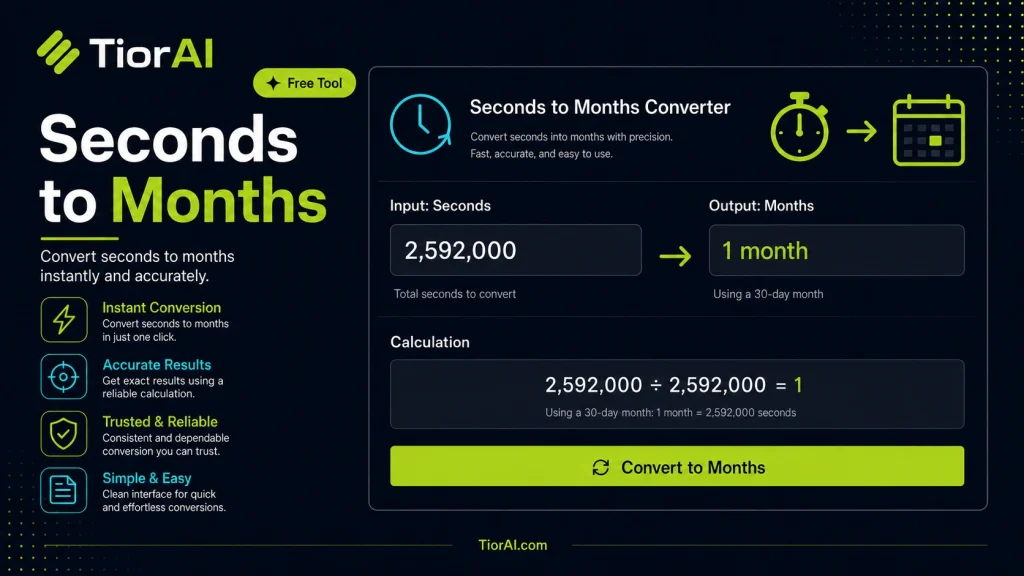
Formula: months = seconds ÷ 2629800
How to use it
- Enter Your Input Value Type or paste the value you want to convert into the input field. The tool accepts any numeric value.
- Select Units and Convert Choose your source and target units from the dropdown menus. The converted result appears instantly.
- Copy or Use the Result Click copy to grab the converted value for use in your project, document, or calculation.
Tip Chain multiple conversions by copying the output and pasting it as the next input - works seamlessly.
Understanding Time Unit Conversion: Seconds to Months
Time measurement units vary widely depending on the context, from milliseconds to years. Converting seconds to months involves translating a precise, small-scale unit (seconds) into a larger, less uniform unit (months). This conversion is not straightforward because months differ in length—ranging from 28 to 31 days—unlike seconds, which are constant.
Why convert seconds to months? This conversion is useful in fields like project management, software development, and scientific research, where durations are often recorded in seconds but need to be interpreted in terms of months for planning or reporting.
How is the conversion done? Typically, an average month length is used, often approximated as 30.44 days (365.25 days per year divided by 12 months). The formula is:
Months = Seconds ÷ (60 × 60 × 24 × 30.44)
This formula converts seconds to days, then divides by the average month length. However, because months vary, this is an approximation rather than an exact conversion.
Common use cases include:
- Estimating subscription durations or service periods from seconds logged.
- Converting elapsed time in seconds to months for financial or legal calculations.
- Interpreting large time intervals in scientific data where months are a convenient unit.
Understanding Seconds to Months Conversion
Converting seconds to months involves translating a precise unit of time into a larger, variable unit. Seconds are constant and exact, but months vary in length from 28 to 31 days. Because of this variability, conversions use an average month length, typically 30.44 days, to provide an approximate result.
This type of conversion is important when you need to interpret durations recorded in seconds into a more understandable monthly scale. For example, software logs might track uptime in seconds, but reporting often requires expressing that time in months.
When to Use This Conversion
- Estimating how many months correspond to a given number of seconds in subscription or billing contexts.
- Converting elapsed time from system logs or scientific data into months for easier analysis.
- Planning projects or contracts where durations are recorded in seconds but need to be communicated in months.
- Financial calculations that require converting seconds-based durations into monthly periods.
Common Mistakes to Avoid
- Assuming all months have the same length, which leads to inaccurate results.
- Ignoring leap years and the extra quarter day that affects average month length.
- Using integer division instead of floating-point, which truncates decimals and reduces precision.
By understanding these factors, you can use seconds to months conversions effectively and interpret the results appropriately in your work.
Frequently asked questions
Reviews and questions
Whether this tool gave people the answer they needed, and what they asked about it.
Sign in to review this tool.
Sign In to ReviewNo reviews yet
Be the first to say whether this tool gave you what you needed.
Ask how to read the result, or what the tool does with an edge case — or answer someone else.
Sign In to AskNo questions yet
Not sure how to read a result? Be the first to ask.
AI tools related to this topic
Tools from the TiorAI directory that work on the same kind of job.

Wolfram Alpha
Wolfram Alpha is a computational knowledge engine that answers factual queries by performing computations on curated data, offering detailed solutions, visualizations, and an API for developers.

ChatGPT
ChatGPT is an AI chatbot by OpenAI powered by GPT-4o. It handles writing, coding, research, data analysis, and natural conversation. Free tier available, Plus at $20/month.