

GCF & LCM Calculator
The Greatest Common Factor (GCF) is the largest number that divides two or more integers without leaving a remainder. The Least Common Multiple (LCM) is the smallest number that is a multiple of those integers. These concepts are fundamental in mathematics, especially in simplifying fractions,…
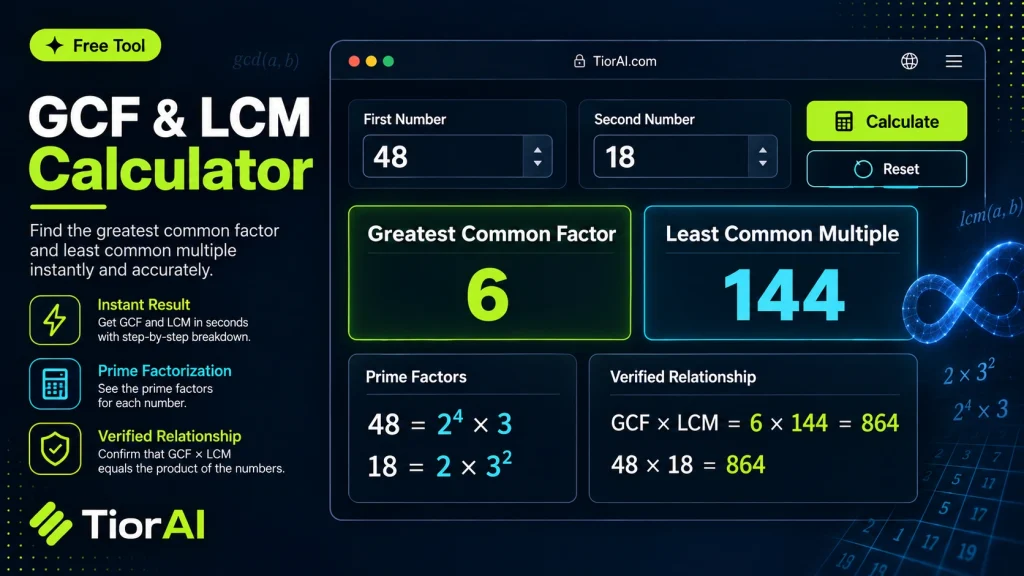
GCF & LCM Calculator
| Result | Value |
|---|---|
| Numbers | - |
| GCF (Greatest Common Factor) | - |
| LCM (Least Common Multiple) | - |
Prime Factorization
How to use it
- Enter Your Values Input your numbers or parameters into the GCF & LCM Calculator. Fill in all required fields for an accurate calculation.
- Calculate Results Click the calculate button to process your inputs. The GCF & LCM Calculator delivers instant, accurate results.
- Review and Use Review your calculated results, explore the breakdown, and copy or share the output for your needs.
Tip The GCF & LCM Calculator rounds results automatically, but you can use the full decimal output for precision work.
Understanding GCF and LCM
The Greatest Common Factor (GCF), also known as the Greatest Common Divisor (GCD), of two or more integers is the largest positive integer that divides each of the numbers without leaving a remainder. The Least Common Multiple (LCM) is the smallest positive integer that is a multiple of each of the numbers.
Calculating the GCF helps simplify fractions, find common denominators, and solve problems involving divisibility. The LCM is essential when adding or subtracting fractions with different denominators, scheduling events that repeat at different intervals, or solving problems involving synchronization.
Common methods to find the GCF include listing factors, prime factorization, and the Euclidean algorithm. For the LCM, methods include listing multiples, prime factorization, or using the relationship between GCF and LCM: LCM(a, b) = |a × b| / GCF(a, b).
These calculations are fundamental in number theory and appear frequently in algebra, arithmetic, and real-world applications like engineering and computer science.
What Are GCF and LCM?
The Greatest Common Factor (GCF) is the largest number that divides two or more integers without leaving a remainder. The Least Common Multiple (LCM) is the smallest number that is a multiple of those integers. These concepts are fundamental in mathematics, especially in simplifying fractions, solving equations, and working with periodic events.
When to Use a GCF & LCM Calculator
- Simplifying fractions by dividing numerator and denominator by their GCF.
- Finding a common denominator for adding or subtracting fractions using the LCM.
- Solving problems involving repeating cycles or schedules.
- Factoring algebraic expressions or working with divisibility problems.
Common Mistakes to Avoid
- Mixing up GCF and LCM definitions, leading to incorrect calculations.
- Trying to find the LCM by listing multiples manually, which can be inefficient and error-prone.
Understanding the relationship between GCF and LCM is helpful: LCM(a, b) = |a × b| / GCF(a, b). This formula allows you to calculate one if you know the other, making calculations faster and more reliable.
Frequently asked questions
Reviews and questions
Whether this tool gave people the answer they needed, and what they asked about it.
Sign in to review this tool.
Sign In to ReviewNo reviews yet
Be the first to say whether this tool gave you what you needed.
Ask how to read the result, or what the tool does with an edge case — or answer someone else.
Sign In to AskNo questions yet
Not sure how to read a result? Be the first to ask.