

From my experience with Linq API for RAG, I found it excels at providing a streamlined and scalable way to combine vector-based document retrieval with large language model generation. This makes it particularly well-suited for developers building AI chatbots, knowledge base augmentation, or custom NLP applications that require dynamic access to external data. However, the platform currently supports primarily English and may require custom pricing for extensive enterprise use. Overall, if you need a developer-friendly API to implement retrieval-augmented generation, Linq offers a robust and flexible solution.
Linq API for RAG: Scalable Retrieval-Augmented Generation API for Developers
Linq API for RAG is a scalable API platform that enables developers to build AI applications combining vector-based document retrieval with large language model generation, improving response relevance and accuracy.
- Best for
- Enhanced AI Chatbots
- Key capability
- Scalable Vector Search
Your actions
Save Linq API for RAG, follow its updates and vote on it — everything stays in your account.
Sign in or create a free account
What is Linq API for RAG?
Linq API for RAG is a developer-focused API platform that enables building applications using Retrieval-Augmented Generation (RAG). RAG combines the power of large language models with external data retrieval, allowing AI systems to access and reason over relevant documents or datasets dynamically. Linq provides scalable vector search and integration capabilities to enhance AI applications with up-to-date and contextually relevant information.
Key features of Linq API for RAG
The Linq API offers scalable vector search, seamless integration with language models, real-time document retrieval, and flexible API endpoints designed for developers to build RAG-powered applications efficiently.
Scalable Vector Search
Efficiently index and search large datasets using vector embeddings to find relevant information quickly.
Seamless Language Model Integration
Combine retrieval results with popular large language models to generate context-aware responses.
Flexible API Endpoints
Use RESTful API endpoints designed for easy integration into various applications and workflows.
Real-time Document Retrieval
Retrieve up-to-date information dynamically to keep AI responses relevant and accurate.
Pros and cons of Linq API for RAG
Pros
- Easy integration with popular language models
- Scalable and fast vector search capabilities
- Flexible API designed for developers
- Supports custom data uploads for tailored retrieval
Cons
- Limited language support beyond English
- Pricing may be high for large-scale enterprise use without custom plans
Key use cases for Linq API for RAG
Enhanced AI Chatbots
Integrate retrieval-augmented generation to provide chatbots with access to external knowledge bases for more accurate and context-aware responses.
Document Search and Summarization
Use Linq API to retrieve relevant documents and generate concise summaries, improving information retrieval workflows.
Knowledge Base Augmentation
Augment existing knowledge bases with AI-generated insights by combining vector search with language model generation.
Custom AI Applications
Develop tailored AI solutions that require combining large language models with external data retrieval for specialized domains.
How Linq API for RAG works
- 1
Sign Up and Get API Access
Create an account on Linq’s platform and obtain API credentials to start integrating.
- 2
Upload and Index Data
Upload your documents or datasets to Linq, which indexes them using vector embeddings for fast retrieval.
- 3
Query with RAG API
Send queries to the API that combines retrieval of relevant documents with generation from language models.
- 4
Receive Augmented Responses
Get AI-generated answers enriched with context from your indexed data, improving accuracy and relevance.
Who is using Linq API for RAG
AI developers
Startups building AI-powered applications
Enterprises needing enhanced search and generation
Data scientists working with NLP
Software engineers integrating language models
Linq API for RAG pricing
Free
$0/month
Limited API calls and data storage for testing and small projects.
Pro
$49/month
Increased API limits, priority support, and additional features for growing applications.
Enterprise
Custom pricing
Tailored solutions with dedicated support, SLAs, and advanced integrations.
Plans and prices are as published by the vendor and can change. Check the official site before you buy. Open the pricing page (opens in a new tab)
Frequently asked questions about Linq API for RAG
RAG is a technique that combines retrieving relevant documents from a knowledge base with generating responses using large language models to improve accuracy and context.
Linq API is designed to integrate with popular language models such as OpenAI’s GPT series and others via API.
Yes, you can upload and index your own datasets or documents to enable customized retrieval.
Yes, Linq offers a free tier with limited API usage suitable for testing and small-scale projects.
Integration support depends on the tool and its available connectors or API. Check the official documentation or integrations page to confirm what is supported.
It depends on your specific needs and how you plan to use the tool. The official website and documentation are the best sources for the latest details.
Integration support depends on the tool and its available connectors or API. Check the official documentation or integrations page to confirm what is supported.
Sign in to review this tool.
Sign In to ReviewNo reviews yet
Be the first to share how this tool worked for you.
Ask about pricing, limits, or how it compares — or answer someone else.
Sign In to AskNo questions yet
Have a question about using or paying for this tool? Be the first to ask.
Featured on TiorAI



More AI API Design tools
Other tools in the same category, for when this one is not quite the fit.

Freemium
GreenEyes.AI – Image Recog. Tech as API
GreenEyes.AI is an image recognition API platform that provides high-accuracy object detection, customizable models, and scalable API access for various industries including retail, manufacturing, and security.

Custom Pricing
Flagright AI
Flagright AI is a RegTech platform that automates AML compliance, KYC verification, and fraud detection using AI and machine learning to help financial institutions reduce risk and meet regulatory requirements.
Free
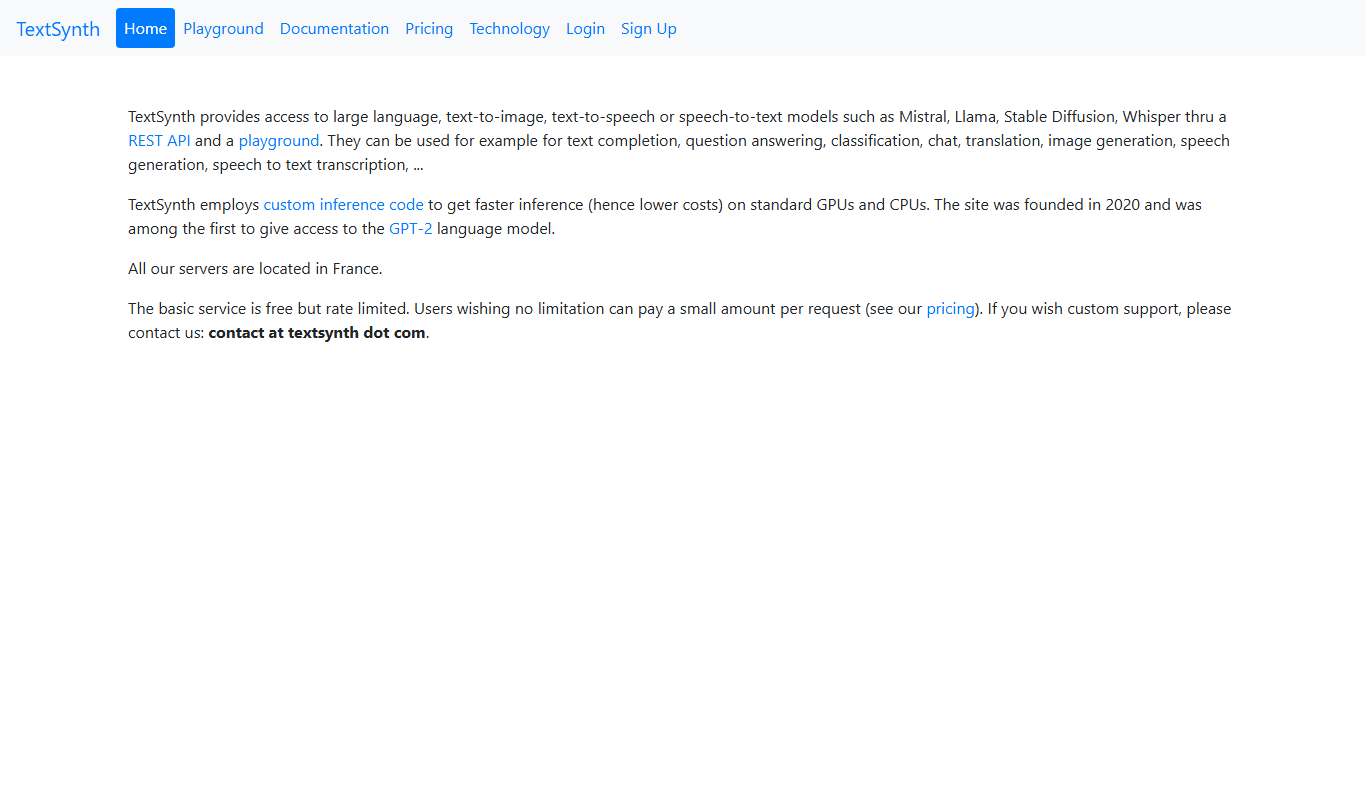
TextSynth
TextSynth is an AI platform for text generation, text-to-image, text-to-speech, speech-to-text, translation and classification.

Free
Stoplight
Stoplight is an API design and development platform that provides visual editing, interactive documentation, mocking, and governance tools to help teams build and manage APIs efficiently.

Free
Swagger
Swagger is a set of tools for designing, documenting, testing, and mocking RESTful APIs using the OpenAPI Specification, widely used by developers and teams to streamline API development.

Free Trial
Boostramp
Boostramp is an AI-driven platform that automates personalized sales email outreach and lead generation, integrating with CRMs to streamline sales workflows.

Free Trial
CRUDERRA
CRUDERRA is a low-code platform that helps users build web and mobile applications quickly using drag-and-drop tools and database integration without needing extensive coding skills.

Free Trial
Aptori
Aptori is a low-code platform that helps businesses quickly build custom applications and automate workflows using a visual drag-and-drop interface and API integrations.