

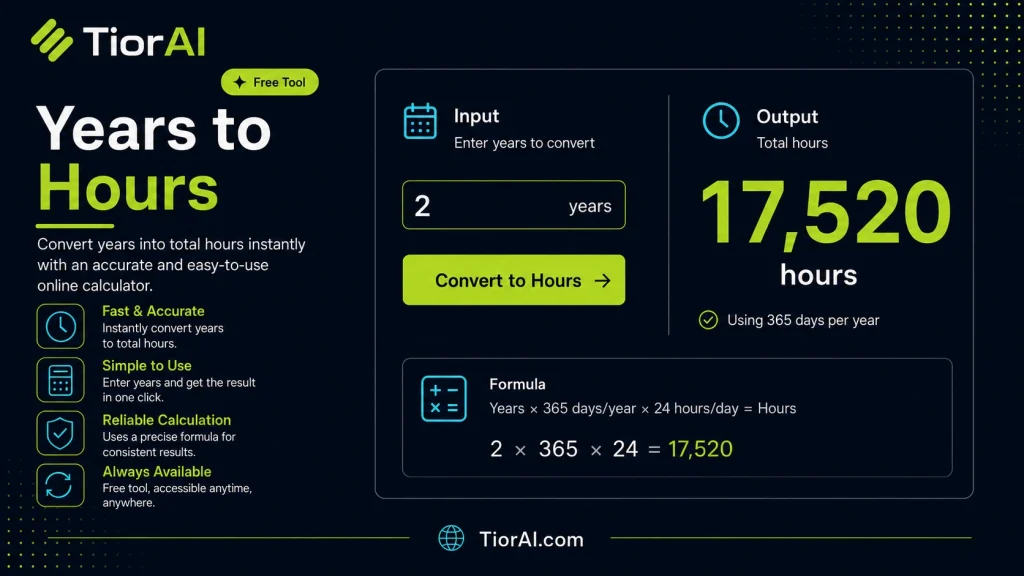
Formula: hours = years × 365.25 × 24
How to use it
- Enter Your Input Value Type or paste the value you want to convert into the input field. The tool accepts any numeric value.
- Select Units and Convert Choose your source and target units from the dropdown menus. The converted result appears instantly.
- Copy or Use the Result Click copy to grab the converted value for use in your project, document, or calculation.
Tip Chain multiple conversions by copying the output and pasting it as the next input - works seamlessly.
About Years to Hours
Converting years to hours is a type of time unit conversion that translates a larger time measurement (years) into a smaller one (hours). This process involves understanding the relationship between different units of time and applying a consistent formula to get an accurate result.
Why Convert Years to Hours?
Time conversions like this are essential in various fields such as project management, scientific calculations, and programming. For example, when calculating durations for long-term projects, understanding the total hours involved can help in resource allocation and scheduling. In science, converting years to hours can assist in experiments or simulations that require precise time measurements.
How the Conversion Works
- Basic formula: 1 year = 365 days (ignoring leap years for simplicity)
- 1 day = 24 hours
- Therefore, 1 year = 365 × 24 = 8,760 hours
For more accuracy, leap years can be considered by using 365.25 days per year, resulting in 8,766 hours per year. This conversion is straightforward but requires attention to detail depending on the context.
Common Use Cases
- Calculating total work hours over multiple years
- Converting age or duration into hours for detailed analysis
- Programming applications that require time intervals in hours
Understanding Years to Hours Conversion
Converting years to hours involves translating a larger unit of time into a smaller one by applying a consistent formula. Since one year typically contains 365 days and each day has 24 hours, the basic conversion multiplies years by 8,760 hours. This conversion is useful in many practical scenarios where detailed time measurements are necessary.
When to Use This Conversion
- Estimating total work or project hours over multiple years.
- Converting age or durations into hours for precise tracking.
- Programming tasks that require time intervals expressed in hours.
- Comparing or aggregating time spans across different units.
Common Mistakes to Avoid
- Ignoring leap years and assuming every year has exactly 365 days, which can introduce errors over long periods.
- Confusing calendar years with exact time spans, especially when dealing with fractional years.
- Using approximate values without clarifying assumptions, leading to inconsistent results.
For more accurate conversions, consider using 365.25 days per year to account for leap years, resulting in 8,766 hours per year. This adjustment is important in scientific calculations or long-term planning where precision matters.
Frequently asked questions
Reviews and questions
Whether this tool gave people the answer they needed, and what they asked about it.
Sign in to review this tool.
Sign In to ReviewNo reviews yet
Be the first to say whether this tool gave you what you needed.
Ask how to read the result, or what the tool does with an edge case — or answer someone else.
Sign In to AskNo questions yet
Not sure how to read a result? Be the first to ask.
AI tools related to this topic
Tools from the TiorAI directory that work on the same kind of job.

Wolfram Alpha
Wolfram Alpha is a computational knowledge engine that answers factual queries by performing computations on curated data, offering detailed solutions, visualizations, and an API for developers.

ChatGPT
ChatGPT is an AI chatbot by OpenAI powered by GPT-4o. It handles writing, coding, research, data analysis, and natural conversation. Free tier available, Plus at $20/month.