

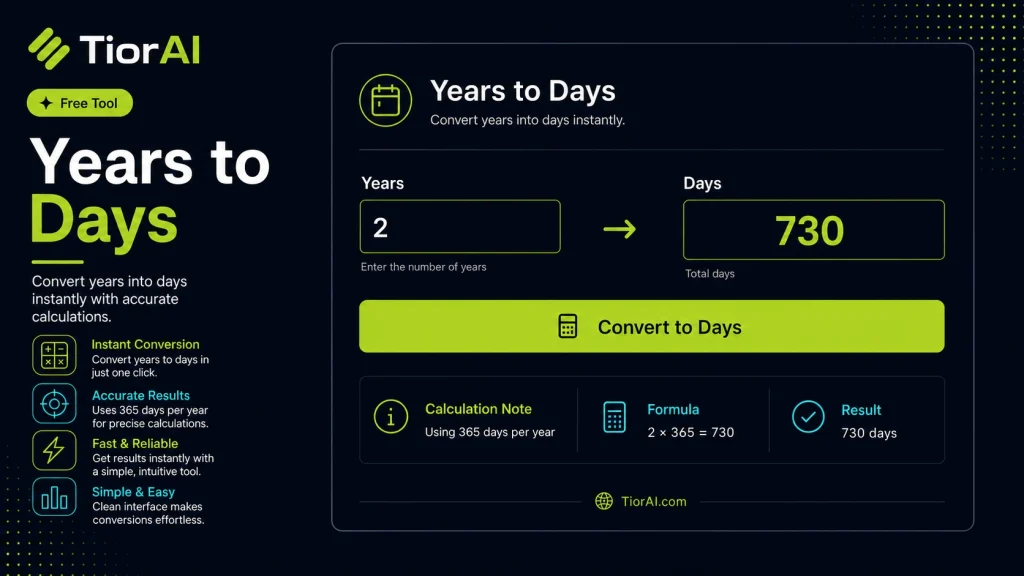
Formula: days = years × 365.25
How to use it
- Enter Your Input Value Type or paste the value you want to convert into the input field. The tool accepts any numeric value.
- Select Units and Convert Choose your source and target units from the dropdown menus. The converted result appears instantly.
- Copy or Use the Result Click copy to grab the converted value for use in your project, document, or calculation.
Tip Need the reverse conversion? Swap source and target to convert in the opposite direction instantly.
Understanding Time Conversion: Years to Days
Converting years to days is a common task in date and time calculations. Since a year is a larger unit of time than a day, this conversion involves multiplying the number of years by the average number of days in a year. However, the exact number of days in a year can vary depending on whether you consider leap years or not.
Why convert years to days? Many applications require time durations to be expressed in days rather than years. For example, calculating interest periods in finance, determining age in days for medical or legal purposes, or measuring project timelines in days for better granularity.
How is the conversion done? The basic formula is:
days = years × 365
But since every 4 years there is a leap year with an extra day, the more accurate average is approximately 365.25 days per year. This accounts for the leap day added every four years, except for century years not divisible by 400.
Common situations for this conversion include:
- Age calculations in days for health or scientific studies
- Project management timelines requiring day-level precision
- Financial calculations involving interest accrual over multiple years
- Converting long-term durations into smaller units for analysis or reporting
What is Years to Days Conversion?
Converting years to days involves translating a larger unit of time (years) into a smaller one (days). This is useful when you need more precise measurements of time durations. Since a year is not a fixed number of days due to leap years, the conversion typically uses an average of 365.25 days per year to account for the extra day every four years.
When to Use This Conversion
- When calculating the total days in a multi-year project for detailed planning.
- To find out a person’s age in days for medical or scientific purposes.
- For financial calculations that require exact day counts over several years.
- When converting long-term durations into days for reporting or analysis.
Common Mistakes to Avoid
- Using exactly 365 days per year without considering leap years, which can cause inaccuracies.
- Assuming all years have the same length, ignoring leap year exceptions.
- Confusing calendar years with other year types like fiscal or academic years.
Understanding these factors ensures accurate and meaningful conversions from years to days, especially in contexts where precision matters.
Frequently asked questions
Reviews and questions
Whether this tool gave people the answer they needed, and what they asked about it.
Sign in to review this tool.
Sign In to ReviewNo reviews yet
Be the first to say whether this tool gave you what you needed.
Ask how to read the result, or what the tool does with an edge case — or answer someone else.
Sign In to AskNo questions yet
Not sure how to read a result? Be the first to ask.
AI tools related to this topic
Tools from the TiorAI directory that work on the same kind of job.

Wolfram Alpha
Wolfram Alpha is a computational knowledge engine that answers factual queries by performing computations on curated data, offering detailed solutions, visualizations, and an API for developers.

ChatGPT
ChatGPT is an AI chatbot by OpenAI powered by GPT-4o. It handles writing, coding, research, data analysis, and natural conversation. Free tier available, Plus at $20/month.