

Utf8 Decode
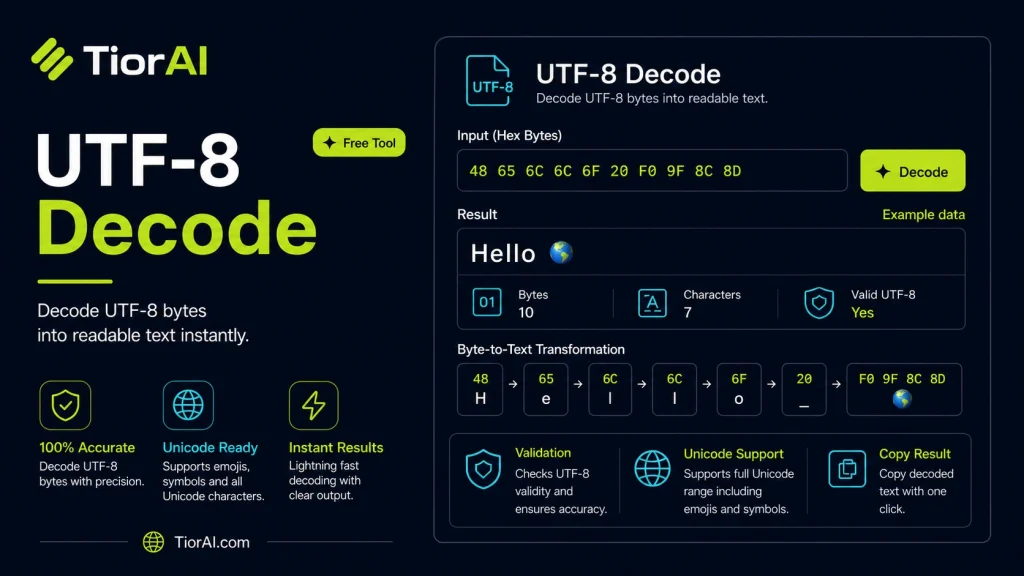
UTF-8 is a widely used character encoding that represents text as sequences of bytes. When text is encoded in UTF-8, each character is converted into one or more bytes. UTF-8 decoding reverses this process, converting byte sequences back into readable characters. This decoding is essential…
| Decoded Text | - |
|---|
How to use it
- Enter Your Input Value Type or paste the value you want to convert into the input field. The tool accepts any numeric value.
- Select Units and Convert Choose your source and target units from the dropdown menus. The converted result appears instantly.
- Copy or Use the Result Click copy to grab the converted value for use in your project, document, or calculation.
Tip Need the reverse conversion? Swap source and target to convert in the opposite direction instantly.
Understanding UTF-8 Decoding
UTF-8 is a character encoding standard that represents text in computers and on the internet. It encodes each character into one to four bytes, allowing for efficient storage and compatibility with ASCII. However, when you receive or work with UTF-8 encoded data, it often appears as a sequence of bytes or escape sequences rather than readable text.
UTF-8 decoding is the process of converting these byte sequences back into human-readable characters. This is essential because computers store and transmit text as bytes, but users need to see meaningful characters like letters, symbols, or emojis.
Common situations where UTF-8 decoding is necessary include:
- Reading data from files or network streams that use UTF-8 encoding.
- Processing web content or APIs that return UTF-8 encoded strings.
- Debugging or inspecting encoded data to verify its content.
Without decoding, UTF-8 encoded text may appear as garbled characters or escape sequences, making it difficult to understand or use. Decoding ensures that the original text is accurately restored for display or further processing.
What is UTF-8 Decoding?
UTF-8 is a widely used character encoding that represents text as sequences of bytes. When text is encoded in UTF-8, each character is converted into one or more bytes. UTF-8 decoding reverses this process, converting byte sequences back into readable characters.
This decoding is essential because raw UTF-8 encoded data often appears as unintelligible symbols or escape sequences. Decoding restores the original text, making it understandable and usable.
When to Use UTF-8 Decoding
- When you receive data from a source that transmits text in UTF-8 byte format and need to display or process it as readable text.
- When debugging or inspecting encoded data from web APIs, files, or network streams.
- When working with international text containing characters beyond the ASCII range, such as emojis or accented letters.
Common Mistakes to Avoid
- Trying to decode data that isn’t UTF-8 encoded, which can cause incorrect or garbled output.
- Mixing up UTF-8 with other encodings like UTF-16 or ISO-8859-1, leading to misinterpretation of characters.
Understanding UTF-8 decoding helps ensure that text data is correctly interpreted and displayed, which is critical in software development, data processing, and web applications dealing with diverse languages and symbols.
Frequently asked questions
Reviews and questions
Whether this tool gave people the answer they needed, and what they asked about it.
Sign in to review this tool.
Sign In to ReviewNo reviews yet
Be the first to say whether this tool gave you what you needed.
Ask how to read the result, or what the tool does with an edge case — or answer someone else.
Sign In to AskNo questions yet
Not sure how to read a result? Be the first to ask.
AI tools related to this topic
Tools from the TiorAI directory that work on the same kind of job.

Wolfram Alpha
Wolfram Alpha is a computational knowledge engine that answers factual queries by performing computations on curated data, offering detailed solutions, visualizations, and an API for developers.

ChatGPT
ChatGPT is an AI chatbot by OpenAI powered by GPT-4o. It handles writing, coding, research, data analysis, and natural conversation. Free tier available, Plus at $20/month.