

SHA Generator
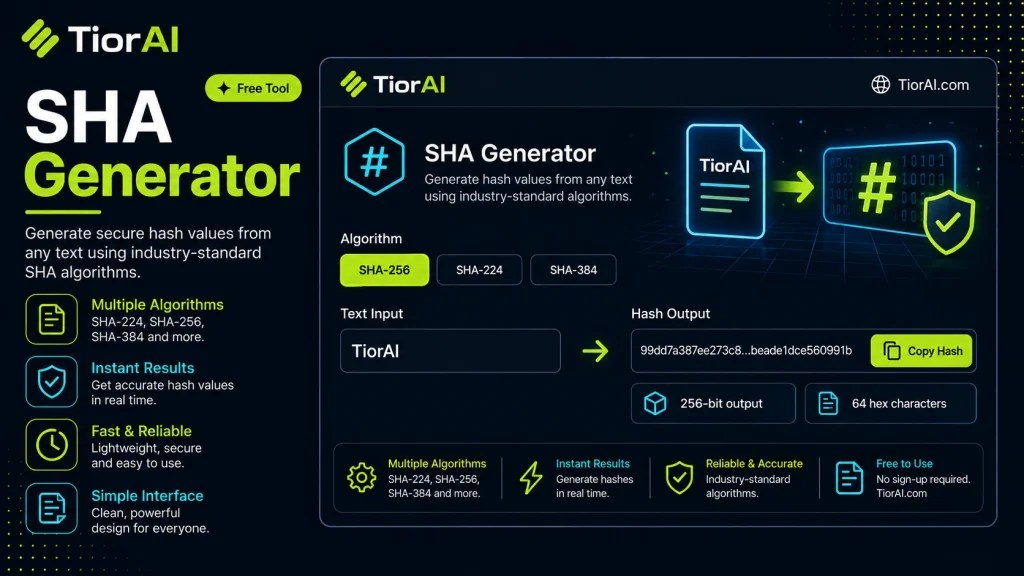
Process and transform your code with the free sha generator. Paste your input, hit the button, and get clean, formatted output — perfect for developers and engineers.
How to use it
- Paste Your Input Paste your code or data into the Sha Generator. The tool accepts standard input formats and validates your entry.
- Process and Transform Click the action button to process your input. Results are generated instantly with proper formatting.
- Export the Output Copy the processed output to your clipboard or download it for use in your development workflow.
Tip Speed up debugging by using the Sha Generator to isolate and test specific code fragments outside your IDE.
Understanding SHA (Secure Hash Algorithm)
The Secure Hash Algorithm (SHA) is a family of cryptographic hash functions designed to produce a fixed-size string of characters (a hash) from input data of arbitrary size. The output hash is unique to the input data, meaning even a small change in the input will produce a drastically different hash. This property is known as the avalanche effect.
SHA functions are widely used in security applications and protocols, including TLS, SSL, PGP, SSH, and digital signatures. The most common variants are SHA-1, SHA-256, and SHA-3, with SHA-256 being part of the SHA-2 family and currently recommended for most security applications due to its stronger resistance against collision attacks compared to SHA-1.
How SHA Works:
- Input data is processed in fixed-size blocks.
- Each block is transformed through a series of bitwise operations, modular additions, and compression functions.
- The final output is a fixed-length hash (e.g., 256 bits for SHA-256).
Why Developers Use SHA:
- Data Integrity: Hashes verify that data has not been altered during transmission or storage.
- Password Storage: Hashing passwords before storing them prevents exposure of plaintext passwords if a database is compromised.
- Digital Signatures: Hashes create a digest of a message that can be signed cryptographically.
- File Verification: Hashes confirm that downloaded files are authentic and unmodified.
Relevant Standards: SHA algorithms are standardized by the National Institute of Standards and Technology (NIST) in the FIPS PUB 180 series. SHA-1 is defined in FIPS PUB 180-4, SHA-2 variants (including SHA-256) are also covered there, and SHA-3 is defined in FIPS PUB 202.
In real projects, developers often use SHA generators to quickly produce hashes for strings, files, or other data to verify integrity or implement security features. These generators automate the complex hashing process, ensuring accuracy and saving time.
What is SHA and Why Does It Matter?
SHA, or Secure Hash Algorithm, is a cryptographic function that transforms any input data into a fixed-length string of characters, known as a hash. This hash acts like a digital fingerprint of the original data. Even a tiny change in the input will produce a completely different hash, making SHA invaluable for verifying data integrity and security.
Developers rely on SHA in many real-world applications. For example, when you download software, the publisher often provides a SHA hash so you can verify the file hasn’t been tampered with. Similarly, passwords are hashed before storage to protect user credentials in case of a data breach.
When Should You Use a SHA Generator?
- File Integrity Verification: After downloading or transferring files, generate a SHA hash and compare it to the original to ensure no corruption or tampering occurred.
- Password Security: Hash passwords before storing them in databases to prevent exposure of plaintext passwords.
- Digital Signatures: Create message digests that can be signed cryptographically to verify authenticity.
- API and Data Consistency: Use SHA hashes to confirm data hasn’t changed during transmission between systems.
Common Mistakes to Avoid
- Using Outdated SHA Versions: SHA-1 has known vulnerabilities and should not be used for security-critical applications. Always prefer SHA-256 or higher.
- Misunderstanding Hashing vs. Encryption: Hashing is one-way and irreversible, unlike encryption. Expecting to decrypt a hash back to the original data is a common misconception.
Technical Context
SHA algorithms are standardized by NIST and widely implemented in programming languages and libraries. They process data in blocks and apply complex bitwise operations to produce a fixed-length output. This design ensures that the hash is unique to the input data, providing a reliable method for data verification.
In practice, developers use SHA generators to quickly produce hashes without manually implementing the algorithm. This saves time and reduces errors, especially when verifying data integrity or securing sensitive information.
Common use cases
- Generating SHA-256 hash for a password
- Verifying file integrity with SHA-1
Frequently asked questions
Reviews and questions
Whether this tool gave people the answer they needed, and what they asked about it.
Sign in to review this tool.
Sign In to ReviewNo reviews yet
Be the first to say whether this tool gave you what you needed.
Ask how to read the result, or what the tool does with an edge case — or answer someone else.
Sign In to AskNo questions yet
Not sure how to read a result? Be the first to ask.