

SHA 256 Generator
Process and transform your code with the free sha 256 generator. Paste your input, hit the button, and get clean, formatted output — perfect for developers and engineers.
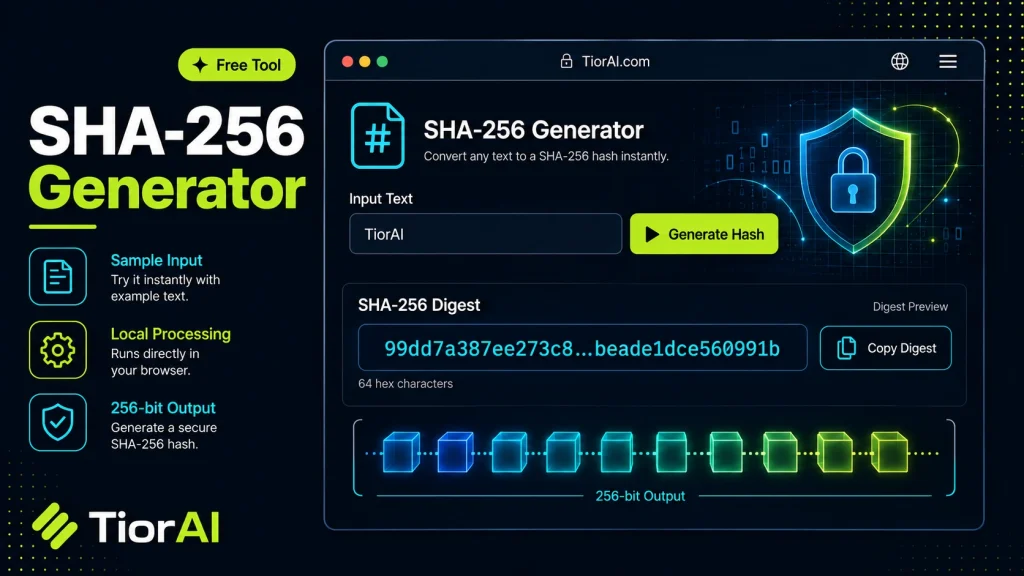
How to use it
- Paste Your Input Paste your code or data into the Sha 256 Generator. The tool accepts standard input formats and validates your entry.
- Process and Transform Click the action button to process your input. Results are generated instantly with proper formatting.
- Export the Output Copy the processed output to your clipboard or download it for use in your development workflow.
Tip Use the Sha 256 Generator during code reviews to quickly reformat or transform snippets for clearer comparisons.
Understanding SHA-256 and Its Role in Security
SHA-256 stands for Secure Hash Algorithm 256-bit and is part of the SHA-2 family of cryptographic hash functions designed by the National Security Agency (NSA) and published by the National Institute of Standards and Technology (NIST) as a federal standard (FIPS PUB 180-4).
At its core, SHA-256 takes an input (or “message”) of any size and produces a fixed-size 256-bit (32-byte) hash value, typically rendered as a 64-character hexadecimal string. This output is unique to the input data, meaning even a tiny change in the input drastically changes the hash, a property known as the avalanche effect.
Why use SHA-256? It solves the problem of data integrity verification and secure fingerprinting. Since the hash is deterministic (same input always yields the same output) but computationally infeasible to reverse or find collisions (two different inputs producing the same hash), it is widely used for:
- Verifying file integrity during downloads or transfers
- Generating digital signatures
- Ensuring data has not been tampered with
- Creating unique identifiers for data
Developers use SHA-256 in real projects to securely store data fingerprints, verify software authenticity, and as part of cryptographic protocols. For example, blockchain technologies rely heavily on SHA-256 to link blocks securely. It is also used in TLS certificates and code signing.
SHA-256 is defined in the FIPS PUB 180-4 standard, which specifies the algorithm’s steps, including message padding, parsing, and the compression function. The algorithm processes data in 512-bit blocks and uses bitwise operations, modular additions, and constants derived from the fractional parts of the cube roots of the first 64 prime numbers.
While SHA-256 is currently considered secure against preimage and collision attacks, it is not suitable for all cryptographic purposes, such as password hashing, where specialized algorithms like bcrypt or Argon2 are preferred due to their resistance to brute-force attacks.
What is SHA-256?
SHA-256 is a cryptographic hash function that produces a fixed 256-bit (32-byte) output from any input data. It is part of the SHA-2 family standardized by NIST and widely used in security applications to ensure data integrity and authenticity.
The algorithm processes data in 512-bit blocks and applies a series of bitwise operations and modular additions to produce a unique hash. This hash acts like a digital fingerprint of the input data.
When to Use SHA-256
- Verifying file integrity by comparing hashes before and after transfer.
- Generating digital signatures or message authentication codes in cryptographic protocols.
- Creating unique identifiers for data in databases or caching systems.
- Implementing blockchain technologies that require secure hashing of transaction data.
Common Mistakes to Avoid
- Using SHA-256 directly for password hashing without salting or key stretching, which exposes passwords to brute-force attacks.
- Assuming SHA-256 hashes can be reversed to reveal original data; they are designed to be one-way functions.
- Confusing SHA-256 with encryption; hashing is irreversible, while encryption is reversible with a key.
Technical Context
SHA-256 is defined in the FIPS PUB 180-4 standard and is widely supported across programming languages and platforms. It is computationally efficient and secure against current cryptographic attacks, making it suitable for many security-related tasks.
However, for password storage, SHA-256 alone is insufficient. Password hashing requires algorithms that incorporate salting and computational cost factors to defend against brute-force and rainbow table attacks.
In summary, SHA-256 is a fundamental cryptographic primitive used to ensure data integrity, authenticate messages, and support secure systems like blockchain. Understanding its properties and appropriate use cases is essential for developers working in security-sensitive applications.
Common use cases
- Hashing a simple string
- File integrity check
Frequently asked questions
Reviews and questions
Whether this tool gave people the answer they needed, and what they asked about it.
Sign in to review this tool.
Sign In to ReviewNo reviews yet
Be the first to say whether this tool gave you what you needed.
Ask how to read the result, or what the tool does with an edge case — or answer someone else.
Sign In to AskNo questions yet
Not sure how to read a result? Be the first to ask.